


Hoe
Description
This section is from the book "A Dictionary Of Modern Gardening", by George William Johnson, David Landreth. Also available from Amazon: The Winter Harvest Handbook: Year Round Vegetable Production Using Deep Organic Techniques and Unheated Greenhouses.
Hoe
This is the implement which should be most frequently in the gardener's hand, for the surface of the soil can never be too frequently stirred. I entirely agree with Mr. Barnes in thinking the hoe one of the gardener's best friends; and, as it always must be a more frequently used implement than any other, what is the best form of its construction deserves some consideration. The handles should never be made of heavy wood, for this wearies the hand, and is altogether a uselessly heavy weight thrown upon the workman. It is merely the lever, and every ounce needlessly given to this, diminishes, without any necessity, the available moving power. The best woods for handles are birch or deal.
For earthing up plants, broad blades to hoes are very admissible, and they may, without objection, have a breadth of nine inches; but this permission of breadth does not extend to hoes required for loosening the soil and destroying weeds. These should never extend to beyond a breadth of six inches, and the work will be done best by one two inches narrower. The iron plate of which they are formed should be well steeled, and not more than one-sixteenth of an inch thick. The weight necessary should be thrown by the workman's arm and body upon the handle, and the thicker the blade, the greater is the pressure required to make it penetrate the soil. It should be set on the handle at an angle of 68°, as this brings its edge when used at a good cutting angle with the surface of the soil, and the workman soon learns at what point most effectively to throw his weight, and holds the handle further from, or nearer to the blade, accordingly as he is a tall or short man. Mr. Barnes, of Bicton Gardens, whose opinions relative to hoeing I have already quoted, has paid considerable attention to the formation of this implement, and has favoured me with a letter upon the subject, from which I will now give some extracts.
He employs nine sized hoes, the smallest having a blade not more than one-fourth of an inch broad, and the largest ten inches. The smallest are used for potted plants and seed-beds, and those from two inches and a half to four inches wide are used for thinning and hoeing among crops generally.
These have all handles varying in length from eight inches and a half to eighteen inches, all the neck or upper part formed of iron, for the smaller sizes not thicker than a large pencil, and that part which has to be grasped by the workman is only six inches long, and "formed either of willow or some other soft light wood, which is best to the fee! of the hand; for hard heavy wood is cumbersome, harsh, and tiring."Each labourer works "with one in each hand, to cut right and left." "The blade is made thin, and with a little foresight and activity it is astonishing how much ground can be got over in a short time".
Mr. Barnes has all his hoes made with a crane neck. The blades broader than four inches Mr. Barnes has made like a Dutch hoe.
"The crane neck allows the blade to pass freely and kindly under the foliage of any crop where the earth requires loosening; and the blade works itself clean, allowing the earth to pass through, as there is no place for it to lodge and clog up as in the old-fashioned hoe, to clean which, when used of a dewy morning, causes the loss of much time in scraping".
"The draw-hoe" is correctly described by Mr. Loudon as a "plate of iron attached to a handle about four feet long, at an angle less than a right angle. The blade is either broad for cutting weeds, deep and strong for drawing earth to the stems of plants, curved, so as to act like a double mould-boarded plough in drawing drills, formed into two strong broad prongs for stirring hard adhesive soils, - or it is formed to accomplish the first and last purposes, as in the double hoe or Dutch hoe.
"The thrust-hoe consists of a plate of iron attached somewhat obliquly to the end of a handle by a bow, used only for killing weeds or loosening ground which is to be afterwards raked. As a man can draw more than he can push, most heavy work will be easiest done by the draw-hoe." - Enc. Gard.
In the island of Guernsey a very effective weeding-prong is used, and is thus described in the Gardener's Chronicle: -
"It is something in the shape of a hammer, the head flattened into a chisel an inch wide, and the fork the same.
The whole length of this prong is nine inches, and it is attached to a staff five feet long. Such an implement is light and easy to use; it requires no stooping, and will tear up the deepest-rooted weeds".
Hoes are made in a great variety of forms; the following, figured in The Rural Register, are those most generally used, and perhaps are all which are truly desirable; they are, when well made, of cast steel.
Square garden Hoe. Fig. 79.
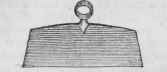
Turnip Hoe. Fig. SO.
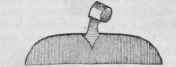
Pronged-back Hoe. Fig. S1.
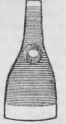
Forked-back Hoe. Fig. 82.
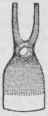
Half round Hoe. Fig. 83.

Triangle Hoe. Fig. 84.
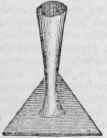
Dutch or Scuffle Hoe. Fig. 85.

Continue to:


My Books

