


192. Laying Out And Planting
Description
This section is from the book "The Villa Gardener", by J. C. Loudon. Also available from Amazon: The Villa Gardener.
192. Laying Out And Planting
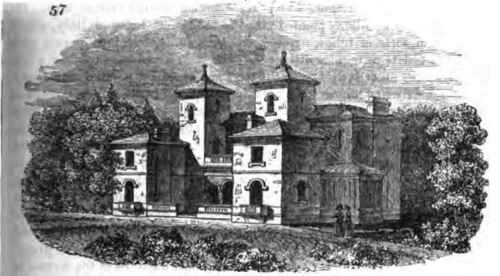
The object, in laying out and planting these two gardens, we shall suppose to be picturesque effect, so as to harmonise with the broken outline and numerous parts which compose the elevation of the house. The disposition of both trees and shrubs is consequently irregular, and by no means gardenesque. The kinds we shall suppose to be partly evergreen, and partly deciduous; and the prevailing species to be such as are common in the gardens or general scenery of Italy.
Evergreen Treees
Pinus Laricio, P. Pinaster, P. Pines, and P. halrpensis; Quercus I"lex and gramuntia; and Cupresaus sempervirens, and Juniperus phcenicea.
Deciduous Trees
Among these may be mentioned, the Lombardy poplar
(which, however, must be very sparingly introduced); the Turkey oak, and the Neapolitan and other acers, various species of thorns, the catalpa, tulip tree, Judas tree, laburnum, almond Pyrus spectabilis, etc.
Evergreen Shrubs
These include the holly, box, sweet bay, common and Portugal laurels, arbutus, phiilyrea, rhododendron, daphne, yucca, and many others.
Deciduous Shrubs
These ore very numerous, and include the Paliurua aculeatus, various species of Rhambus and Rhus, azaleas, lilacs, cistuses, almonds Coronilta Emerus, colulea, and many others,
193. As characteristic of Italian scenery, the vine ought to be planted, and 'allowed to climb up the trees, not for the take of its fruit, but for effeet; and one of the beat kinds for this purpose is the claret grape, on account of the: colour of its leaves in autumn. The pomegranate, the phiilyrea, and the ilex are highly characteristic of Italian gardens; the pine and the Arundo Donax,, of Italian scenery; and the orange tree, and the agave, or its substitute, the yucca, both, in tubs and vases, of Italian villas. The most characteristic shrubs of the flowering kind belonging to Italy are, the cistus and the cyturns. We do not here mention the myrtle, the olive, or any other trees or shrubs, which will not thrive in the open air in Britain, because they could not be introduced with effect in British imitations of Italian scenery. The Ruscus hypophyllum, and the shrubby species of asparagus, are also found more frequently in Italy than in any other part of Europe, unless we except Greece. It fortunately happens for the imitator of an Italian villa in the suburbs of a great city, that the Pinus Laricio, the most common pine in the open scenery' of Italy; the pinaster, the next common; and the stone pine, which is most generally found near Italian houses, and in their gardens, will all grow remark-sbly well in the smoke of London; as may be seen by examining the trees of these species in the arboretum of the Messrs. Loddiges, and comparing their appearance with that of the American pines, and even the Scotch pine,, growing beside them.
Continue to:


My Books

