


315. Planting
Description
This section is from the book "The Villa Gardener", by J. C. Loudon. Also available from Amazon: The Villa Gardener.
315. Planting
The general disposition of the trees and shrubs is exhibited in the plan fig. 125.; but it remains for us to indicate the distribution of the leading genera. The first point which deserves to be noticed is, that, in order to harmonise the wood within the ring-fence with the trees in the hedgerows or strips beyond it, a few trees should be planted within, of the same kinds as those without. For example, in fig. 125., there are elms in two narrow slips beyond the boundary at a; and, therefore, there must be a few elms of the same kind scattered among the other trees within. At 6, there are some Lombardy poplars in the foreground of the exterior scene; and, therefore, two or three of the same species are planted within the boundary. At c, there are some sweet chestnuts without; and, consequently, some are planted in the interior. From d to e, there is an extensive plantation of larches in the exterior scenery; and, therefore, to appropriate this plantation to the newly-formed residence, a good many larches must be planted in the enclosed grounds. At f, the exterior plantation is a natural oak wood; and, therefore, Quercus pedunculate and Q. sessiliflora are the prevailing trees in the interior.
In some cases, it may not only be desirable to have the same sorts of trees on both sides of the ring-fence, but even to allow portions of the old hedgerows, with the trees in them, to remain in the improved grounds, in order to harmonise what is within with what is without; but this kind of treatment should never be attempted, except where its effect in appropriating the adjoining grounds, as well as in harmonising the general landscape as a whole, will be such as to silence all objections. All the trees introduced for the purpose of harmonising the interior of the ring-fence with the scenery without, in such a case as that before us, need not exceed 50 or 60; and it will most commonly happen that these may already exist in the condemned hedgerows, or in scattered groups in the fields, as is the case, to a considerable extent, in the plan fig, 105., p. 199. The trees in the old hedgerows which it may be thought advisable to save, will only want to be freed from the thorns and other hedge plants (except a few left to group with them), and to have the ground about them levelled down and smoothed.
The groups already existing may either be thinned out or added to, as may be found requisite.


316. It may he here observed, that, in the geometric style of laying out grounds, the mode of harmonising a residence with the surrounding country was, by the projection into it of a continuation of those avenues and lines of trees which formed part of the residence. This implied the possession of the grounds beyond the park fence; and, when this is the ease in the modern style, a few groups without the boundary fence, of the same kind of trees as those within, will effect the same object. This used to be frequently done when a park or parks were surrounded by a common: and Hounslow Heath was formerly clumped, for the sake of the adjoining country seats of Syon, Syon Hill, etc.; as Cobham Common was, to appropriate it, in the eye of exclusive taste, to Claremont and Esher.
317. All the foreign trees and shrubs that are to be introduced in order to complete this residence, we intend to plant without fences, and to place at such distances as that they will not require any thinning for at least ten years. The ground on which these are to be planted is supposed to be thoroughly trenched and drained, and even, where necessary, manured, before planting it; so that the trees and shrubs cannot fail to thrive rapidly. During the growth of these trees, we would not allow any grass or weeds to grow within several feet of their stems; but, at the same time, we would not dig the surface, but only hoe it, to destroy the weeds, and fork up the soil to the depth of three or four inches, to render it a conductor of heat and moisture, and to admit air to the fibrous roots which rise up near the surface. We would not, during the same period, prune off any of the side branches, except such as had begun to decay, leaving each tree and shrub to assume its natural shape.
318. Some will imagine that a plantation in which the trees are at such a distance apart will appear thin; and this, we allow, will be the case for two or three years at first; but in the fourth year, in consequence of the lateral branches extending themselves, there will be an appearance of richness and massiveness in such a plantation, which plantations as thick as they are generally made never acquire at any age. There is not a greater mistake, nor one more commonly made by practical gardeners, no less than by amateurs, than that of planting thick, with a view to producing a dense mass of foliage that shall not be seen through; and which shall thus become a screen to objects which it is desired to conceal. On the contrary, the true and only mode of producing a dense mass of trees or shrubs is, to plant so thinly as to admit of each tree or shrub becoming clothed with branches from the ground upwards. A plantation of this kind, of only two trees or shrubs in depth (the plants being inserted alternately), will, as soon as their branches touch, form an effectual screen; whereas a plantation of scores of trees in depth, if the plants are to close together as to draw one another up, and leave the stems without side branches, will be everywhere seen through.
Any one may have a proof of this in the strips of plantations along road-sides, made to shut out the public road from gentlemen's parks or pleasure-grounds. At the distance at which the house is placed, the road is concealed from its windows by the heads of the trees; but the spectator riding along the road sees through between their stems without any difficulty. The immense masses of wood in Kensington Gardens being without undergrowth, and never having been thinned, are seen through in every direction, though some of them are a thousand feet in depth; and thus (now that the old yew hedges planted by London and Wise have been cut down) there is not a single space on which the imagination can rest throughout the whole of these extensive grounds. A plantation which is thinly planted has this other great advantage; via. that, while it cannot be seen through, it can be seen into: its margin, instead of being a line of naked stems, forms a succession of prominences and recesses, each varied more or less in form, and in light and shade; and thus constituting a rich and varied boundary, instead of a meagre and monotonous one.
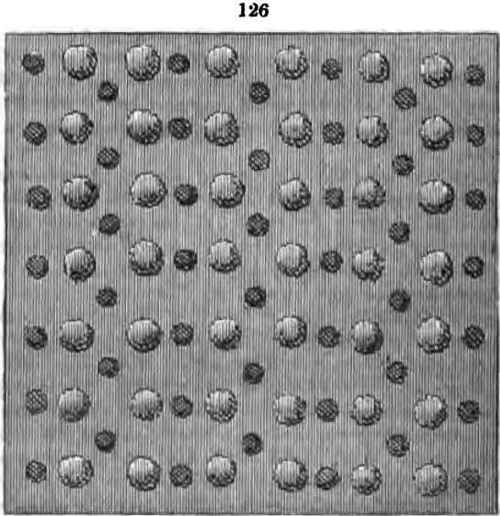
There is scarcely any point which we are more anxious to impress on the minds of our readers, than the necessity of planting trees and shrubs thinly, and of thinning out afterwards, as the trees advance in growth, so as, in general, to keep them clothed from the ground upwards; and always to do so when the object is concealment. As, however, in spite of all that can be said on the subject, many persons have an insurmountable objection to the appearance of a thinly-planted plantation, it may be avoided, by planting trees between those which are to remain, not as nurses, but of a smaller size than the others, so as to fill up the spaces irregularly, as shown in fig. 126.; or to plant the permanent trees at once in quincunx, as shown in fig. 127., by which means the appearance of bareness is avoided, and yet the trees are kept at the necessary distance asunder.

Continue to:


My Books

