


Design XXX. Plan And Views Of The Garden And Grounds At Hendon Rectory
Description
This section is from the book "The Villa Gardener", by J. C. Loudon. Also available from Amazon: The Villa Gardener.
Design XXX. Plan And Views Of The Garden And Grounds At Hendon Rectory
-Plan and views of the garden and grounds at Hendon Rectory, with the mode of planting them,
398. General Observations
This residence is selected in order to show what may be effected on a very small spot by the choice of trees and shrubs of a superior description, by the distribution of green-house plants in tubs and pots, and also by combining the gardenesque with the picturesque. There is nothing remarkable in the art or taste displayed in laying out this place; that having been done before the present occupier, the Rev. Theodore Williams, had acquired a taste for botany and gardening. On the other hand, the selection of the plants grown in pots, boxes, and vases, and their disposition on the lawn; the kinds of trees and shrubs planted in the masses and groups; and the manner in which these are managed; display the greatest taste, and a degree of care and high keeping in the management, which is very rarely to be met with in either small or large gardens. Mr. Williams, considering that, in all works of art, and in all natural objects which are to be examined singly, one of the greatest beauties-is symmetry, has those trees and shrubs which he manages in a gardenesque manner brought into the most perfectly symmetrical forms, by tying the branches up or down, inwards or outwards, as may be necessary, with small, almost invisible, copper wire; by which means, not only every plant in a tub or a pot is perfectly symmetrical, whatsoever be its form, but those trees and shrubs which stand singly on the lawn, or compose gardenesque masses are individually so treated; and, standing as they do a few inches apart from each other, the separate shape of each plant is seen by the spectator.
The same care is bestowed on the dahlias, which are here grown in large quantities, and of sorts most of which were raised under the direction of Mr. Williams, from seeds saved in his own garden. That which renders Hendon Rectory altogether unique in a gardening point of view is, a collection of Conifer© in pots. These Conifers are in part set out on the lawn in the summer season, and in part kept under glass; and all of them are trained into the most beautifully symmetrical shapes that are anywhere to be seen. As the pine and fir tribe is liable to be attacked by insects in the summer season, it is the business of one gardener to attend entirely to them and to the Cupressinae; in other words, to the pines, firs, cedars, araucarias, dammaras, cypresses, dacrydiums, junipers, and arbor vitaes, in pots. They are thus kept regularly watered, accurately tied into shape, and perfectly free from insects. Some of the plants of this kind at Hendon Rectory are of great value; one, a dacrydium, in particular, is matchless for its size, beauty, and rarity. The same plan of dividing the labour of the place is adopted with reference to the dahlias, which, from the day they are planted out till the time the roots are taken out of the ground, are constantly under the care of one individual.
Another man is solely occupied in propagating by cuttings or otherwise; and one is kept as a man of all work, to assist the others, and to look after the walks. The duty of the head gardener is to see that the rest perform the several works assigned to them, and, in general, to be careful that the whole is kept in perfect health and order.
The fence which separates the grounds of Hendon Rectory from the road which leads from Hendon to Mill-hill, is of oak pales; and the main entrance is through a door, also of oak. Besides the garden, the property consists of a grass field, of 3 or 4 acres, surrounded by an irregular hedge with oaks and elms, which harmonises so well with the adjoining fields similarly enclosed, that the limits of the property are no way discernible. The details of the plan (fig. 208.) are as follow: a, Principal entrance. To the left is shown a small path in an ogee direction, leading to a door, opening into the court of offices (m). b, A point, from which the view fig. 207. is obtained.
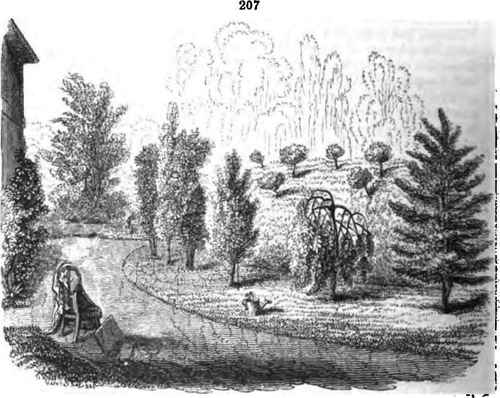
View at Hendon Rectory.
C A point, where the spectator, haying his back to the house, sees before him a narrow strip of lawn, with handsome symmetrical plants of the following kinds: - Neat the entrance door. Taxbdium distichum; then Sophora japonic pendula; next, Finns Magnus, Dahlia; Taxodium distichum nutans. Dahlia, Pinus rigida, Taxodium distichum patens. Beyond this, there is a row of dwarf hybrid rhododendrons, as a margin to a bank of common laurel, cut smooth above, with standard roses, and other trees, all cut into symmetrical roundish forms, rising through It, as seen in fig. 207, which forms a very singular phalanx of objects, and serves Co occupy the mind of the spectator, and prevent his recollecting that he is so very near the boundary and the public road. Turning round, with the face towards the house, a number of rare and beautiful plants are displayed on a rockwork composed entirely of crystallised spar.. The walk turns round to the entrance to the house; which circumstance corresponds well with its cottage and unobtrusive character, and is, in reality, as we think, in better taste than if the walk had been conducted to the main entrance, with a sweep like that of a carriage approach.
d, The entrance lobby of the house. e, The dining-room.
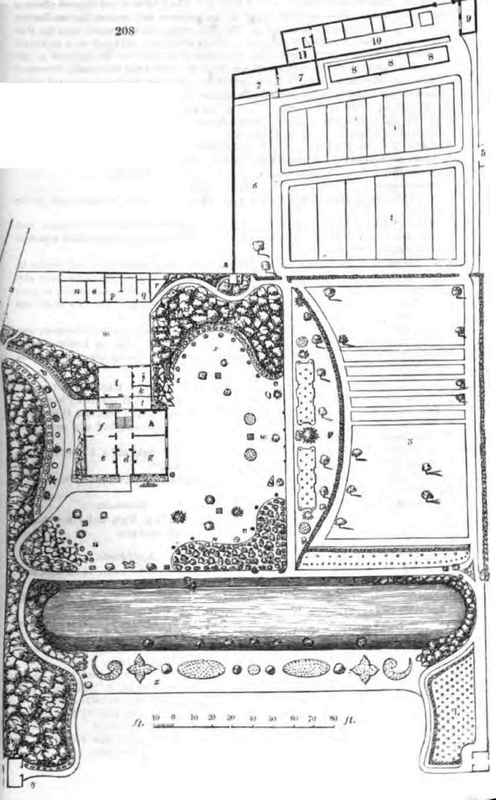
f The library, which opens into the dining-room with folding doors; both rooms being intended for books. g, The drawing-room.
h, Study. i, Kitchen. j, Back-kitchen. k, Pantry. l, Dairy.
at, Court, common to the kitchen and stables, with folding gates to the public road.
n, Justice-room. o. Coach-bouse. p, Two-stalled stable.
q, Harness-room. r, Dust-hole.
s, Servants' privy, entering from a winding walk, which passes from the stable court to the garden.
t, Situation where there is a handsome Gothic aviary partially concealed by bushes, sad containing a good collection of birds; Mr. Theodore Williams, Jan., being much attached to the study of ornithology.
u, A point round which there is a constellation of rare and beautiful trees and shrubs in pots, besides various statuary and sculpturesque objects. Among the hardy trees are, Photinia serrulata and Pinus Pallasiana and among the green-house plants, in pots and vases, are, oranges, myrtles, fuchsias, tree rhododendrons, etc. The view from tins spot, looking towards v, is indicated in fig. 209.
v, A gardenesque plantation, in which every tree and shrub is kept distinct, and every one trained into a symmetrical shape. The mass gradually rises from the height of 2 ft. round the margin, to the middle, which is 7 or 8 feet high. Among the plants in this gardenesque mass are the following:
Continue to:


My Books

