


Destroying Docks And Thistles. Continued
Description
This section is from the book "The Villa Gardener", by J. C. Loudon. Also available from Amazon: The Villa Gardener.
Destroying Docks And Thistles. Continued
410. With respect to the dimensions of the drains, as the surface is not to be ploughed, they need not be deep; and any greater width than may be required for attaining the depth fixed on is unnecessary. In general, from 15 in. to 18 in. in depth, and from 8 in. to 10 in. in width at the surface, and from 3 in. to 4 in. in width at the bottom, will be sufficient; except in parti-cular parts of the field, where the drain may have to cross a slight rise in the surface, and where it should be deeper in order to maintain a sufficient slope at the bottom to give currency to the water. The drain, being dug out, may he filled two-thirds of its depth with small stones, brickbats, or very coarse gravel; or with thorn branches, straw ropes, exhausted tanner's bark, carpenter's shavings, or any refuse vegetable matter that will partially or wholly rot, and leave a vacuity for the passage of water. In Essex, the material most commonly employed is straw twisted into a rope 3 or 4 inches in diameter. Reeds tied in cylindrical bundles of a few inches in diameter, are also employed in the same county, as willows are in Huntingdonshire, furze in Warwickshire, broom in Nottinghamshire, the spray of the larch in Wales, and heath in the north of Scotland. The most convenient materials in clayey districts, which are never productive of either gravel or rock, are the branches procured by cutting down thorn hedges.
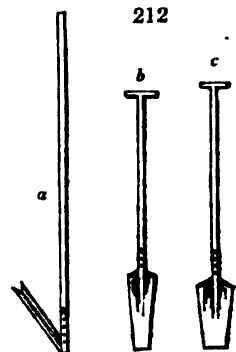
These branches, including the spray, may be laid lengthwise in the drain, and firmly trodden in; covered with soil, and again firmly trodden in; and, finally, the surface turf replaced. In order to make allowance for the sinking of the materials of the drain, this surface turf should be kept two or three inches higher than the adjoining surface, its edges being beaten down so as to form a small semicircular ridge in the direction of the drain. In the digging out of these drains, two kinds of spade are used: the first (fig. 212. c), 8 in. broad at the tread, is for taking out the surface-spit; and the second (b), which is 5 in. wide at the tread, for digging out the remainder. Afterwards a sort of hoe, or scoop, is used (fig, 212. a), for clearing out the loose particles and small lumps of soil from the bottom of the drain.
A simple and not an expensive mode of forming drains in strong clayey pastures, is to take off the surface-spit 9 or 10inches in width; and, a gutter having been formed in the subsoil, 18 or 20 inches in depth, the surface-spit is replaced. This mode of draining is most effective where the surface is naturally tolerably even; but, where inequalities are to be passed over, the gutter beneath requires to be cut down to such a depth, that its sides are apt to crumble in.
There are several kinds of draining ploughs, and one, the mole plough, forms a cylindrical furrow drain; but none of these machines can be recommended for using in a villa paddock; and, indeed, from their original cost, and the great power required to draw them, it is very doubtful to us whether they pay anywhere.
411. Wherever it is determined to break up old pasture land, on a wet or retentive soil, a different kind of underground drain is required to what was sufficient when it was under pasture. Though not quite so numerous as in grass lands, yet these drains require to be much deeper, and are consequently more expensive; nor will they altogether supersede the use of frequent shallow drains, after the ground is laid down again for permanent pasture.
412. Remarks
We have dwelt longer on the subject of renovating the paddock than those will think necessary who are not aware how much the difference of produce depends on management. Our wish is to see the paddock in as high order and keeping, in its way, as any part of the pleasure-ground or the kitchen-garden; and, well knowing how much of the comfort of a villa residence depends on the abundance and excellence of the milk and butter it produces, we feel that we can scarcely sufficiently impress our readers with the importance of bringing their grass fields into the highest state of cultivation, and afterwards keeping them in the highest order.
413. In renovating the kitchen-garden, the reader should bear in mind the importance of not having the roots of the trees too deep in the soil, and that, should this be the case, he must either take up and replant, or renew; unless, which is very rarely the case, he can reduce the surface of the garden so as to leave all the main roots of the trees at a proper distance beneath it. The soil of the kitchen-garden may, as before observed, be restored by rest, without any crop whatever; by the substitution of a lage portion of fresh soil; or by the application of animal manure, such as good stable dung or night soil.
Continue to:


My Books

