


Insects. Aphis, Or Plant Lice
Description
This section is from "The Horticulturist, And Journal Of Rural Art And Rural Taste", by P. Barry, A. J. Downing, J. Jay Smith, Peter B. Mead, F. W. Woodward, Henry T. Williams. Also available from Amazon: Horticulturist and Journal of Rural Art and Rural Taste.
Insects. Aphis, Or Plant Lice
This prolific and obnoxious family of vegetable parasites is interesting, on account of its anomalous character, being considered viviparous during the summer, and oviparous in the autumn, by that distinguished entomologist, T. W. Harris, M. D. Vincent Koller also informs us that Schmidberger collected eggs of the Apple Chermes (C. mali) which hatched in March, on plants in his room. This may be true of some species, but will not apply to others, which, if not always viviparous, are rather pupiparous, and not oviparous, as stated.
Stephens, in his Systematic Catalogue of British Insects, has recorded forty-nine species of the genus Aphis alone, and others belonging to several cognate genera. Six genera are given, by Westwood, of the family Aphidae, viz: Aphis, Lachnus, Atheroides, Erisoma, Adelges, Thelaxes, and perhaps Brysocrypta. It has been proved, by Reaumer, that in five generations (and it is supposed there are twenty in a single season), one Aphis may be the progenitor of 5,904,900,000 descendants. Maunder says ten thousand million millions are thus generated in one season.
The species reside in great societies, upon almost every species of plants, sapping the vital currents of their juices, inducing sickness, gangrene (or the growth of fungi), and death of the plants so infested, in numerous instances; and when not killed, they are greatly impeded in their growth from the exhaustion sustained by these parasites.
The following cut illustrates our common species, found infesting our gardens and orchards. A brief notice of each figure, in the numerical order engraved, shall be given, and such remarks made as the facts in the case seem to call for: -
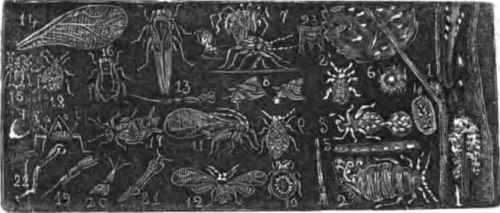
Fig. 1 represents a woolly species without honey tubes, no doubt belonging to the genus Erisoma, and perhaps identical with the Aphis lanigera of Hausmann, and quoted by Mr. Harris. Those are in small colonies, webbed in, or covered with fine, cottony threads, in the chinks of young suckers around the apple-trees, in knot-holes on the trunk, or axils of the leaves or young shoots from the main trunk of the tree. Fig. 2 represents the single insect; 2, the same, more highly magnified, showing the manner in which the white threads are expelled as excrement; other finer threads may issue from the spiracles or pores of the body, as stated by authors. Fig. 3 represents one pressed between two pieces of glass, exhibiting the young (folly formed) floating in the liquids of the parent. Fig. 4 is one of them separated, showing the fall formation of the young insect. Fig. 5 is a string of ovaria of increased size to the folly-formed creature. Fig. 6, a jelly-like globule, surrounded with fine, fiocculent threads, found among the Aphids. Is it an egg 1 On the 23d day of November, 1857, in the presence of Mr. McFadden, I opened one, and discovered it filled with young, the eyes of which, and the contour of the body, plainly visible in each, all in a kind of sac or matrix of the parent.
Why lay eggs at all, since our severe cold nights of November 19 and 20, when the thermometer was 6° below freezing, has failed to destroy the vitality of the parent? This species do not appear to have any winged ones among them. Alfred Smee, F. R. S., gives a figure similar to Fig. 4, and says: "This therefore shows me what sort of an egg we may expect to find, if the creature ever lays one".
Fig. 7 is a species noticed August 22, 1857, enveloping the lower branches of a noble specimen of the American Beech (Fagus ferruginea), like minute white-headed fungi, at first sight The oscillating motion among the little, cottony tufts arrests the attention. On closer inspection, we find they are little creatures with their bodies erect, terminated by a plume of fine, white, tangled thread, with a few thicker and longer ones interspersed, busily engaged at pumping up the sac, by means of their suctorial apparatus. They have six-jointed antennae, a short collar, ample thorax, body carried at a right-angle thereto, of an ochrace-oufl color, and two greenish lines from the collar to the extremity of the body. On careful inspection, I cannot reconcile it with any of Westwood's genera. I consider it an undescribed species, at least. Those, no doubt, have winged individuals, having noticed rudimental wings on some specimens. Fig. 8, a globule of fluid of one, and a living aphid expelled from the other, of two individuals among a number on a cabbage leaf; same as Fig. 9, the Aphis brassicae. Body, greenish, covered with a whitish, mealy substance, in dense patches, on the cabbage, called mildew.
These were also active on this 23d day of November, on the heads of cabbage left standing in my garden, of all ages. I have failed to detect eggs among them, but have seen living aphids, and the pupa, also of ichneumon-flies, contained in them. Fig. 10 shows the under side of one, having a flat, fringed disk, by which it was firmly attached to the epidermis of the leaf, apparently dead, though containing the pop© of its brood alive (similar to the scale insect) within the globular, inflated carcass; in others, the pupae of ichneumons, of which latter I also captured specimens while engaged at ovipositing. The winged aphid is similar (Fig. 11) to those of the A. vastator of Smee (A. rap© of Curtis), Fig. 12 and 13, at rest and on the wing. On the warm afternoon of November 16, I observed them flying in clouds. The collar is of a dirty yellow (as also the abdomen), or brownish. The thorax high, of a shining black; antenna with a terminal, long, hair-like joint, variable (see Fig. 13). Fig. 14, shows the fore wing.
Fig. 15, a peculiarly square-shaped specimen, on the snowball. Fig. 16, a small, black fellow, found in great numbers on various plants - perhaps Smee's " little black rascal" - on the wing, called "smother flies." Fig. 17, from the Phlox divaricata. Fig. 18, also on the snowball, with short, honey tubes, of lead colored pubescency; proboscis short. Fig. 19, the promucis, or snout, with a long tongue, or setae, as usually seen. (Fig. 20, Smee's figure, with a setae and two sheaths, which I could not see.) Fig. 21, the same, with the sets inclosed. Fig. 22, a leg; shin, hairy, bristled; tarsi, apparently only one-jointed; if there are two joints, as stated, the upper must be very minute. Fig. 23, the anal prolongation of some, and the honey tubes. Fig. A, a rear view of a winged specimen; o o, the deflexed wings, like a roof; i i, the honey tubes. E shows a peculiar projection on the sides of each eye, noticed in winged aphids. I have seen the male vastator, in his winged state, in connection with a wingless female, November 18.
I have seen both winged and wingless females produce their young alive, up to November 20. They were, on the 23d of November, congregated in dense groups on the under side of the few remaining leaves on my dwarf apple-trees, on the Kerria japonica, and other rosaceous plants, in their winged state, and all grades of wingless ones, with their snouts inserted into the leaves, unharmed by the cold, rain, and frost, and likely to withstand the severity of the winter, as shall be seen. But eggs I cannot find. Though Mr. Harris says "the winged plant-lice provide for a succession of their race by stocking the plants with eggs in autumn," and, after stating that those hatched in spring are all females, producing brood after brood to seven or more generations, without the intervention of a male, continues: " This extraordinary kind of propagation ends in the autumn with the birth of a brood of males and females, which in due time acquire wings, and pair; eggs are then laid by these females, and, with the death of these winged individuals, which soon follows, the race becomes extinct for the season".
Mr. Smee, after close scrutiny and patient investigation, asks the following questions: "Does the vastator lay eggs which hatch in spring? Does it hyber-nate and come out again in spring? Does it continue to propagate, notwithstanding cold, frost, and rain?" And adds: "Up to November 4,I have found the creature bringing forth its young alive".
This sustains my observations, and I will hazard the assertion that they do not lay eggs, that they do hybernate, and come out again in spring - at least, those species I have illustrated and examined.
The means nature has provided to check these creatures, and the remedies to destroy them, I shall defer for another article, this having become too lengthy, and much of interest connected therewith not said. Though so small in size, at most only one-tenth of an inch, their immense numbers make them formidable to the horticulturist, and therefore a thorough knowledge of them is desirable. By way of a moral, I'11 conclude with the following couplet, by F. H. S.: -
"Daily vices, though small they be, May make our souls with sorrow rife; Like aphids on some plant or tree, They sap the very springs of life".
Continue to:


My Books

