


Ivy
Description
This section is from "The Horticulturist, And Journal Of Rural Art And Rural Taste", by P. Barry, A. J. Downing, J. Jay Smith, Peter B. Mead, F. W. Woodward, Henry T. Williams. Also available from Amazon: Horticulturist and Journal of Rural Art and Rural Taste.
Ivy
This invaluable evergreen climber is not sufficiently appreciated in this country; wherever it will thrive it should be planted,both for covering walls and to run up the blank stems of trees, using bone manure as the best enricher of its soil. Nothing creates the idea of age so quickly as abundance of ivy. Where it is not sufficiently hardy to ascend trees or walls, a handsome effect may be produced by allowing it to run over the surface of the ground, where it will form a fine verdure in shade that injures grass. We are not sure but that it might form a carpet of green in the southern states, where grass is difficult to cultivate. At Philadelphia it succeeds admirably, though some of the finest old specimens are occasionally totally destroyed by the cold; sudden extremes from warmth to great depression of the thermometer, seem unfavorable to its longevity. The "English" here is the most hardy, and the "Irish" the most rapid growing, though some difference of opinion exists on this subject. Philadelphia is probably the northern limit where you often see large walls ivy-covered, though at Sunnyside, Washington Irving's, and a few other places in that region, where it is planted on the north sides of dwellings, it is occasionally seen very beautiful and healthy; but generally at the North it can be successfully grown on the ground, where it runs very well, and if covered with leaves and brush it will do perfectly.
It might be employed as in the preceding cut even in northern climates, and annually laid down carefully before the cold weather sets in, and we advise a trial of this as a probable means of success. It should always be protected from the sun in winter, which kills it by sudden thawing after severe frost.' Downing thought so highly of it as to say nothing could take its place. For further particulars regarding this most beautiful of climbers, we refer to an article of some length from our own pen, in the 4th Vol. of the Hortictulturist, December, 1849, page 252, and now proceed with our translation from the Revue Hor-ticole:
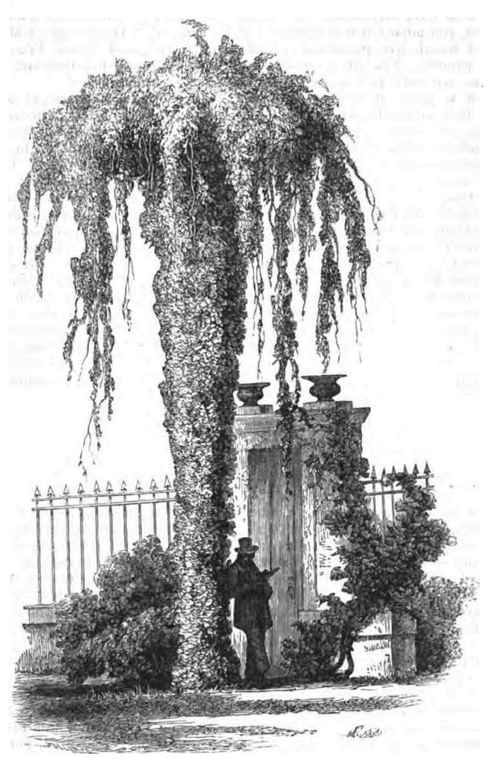
IVY BOWER.
"There may be used for the ornamentation of parks and gardens, an arrangement of Ivy to form a trunk by uniting and interlacing its branches. I am certain of this from experience: in 1852,1 transplanted a Laricio Pine sixteen feet high, and placed it before the house I occupy, in the Jardin des Plantes. The tree died in a few months. I had the branches cut off, and then planted at the root two Ivys and two Banksia roses; for two years, the two plants lived in harmony, and the yellow flowers of the Banksia roses arranged themselves very gracefully on the deep green of the Ivy leaves; but little by little the latter outgrew the rose, stifled its more feeble companion, and reached the top of the pine trunk. Then I had an iron circle of three feet in diameter placed at the summit of the tree; the branches of the Ivy very soon clasped the circumference, and now they weep over all around, and present the appearance of a candelabra always green. The stem of the Ivy is already strong enough to support itself, if the support should crumble; but the resinous nature of this evergreen trunk ensures its duration.
If I had it to do again, I would make the circle six feet in diameter, in order to have between the trunk and falling branches, a bower, where at all times shade and freshness would be found.
"In central Europe, the Ivy grows very vigorously, but not beyond the 58° of latitude. It grows, however, in the island of Gothland; but it is no longer found in Sweden, in Ostrogothia, or in Westrogothia. In the British Isles, it stops at the Shetland Isles, and no longer grows in the Hebrides, nor in the Ferve. In England and in Germany, it embellishes all the ruins, clothing them with perpetual verdure. No traveller can forget the Ivys which adorn the ruins of the Castle of Heidelberg; those of the feudal fortress of Bressuire, and the Castle of Courtalein, (Eure-etrLoire,) inherited by the family of Montmorency. This castle dates back to the year 1440; it is defended by a tower of sixty-nine feet in height; the ivy is trained with much care on the trellis, and the windows seem carved out of the foliage. It would be difficult to conceive the charming effect, which this castle of verdure produces.
"In England, I admired the Ivys which cover the ruins of Kenilworth Castle; Loudon cites those of Brockley Hall, in Somersetshire, that climb on the trees. One is ten feet in diameter, another eleven feet - both must be very old, for the growth of the Ivy is slower than in the middle of France. Another Ivy covers a cottage in the city of Morpeth, in Northumberland; it shows a diameter of nineteen feet to the height where it divides into branches, and ten feet above the soil.
"Ivys so often cover ruins or old edifices, that it would be very interesting to study their growth in diameter. It can be done by counting the number of woody layers of the large Ivys cut at the base. A certain number of examples compared among themselves would furnish us means that would serve for a foundation for calculations upon the age of all the large Ivys, whose diameter should have been measured; for these plants growing near a ruin, in a soil which is neither cultivated nor manured, must have a moderate growth, such as we might expect. The estimation of the age of an Ivy on a ruin, would be very interesting in itself, for I am convinced that examples of them would be found of astonishing longevity! further, we would plainly have a minimum limit for the antiquity of the ruin itself. In short, the latter is necessarily anterior to the Ivy that covers it. The vegetable physiology and the history of ruined monuments, such as cover the soil of Europe, would then have an equal interest if these studies were pursued".
Ivy #1
I fully agree with you, Mr. Editor, in your admiration of this beautiful plant. We cannot grow it here, as you do, but are compelled to plant it in shady and sheltered situations, and be satisfied with a moderate annual growth. I amused myself last winter by growing it from cuttings, in water, and derived much pleasure from watching the development of the roots, which were freely emitted, and the growth of the leaves.
I have now a strong plant in a pot, grown in this way, and have several that have remained all summer in the water, which rarely requires renewal.
Continue to:


My Books

