


Notices Of Trees
Description
This section is from "The Horticulturist, And Journal Of Rural Art And Rural Taste", by P. Barry, A. J. Downing, J. Jay Smith, Peter B. Mead, F. W. Woodward, Henry T. Williams. Also available from Amazon: Horticulturist and Journal of Rural Art and Rural Taste.
Notices Of Trees
Under this head it is proposed to give occasionally a sketch of such trees as may come under the writer's notice, that are any way remarkable in size, beauty, or rarity, with such remarks as may generally interest. As knowledge, like charity, should always begin at home, the nearest interesting collection of trees is first taken in order, - that of the Messrs. Johnson, Germantown, Penna.
These trees were planted by the father of the present proprietors, between the years 1805 and 1812; and to those who imagine that they have to wait what they term "a whole life-time," in order to enjoy the fruits of their labors, - shade, shelter, and retirement, - they have afforded for a long time an excellent example of what a bountiful reward a few short years will heap upon them. The handsomest specimen on the grounds is one of the European Silver Fir (Picea pectinata), and it would probably be not too much to assert that it is the most beautiful tree of the kind in the United States. Its present height is ninety-six feet, and its circumference is nine feet four inches at three feet from the ground. Near the ground line it is eleven feet and nine inches, and the whole trunk perfectly straight, and clothed with fine healthy branches to its very base.
*The last number of the London Quaterly Review, which has come to hand since this article was penned, says: - "It appears that the Larch yields the greatest profit of any description of tree, and in the hortest time. It Is proverbial, in fact, that Larch will boy a noise before Oak win fnrnish the saddie. The timber is said to be superior to foreign Fir in the following respects: It is clearer of knots; more durable, even the dead branches being never found rotten; it is much less liable to shrink or split; it may be seasoned in a much shorter time; it is tougher, of a better color, and susceptible of a polish superior to that of the finest Mahogany, and bears exposure to climate and moisture for many years without undergoing any change. It has however, been found open to objection for ship building".
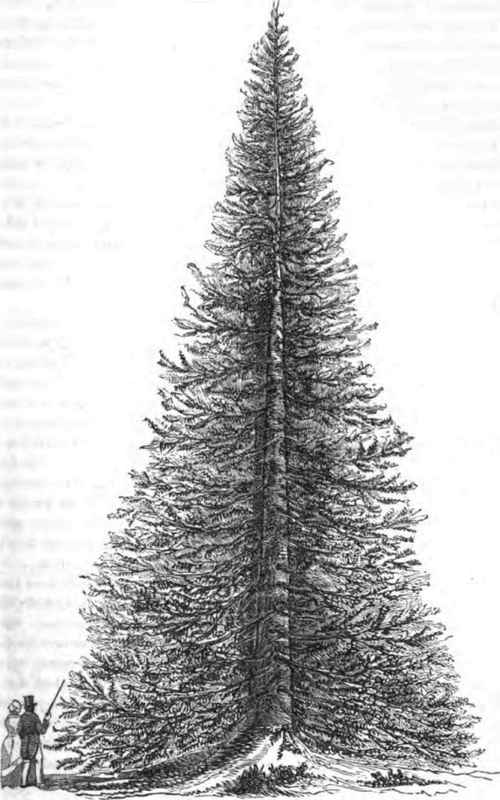
PICEA PECTINATA OR SILVER FIR.
It is believed to be one of four trees first introduced into the United States by the late Mr. Prince, of Flashing, another of which was planted, and still remains, at Bartram's. It would be interesting to know the fate of the others. Some of the gentlemen still connected with that establishment might be able to favor the readers of the Horticulturist with some account of them. The Silver Fir is deservedly coming into greater note than it has heretofore enjoyed. It is superior in beauty and rapidity of growth to many more popular novelties. Its growth is rather slow while young, and at that stage of its existence is apt to have its leading shoot and terminal bud killed or injured in severe winters. This injury is entirely prevented by wrapping the part in danger with cotton wadding early in winter, taking it off again early in spring; a thin covering will suffice, - just enough to keep the sun from thawing suddenly the frozen shoots.
Near to the Silver Fir is a very handsome specimen of the Snow Drop or Silver Bell tree (Halesia tetraptera), a perfect snow storm of blossoms, which, at this date (May 18th), are rather past their best. This beautiful tree has not one objectionable feature, a character possessed by few others; and while it will grow as large as an Apple tree is so accommodating in its disposition as not only to thrive in any dry soil, but also to commence blooming when only a few feet high.
Another tree, which, with me, has always been one of the most interesting specimens on the grounds, is the Bladdernut (Staphylea trifolia). This, which in botanical works is described as a shrub "six to twelve feet high" and which I have never met in a wild state in any other condition than a thick bush, here reaches the height of about twenty-five feet, and has a stem two feet three inches in circumference. At the present time its large round head is a mass of greenish white, heathlike, sweet-scented blossoms, and though its period of blossoming is of short duration, is very well worthy of claiming for the plant a place in every collection. It has one fault - a great fault - but one common to many other very handsome ornamental trees; namely, a great propensity to throw up suckers, so much so as totally to incapacitate it from enjoying the privilege of being a lawn tree. Its proper place is the wilderness; and as no garden of any pretensions ought to be without this interesting feature of a landscape, no garden should be without the Staphylea.
The garden is so shaded by Pines and Spruces, which keep the atmosphere beneath them humid and the soil so cool, that large masses of the Mountain Laurel (Rhododendron maximum) thrive in remarkable luxuriance under their branches. Some of their leaves equal in size those of the English Laurel (Prunus lauro-cerasus). In the deepest shade, the Periwinkle (Vinca major) luxuriates in evergreen splendor the whole year, where grass would not live a month, - an excellent plant for such situations. A plant of the aucuba Japonica, that has been out many a year, comes out of last winter's struggle unscathed, showing how much situation and circumstances have to do with the hardiness of these plants. A large Canadian Yew (Taxus Canadensis), though indigenous ten miles from these grounds, has had many of its leaves very much damaged; as indeed the Wood Laurel (Kalmia latifolia), a much commoner plant, has in many instances. The habit of this Yew is to trail rather than to grow erect, and though probably covering a circle fifty feet in circumference, is not more than six feet in its highest point.
One of the finest Catalpas (Catalpa bignonoides) is also here; its trunk at three feet from the ground is ten feet nine inches in circumference, and its large round head every year produces a mass of gorgeous flowers equalled by few things of its season, except the Paulownia. It is unfortunately a very late tree to put forth its leaves in spring, and loses them again very early in the fall. Its beautiful flowers and tortuous branches are its chief claims to the arboriculturist's notice.
There are many other very interesting trees on these grounds, well repaying a visit from a lover of them, but not calling for special notice here; except, perhaps, a magnificent White Fringe tree (Chionanthus virginica), and a large gold variegated leaved Box tree. The former at the base, where its numerous branches diverge, is four feet and a half in circumference, and the branches themselves have a radius of fifteen feet. It is of the variety that never perfects its seeds, but is most profuse in the expansion of its floral treasures. M.
[We are greatly indebted to M. for taking up the subject he has chosen; he is particularly well qualified for the task. The European Silver Fir has long been a pet with us; in general appearance, to an uneducated eye, it resembles most the Balm of Gilead - now generally abandoned by those who know its worthlessness after a few years of beauty. The Silver Fir retains its lower branches perfectly, is one of nature's most glorious productions, and especially beautiful in May and June with its new and superbly bright green growth. After it is established the leader is uninjured, and it grows quite rapidly, though slow in the first two or three years after transplanting. Were we compelled to choose but one evergreen, it is more than probable the Picea pectinata would be our selection.
H. has scarcely done full justice to the grounds where this tree is found; they were planted with great judgment and taste, and are maintained in their delightful repose with pious care snd elegance. - Ed].
Continue to:


My Books

