


Propagating Plants By Cuttings Of Ripe Wood. Part 3
Description
This section is from "The Horticulturist, And Journal Of Rural Art And Rural Taste", by P. Barry, A. J. Downing, J. Jay Smith, Peter B. Mead, F. W. Woodward, Henry T. Williams. Also available from Amazon: Horticulturist and Journal of Rural Art and Rural Taste.
Propagating Plants By Cuttings Of Ripe Wood. Part 3
Rank substances, such as undecayed vegetable or animal matter, should never be allowed near cuttings; and where it may be necessary to use manure, it should always be old, well decomposed, and thoroughly incorporated with the soil at least six months before the cuttings are planted.
Some propagators plant their cuttings and then cover the surface of the soil with manure. The juices of this will percolate the soil at every shower, and furnish food in solution to the cuttings. I have found this to answer remarkably well in some seasons, while in others a fungus (mushroom) would spread itself through the manure, and when it came in contact with the young wood, it was very likely to destroy it. This, however, can be easily prevented by frequently stirring the manure; and I may here remark that from many years' experience I have never found any other mulching necessary (if the soil was previously rich) than that of frequently stirring the surface. Planting the cuttings too deep should also be avoided, as the farther from the surface they are, the less solar heat they will receive, and this is necessary to insure rapid growth after they have become rooted. If the cuttings are short, plant perpendicular; if long, they may be put in at an angle. In growing cuttings of the ripe wood of evergreen plants, the same plan should be adopted as with deciduous plants, except that the cuttings must not be entirely excluded from the light or wholly buried in the soil, for in making them, the leaves are left on that part of the cutting which remains above ground.
If they were covered entirely with earth they would soon decay. The leaves of our hardy evergreen plants are covered with a very compact epidermis, which does not allow them to exhale or inhale moisture very rapidly when in a dormant state.
This peculiarity in their structure admits of their being placed in such a position that roots will form while their leaves do not suffer. They should be placed in what are termed cold frames, and covered with glass that has been dimmed either with whitewash or white paint, so as to prevent the direct rays of the sun from reaching them, as that might give them too much heat and excite them into growth before roots were formed; or the frames may be covered with a screen made of lath, as shown in figure 89. This may be covered with straw or mats in winter to keep out the cold. The soil in which they are planted should be more porous than that in which cuttings of deciduous plants are grown, as the stems are not quite so firm, and are more liable to be affected by moisture. One third old decomposed weeds or leaf-mold and two thirds sand make a good material for the purpose. Keep the bed constantly moist, but never wet. The same care as to temperature must be observed as with other ripe-wood cuttings, never allowing the heat above ground to go below 35° or above 50°, if it can be avoided, until roots are formed.

Fig. 89.
Walks and garden paths should be kept clean and free from weeds or grass, as much of the comfort and appearance of a place depends on their condition. In the making of walks, the refuse of iron or copper works forms a good base, upon which weeds rarely grow. Loose gravel is very objectionable to trench upon, and we have often cement plain gravel path by merely adding wood ashes, raking it well, then wet down and roll. A short time will cause it to set and become firm. Once a walk is formed, it should not be disturbed with the hoe, but the weeds while young should be hand-pulled, or, better yet, dosed with salt to destruction.
Gas tar, coal ashes, and gravel also make a good path, but the odor from the tar, which continues a long time, is to many objectionable.

Fig. 90. - Sea-Side Cottage - Perspective View.
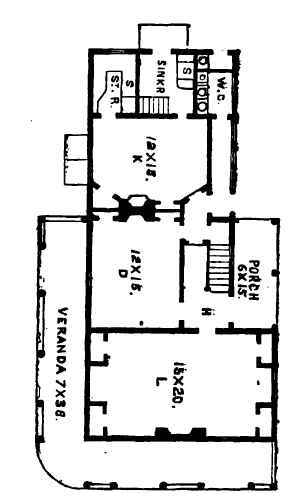
Fig. 91. - First Floor.

Fig. 92. - Second Floor.
Propagating Plants By Cuttings Of Ripe Wood #1
Like most of Mr. Fuller's writings, this contains full explanation of the why and wherefore cuttings should be made at certain seasons, and also why a particular way of making them is more desirable, although, perhaps, not essential to success. I have practiced for many years putting cuttings in the ground where they are designed to grow, the next coming summer, in the fall, and I have found that with gooseberries, currants, etc., etc., as soon as the main or terminal bud has fully formed and matured, I can commence making my cuttings without reference to the fall of the leaf. The same also with the grape; as soon as the fruit may be said to be fully ripened - I don't mean colored, but thoroughly matured - I can cut and put in my grape cuttings and grow them without having to resort to any patent process. And, by-the-by, many a grape cutting is lost, as all the shoots, which are often rubbed off when a vineyard has not been early gone over, if preserved, will grow readily and make good plants the following year.
Continue to:


My Books

