


The Practice of Pruning; The Peach. From The New Edition Of Lindley' Theory Of Horticulture
Description
This section is from "The Horticulturist, And Journal Of Rural Art And Rural Taste", by P. Barry, A. J. Downing, J. Jay Smith, Peter B. Mead, F. W. Woodward, Henry T. Williams. Also available from Amazon: Horticulturist and Journal of Rural Art and Rural Taste.
The Practice of Pruning; The Peach. From The New Edition Of Lindley' Theory Of Horticulture
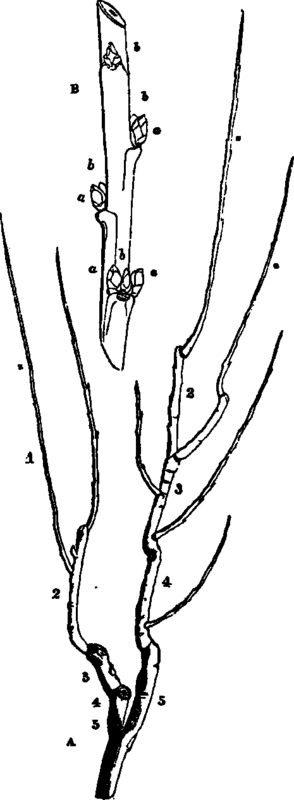
The mode of bearing is as follows: - A, represents the branch of a Peach tree. The figures 1, 2, 3, 4, 5, denote the respective ages of the portions of branch opposite. The asterisks at the sides of the shoots, indicate the place to which these may be shortened at the winter pruning. B, is a portion of a bearing shoot furnished with both wood and blossom-buds; a, a, a, a, are blossom-buds; b, b, b, b, wood-buds.
Peach and Nectarine trees bear their fruit exclusively on wood of the preceding summer's growth. For example, if one pull a Peach in the summer of 1847, it must be from wood formed in the summer of 1846, and which had no existence, as a shoot, in 1845, although then its origin might have been traced to a vital point within a bud. Such an almost invisible point was the shoot B, in 1845. In summer 1846, this point, developed from a bud, grew a shoot, furnished with leaves disposed singly, in twos or in threes, along the growing shoot. In the axil of each of these leaves, the rudiments of a bud were formed. The leaves, having accomplished their office, dropped in autumn, whilst the energy of the young buds continued to increase. Their winter appearance is represented in Fig. B. The blossom-buds are distinguished by their plumpness: they have an ovate form, which gradually becomes globose: they have a hoary appearance, owing to the scales opening and exposing their downy integuments. The wood-buds are slender and conical. Their scaly covering is less deranged by expansion of their interior parts in early spring, and consequently they exhibit less of that hoary pubescence by which the others are distinguished.
In the case of triple buds the middle one is generally a wood-bud.
The Peach differs materially from the Pear and Apple trees. In these a shoot may be shortened to any bud, and the one immediately below the cut will almost invariably produce a shoot; but the Peach shoot must be cut to where there is a wood-bud; for if cut to a blossom-bud only, no shoot can result. Sometimes all the buds on a shoot are blossom-buds, except the terminal one, and one or two at the base. Such shoot must either be left its entire length, or cut back to the wood-bud at its base. The shoots of the Peach naturally terminate with a wood-bud. If this be cut off, the blossoms on the part left will expand and the fruit may set, but all will prematurely drop; thus, if all the buds marked b were blossom-buds, they would expand; but the eight blossoms would either drop without setting, or the fruit would drop at the time of stoning; at all events, a leafless, budless shoot would result, incapable of further vegetation. It dies downwards to the first wood-bud. The blossom-buds, a of B, will produce four Peaches, but one is enough to leave to come to perfection.
From the wood-buds, b, shoots will proceed; these, in the course of the summer, will form buds for future bearing; and a twelvemonth hence they will appear similar to those on B, which, having once borne fruit can do so no more, and therefore its place must be supplied by the most appropriate shoot it produces at or near its base, or by a shoot from an adjoining branch.
These facts are the foundation of all the long intricate plans for pruning and training this tree. The following are, 1 think, the best concise directions which have yet been given on this subject:
"Commencing with the winter pruning, the first rule to be laid down as a basis for all the rest, is to shorten every shoot in proportion to its strength, and to prune to where the wood is firm and well ripened: this will cause all the pithy and unripened wood to be removed, thence ensuring a supply of that which is better ripened for the ensuing year. But in order to give every facility to the ripening of this wood, it must be trained thin, not in profusion according to the general custom, but such shoots only as may be required for the following year.
"Trees which have arrived at a bearing state should have their strongest bearing shoots shortened to twelve or fourteen inches, those next in strength to eight or ten, and the weaker ones to four or six inches, pruning each to what is termed a treble eye, or that where there is a blossom-bud on each side of wood-bud: where branches are not in a bearing state, these treble eyes will not be found; they must therefore be pruned to a wood-bud alone, which is always known by its sharp point.
Shoot of the Peach-Tree.
" In May, the season for disbudding the tree, all foreright shoots, as well as those from the back, must be carefully removed with a sharp small-bladed knife, taking care to cut close to the branch, but not into the bark: a few, however, of those foreright shoots had better be cut within a quarter of an inch only, which will leave two or three leaves to each, to shade the young fruit, and such slight wounds in the branch as have been occasioned by cutting the shoots off close.
"As soon as the young shoots have grown long enough, the leading one from each branch should be nailed neatly to the wall, selecting one or two of the side shoots produced lower down the branch, and training them parallel also. This applies to those of the stronger branches, at and near the extremity of the tree. Those in the middle and near the bottom, will allow of but one shoot probably in addition to the leaders; this will depend upon the space left in the winter pruning; if sufficient, it is always better to have a young shoot on each side as well as the leader, than to have only one, for it is by this arrangement that a succession of young wood can be kept up throughout every part of the tree.
"Should young shoots, indicating extraordinary vigor, any where make their appearance, they should immediately be cut out, unless where a vacant part of the wall can be filled up, because an excess of vigor in one part of the tree cannot be supported without detriment to the other. Peach trees, when in a state of health and vigor, generally throw out laterals from their stronger shoots; when this is the case, they should not be cut off close, but shortened to the last eye nearest the branch; and if there is room, one or two of those first produced may be nailed to the wall; or the middle shoot may be cut out, leaving the two lowest laterals, and allowing them to take its place; thus frequently obtaining two fruit-bearing branches, when the former one would, in all probability, have been wholly unproductive of fruit the following year".
[The American reader will not fail to apply the theory to our climate; here the "wall" part of the above instructions is rarely resorted to. - Ed. H].
Continue to:


My Books

