


A Trip To Cuba And The Southern States. Continued
Description
This section is from "The Horticulturist, And Journal Of Rural Art And Rural Taste", by P. Barry, A. J. Downing, J. Jay Smith, Peter B. Mead, F. W. Woodward, Henry T. Williams. Also available from Amazon: Horticulturist and Journal of Rural Art and Rural Taste.
A Trip To Cuba And The Southern States. Continued
All agreed, wherever the old topic of the weather was talked over daily, that it was an unusually cold spring,■ and we concluded we had done as unwisely as most do, by leaving Cuba too early.
* The visitor to Cuba should he informed that the land side of the Moro Castle, which presents a level surface, is a place of danger. We were here unexpectedly saluted by a cannon hall, fired at a target, while collecting corals, shells, and sponges.
On the 3d of March, at Charleston, vegetation was much more forward than in the higher regions of Georgia on the 10th of April. Peach-trees were in bloom, and tomatoes of considerable height, but a cold night or two had injured the fruit, and the orange-trees looked discouraged. We noticed, at Charleston, many plants and shrubs living in the open air, that, if we could possess, our gardens would equal almost any in the world; among these, the Gloria-mnndi, or Laurus cerasus, and the Magnolia grandiflora, were the most striking and useful as ornaments; one of the latter, in a town garden, is forty feet in height. Considerable attention is paid here to gardening, but less than the climate would pay for: grass is not very successful, even with great care, and here we bade adieu to that luxury of the eye in the colder North, for many weeks.
Our party (now a large one) enjoyed the trip down the Florida coast greatly, though the weather continued cold till we reached the latitude of the Bahamas. The following sketch presents characteristic views of the coast, the palmetto here, the highest object, and the everlasting solitude of the beach.
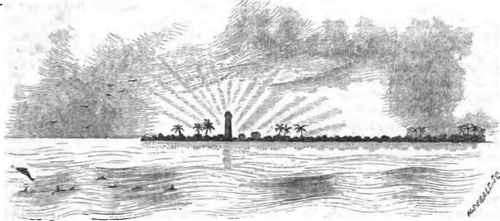
CAPE FLORIDA.
St. Augustine was passed, but not seen. Generally, we were near the coast, which fatigues by its monotony, but this is entirely obliterated by the scenery and vegetation which presents itself at Key West, in novel forms to a Northerner who visits this region for the first time. Most of the productions of Cuba flourish here in perfection. A worn-out mind, accustomed to the wintry winds of Pennsylvania and the North, may here fairly and fully enjoy a new sensation in his first glance at the glorious palm-trees.
As we neared the wharf in early morning, all the travellers were on deck, in full rig for a run on the dry land, but we were not all fully prepared for the scene that rapidly came in view. "What tree is that?* exclaimed a dozen tongues at once. "Oh! how beautiful!" "glorious, indeed!" was heard from every quarter, as the ostrich-like plumes of the cocoa-palm waved in graceful beauty in a tropical breeze, and displayed the nuts hanging in their various stages of growth, from the flower to the full-grown fruit. We all made rapid steps to get a near view; they were planted near the wharves, and having but lately come into bearing, presented the appearance of the handsomest shade tree we had ever conceived of. When more folly grown, the leaves and fruit are so elevated as to present a less pleasing aspect. That first sight of the cocoa-nut palm has left an impression that no subsequent experience at all parallels for intensity. A few minutes more and we were under the escort of Major Saunders, and in the confidence of his colored man, in search of milk from the nut. Sambo took us to the garden of one of his black friends, with a cottage no doubt much like Paul and Virginia's, and with little negroes running about in nature's garb under the palms.
Sambo bought liberty to ascend, and soon detached the ponderous nuts from their stems, the mothers holding their children like dogs in a leash, lest the falling fruit should crack their skulls. We betrayed no ignorance by giving directions, and Sambo soon found an axe, with which he chopped off the upper end of the fruit, and upset it into a pint and a half tumbler, first showing us that it was entirely full of the almost transparent liquid. The elevated position in the wind which it had enjoyed, had kept the milk cool, and we demolished the whole, the regular charge appearing to be sixpence; the empty shell, and its network of green covering, was cast away as useless, but an examination displayed a very thin lamina, not thicker than the blade of a knife, of a white, soft substance, which, as the milk dries away, and the nut becomes older, thickens to the consistence we find in its more ripe and desiccated state at home.
The cocoa-nut will not produce its fruit except in the vicinity of the sea; at Kew Gardens there is a large plant, but it is barren for want of salt air. This nut is now in extensive demand for making palm-oil, and it is supposed that a large district of the yet entirely uninhabited Florida coast is well adapted to its growth. As soon as the Indians of that region are got rid of, and the white man is unmolested, the experiment will probably be tried on an extensive scale. The tree bears in its sixth year.
Mr. J. P. Baldwin, the intelligent collector of the port, and an enthusiastic horticulturist, has a large garden near the town, and an active negro gardener (yclept Sandy Cornish), to whose varied information we commend questioners new to such novelties as he hoes and discourses on. He has great success with bananas, the sugar and rose apple, guava, Ac, and he declares that he gets three crops of grapes annually from the same vines. But the Sisal hemp is the most profitable crop of the Key, and, with care,, will yield $400 to the acre at a cost of only $10, if a machine could be invented to clean its fibre from the surrounding aloe-like substance which envelops it. Sandy showed us many novelties, but as these came more fully under our notice in Cuba, we shall defer them to a future page.
The orange attains great perfection at Key West, and the cultivation of this and the cocoa-nut, Ac, for exportation, is profitable. The island, though highly attractive for its vegetation, is not a desirable residence; it depends mostly upon the Isabel for its supplies and the mail, and its coral rocks present no features of beauty. We had left the region of snow which continued abundant at home all March, and found the whole population here clothed in summer costume, with Panama hats, at this early date; with slight exceptions, this is the costume of the entire winter. The officers on the station had much to say of the utter uselessness of the war carrying on against the Indians, and admitted that though five thousand troops were in the field, only one of the enemy had yet been captured, and she was a woman!
As the editors of the Horticulturist have rarely or never ventured of yore beyond the latitude of Washington, however incompetent to the task we shall endeavor to interest our readers with a few memoranda respecting a climate as new to some of them as it was to us, and, in our next number, shall enter briefly upon Cuban topics.
Continue to:


My Books

