


Correspondence (14)
Description
This section is from "The Horticulturist, And Journal Of Rural Art And Rural Taste", by P. Barry, A. J. Downing, J. Jay Smith, Peter B. Mead, F. W. Woodward, Henry T. Williams. Also available from Amazon: Horticulturist and Journal of Rural Art and Rural Taste.
Correspondence (14)
Mr. Editor. - The following I take from the newspapers, where it has been extensively published:
"The Agricultural Bureau of the United States Patent Office have received intelligence of the shipment from Havre, France, of a large swarm of Lombardy bees. These bees will be sent upon their arrival here direct to the Agricultural Bureau. They are of a larger size than the ordinary bee, and having a longer bill, are able to suck flowers inaccessible to the American bee. The product of an old hive of these bees is sometimes 150 lbs. of honey in one season. These bees will not be disturbed until 1861".
This will be news to many a bee-holder; I hope it will not give our public an opportunity to bee-rate our "Bureau;" at all events it must bee evident that the public must pay the long bill which will bee presented. I should not like to bee placed in the bureau's Bee-Attitude.
We handed the above to a young friend, who says: "Our correspondent should bee sure ee-fore he condoms or missbeehaves; the honey may bee better than ours, but it is probable 'disturbed'meant distributed; at the first disturbance may we all bee there to see. When a swam tee-takes itself to any of your friends, I hope they will measure the length of their " stings" bee-fore they bee-rate them; but it will bet best to bee-ware, or sad distasters may bee-fall bee-fore they bee-taken." Frank.
Another says: "All this is anticipatory till we see that they really are bee-comer*, for at present they are only bee-ginnere; as we hear only of intelligence of the shipment they can hardly bee said yet to bee bee-gotten; can the announcement bee meant to bee-guile bee-fere they are bea-held? Is there no danger that ship has left them bee-hind 1 In whose bee-hal are they to 60s distributed? If they arrive this winter may they not be bee-lated? Is the paragraph intended to bee-little the bureau? What will the hive bee like 7 We live under a government which is truly Bee-neficent".
Still another continues the strain: "Allow me to put in for a first Bee-speak".
Again says a Bostonian: " I have plenty of room when you have any to Bee-stow.91
An enthusiast closes with the hope that if there are many applicants he may come in Bee-twixl.
What sort of a noise do the long bills make? Something no doubt - like a Bee-wail.
Our correspondents are either bee-wildered or bee-witched.
I was quite discomfited yesterday, to find, upon unwrapping a fine specimen of Easter Beurre, which I had promised myself the pleasure of sending you, that it bad begun to decay, in consequence of injuries sustained at a recent exhibition, (where it was one of the best 12 winter pears of one variety).
I therefore send you the outline and measurement. The weight was a trifle short of a pound. It was grown upon a dwarf tree, which bore at the same time, a good crop, of very fair-sized fruit, some quite large. This one was the largest that I have grown, and I think the largest ever shown here - perhaps you Philadelphians grow larger ones, we don't.
I like the pear very much, but with me it does not keep; I think that 1 never kept one until Christmas, and rarely many beyond the first of December. Some people say that it is difficult to ripen; I wish it didn't ripen quite so easily! I ate a very fine one at E. & B's. once on April 22nd, (if I do not forget,) and was told that no extra care was taken to preserve them; so it does keep in some places. Truly, Buffalo, Nov. 11, 1859. J. B. £.
Ed. Horticulturist: - There, sir, is a drawing of it - my invention. I feel the pride of an inventor; and I say "hands off " to all cunning and acquisitive Yankees; for I mean to apply to our good uncle Samuel for a patent. In the meantime I will allow every good and devoted horticulturist to make use of it. It is a fruit-gatherer, and in a moment of inspiration, leapt perfect from my brain, like Jupiter from the head of Minerva. I have heard and read of other fruit gatherers, but they are all, to my mind, complicated, defective, or tedious in their use. Mine I take to be faultless; and such is my opinion after one season's use of it. It is very simple - a strong wire is bent in the form (a b c d) as shown in the figure. A bag (d f g h) is attached to it. The jaws of the wire (left long) are securely attached to a common cane fishing rod, (k d,) of any desired length. The expanded portion of the wire is passed over the fruit; and a slight shove secures the stem of the pear or apple in the jaw (a b) of the wire. In nine times out of ten this breaks off the fruit - should it fail, a slight twist, right or left, is sure to break it off. The gatherer may thus fish for his fruit, and never fail to catch at least one, with a very small bag.
Should he prefer to work faster he may make the bag large enough to hold as many fruit as his pole will sustain.
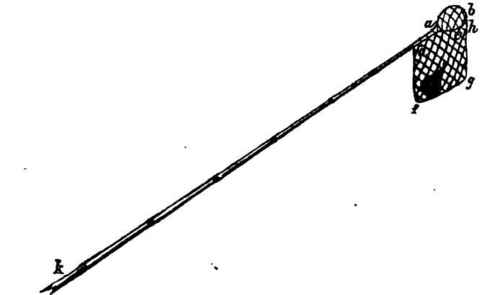
For cheapness, simplicity, and efficiency, my tackle is hard to beat Chillicothe, Nov., 1859. Geo. Washington Grubb.
Continue to:


My Books

