


Correspondence (22)
Description
This section is from "The Horticulturist, And Journal Of Rural Art And Rural Taste", by P. Barry, A. J. Downing, J. Jay Smith, Peter B. Mead, F. W. Woodward, Henry T. Williams. Also available from Amazon: Horticulturist and Journal of Rural Art and Rural Taste.
Correspondence (22)
Editor Horticulturist: - I was raised in the parlor, and when I was married, a few years since, scarcely knew a lilac from a locust-tree. However, I married a farmer, and came to the country to live, and opened some eight or ten acres for ornamental improvement; I say opened, for there was a regular cutting of corn-stalks to begin with, to say nothing of the removal of pig-sty, tan-house, ash-house, and " other things to match," that we found just in front of our small old-fashioned country house. Now, you, who are accustomed to your hundreds of acres of " improved ground," will smile at my ten acres. But in this part of the country it is the most unheard-of extravagance and folly. Soon after I had had my " yard enlarged," a very practical neighbor said, " You are very extravagant to put all the farm in the yard." I replied, that ten acres was not all of 350 in the first place, and in the second, that it was economy; for, said I, you have a small yard, and a small garden, orchard, and meadow - separate fences around all; mine are all together, and I save fencing.
This is the way I talked: and I loaned my books, and divided my flowers and shrubs with them, and now such an "enlarging of yards," and digging and planting as would astonish you! But my own ignorance was a worse enemy than the prejudice of others: however, I did the most sensible thing that could be done, I subscribed for the Horticulturist. I had no gardener, couldn't tell when I should be able to afford one, but thought I might venture to have the farm hands plant a few things, and let them be growing; and when we commence planting, it ends, I presume, when there is nothing more to plant, and no place to plant it; and so I planted on, and on, and on, hiring an Irishman to work with me, until I count my fruit and ornamental deciduous trees by hundreds, and have seventy handsome evergreens, such as Hemlock, White and Scotch Pine Norway Spruce, Balsam Fir, Arbor Vitus, &c; and all the Spiraeas I have ever heard of, as well as Lilacs, Flowering Peach, Cherry, Currant, Syringas, Rhus cotinus, Dogwood, Redbud, and every kind of flowering shrub, and shrubs with ornamental berries, not forgetting the evergreen shrubs, such as Holly, Pyracanthus, Mahonia aquifolia, Ac, and no one would ever know this to be the same place that it was four years ago.
We haven't house-room enough for a white gardener, but in the plan of our new house 1 have a room for a single man, and he can't get married until we are able to build him a gardener's cottage. So for the present my liege lord has given me one of the form hands for gardener. " I know my duty better" than to send the word slave to a northern P. 0. these times.
But I set down to ask you a few questions, if you will be kind enough to give me the answers through your valuable paper, for of course I don't expect you to devote your valuable time replying to such a preamble as this. I not only read the Horticulturist, but I study it, every day of my life I have the back Nos. bound, and when I am particularly interested in any one subject, I read every article on that subject, in all the volumes I have. But I can't find out what's the matter with my apple-trees. Some six, eight, or ten inches from the ground, and sometimes nearer, the bark has turned black, and dead, and is dropping off; and in some cases there are small round holes, as if bored with a gimlet; but all the trees that have lost their bark are not bored. Do the birds, woodpeckers, Ac, make these holes? or is it the apple-borer? or, is the condition of the bark called blight? if so, how can I save these trees? Must I let suckers.from the stock grow round them, to shade them? And hereafter, to avoid the trouble, shall I buy my trees branching within an inch or two of the ground, that the leaves may protect the trunk - from what, sun or wind? They are such beautiful young trees, just coming into bearing - and such varieties as Pryor's Red, Rhode Island Greening, Ac And then my pear-trees, some of them, Louise Bonne, Passe Colmar, Vicar of Winkfield, etc. (oughtn't that to be Wakefield? Where is Winkfield?) have a fine crop of pears every year, but they drop off when no larger than my thimble.
What shall I do?
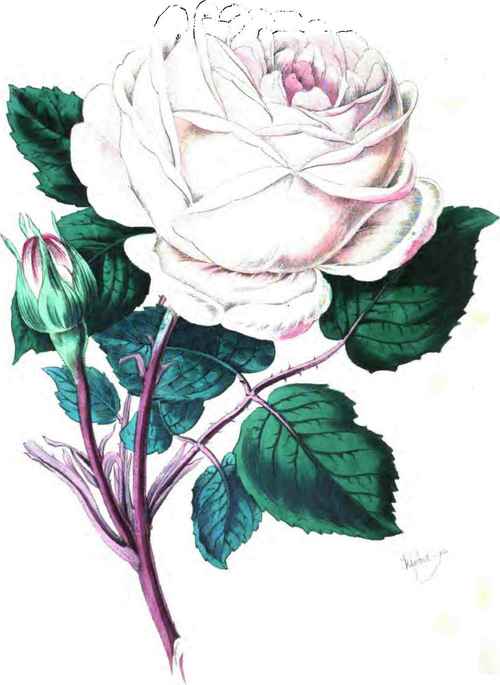
TEA CHINA.
And where can I procure a rose, Tea China, or Souvenir d'Elize? I have been trying to find it ever since I saw the plate in the Horticulturist. Is it perfectly hardy? will it stand out in Kentucky without any protection? I have an Isabella Grey. Winter before last I thatched it, and in the spring it was dead to the ground. Last winter I didn't thatch it, and it died to the roots. This winter I have thatched again slightly, after filling stable manure around the stem. Although it sends up vigorous long shoots every summer, it has never bloomed, and so I presume it blooms on the old wood, or on shoots from the old wood. What must I do with this? I have had a Beauty of Greenmount and Woodland Margaret, but have lost them both. I mean to replace them, however. Woodland Margaret bloomed once, and was certainly the most fragrant rose I ever saw. Are these two perfectly hardy? How ought we to manage them in winter in Kentucky? My bush roses won't bloom; how shall I make them? I have a large bed for bush roses, Palm Leaf, and the soil was rich and black, light and loose, with clay bottom, which I have never seen, however, and I have seen down four spades deep.
When I made the bed, I put some rich earth where there had been oat stacks for years and years, and since, every fall, I cover the bed several inches with stable manure, and in spring fork it in; do they want sand?
You won't let me write to the Horticulturist again, because I don't know when to stop. Please reply to my questions to Maggie, through the paper.
I have sent you several subscribers, only one from this post-office, however, William Hoffman, but 1 mean to send more. Respectfully, Carrie D. M.
Mount Sterling, Kentucky, 17th Jan., 1861.
[It is a lucky thing you "married a farmer a few years since,"Carrie, or we should be "dead in love with you."Now don't show this to your " liege lord," unless he has got a soul as big as your own. Why isn't Kentucky just over our river instead of the Ohio? We'd soon be over and help you out of your troubles. You went to work heroically, and have your reward. If your neighbor talks to you any more in that way, just box his ears. You were right, and reasoned like a woman of good sound sense and sound taste, and as the best evidence of this you subscribed for the Horticulturist. Then you planted and planted, and now you count your trees by hundreds. That's admirable. Would that every State, and city, and village, and farm had at least one such woman! What strange scenes of beauty would spring up all over the land! Tell your " liege lord" that we say he must provide you with a gardener's cottage this very spring; the gardener might take it into his head (they get strange things in their heads sometimes) to get married, and then what would you do? But if you have told him he can't get married, then he is bound not to do it Now, Carrie, you can send any thing you please to our P. O. these or any other times, and if there's any fighting to be done about it, we'll do it A man don't get such a woman to defend every day.
You see we are getting a little worked up. - Certainly, we'll answer all your questions, and if you hadn't " gone and got married " a few years since, we might ask one; but it's no use now. You do precisely right in studying the Horticulturist, and following a subject up, and that is what all ought to do. It is not the woodpeckers that damage your trees; it may be the blight, but we suspect that the borer is the enemy concerned in this matter. Examine the holes in all your trees, and get the borers out either by cutting them out or running in a wire; remove, also, the dead bark. Then get some common tar, and reduce it to the consistency of thin paint by adding hot water; apply this to the trees with a brush about an inch below the surface, and six or eight inches above. The tar must be used as a preventive, not a cure; where the grubs are already in the trees they must be got out with the knife or wire. By no means let the suckers grow about your trees; out them clean out. Let your branches start two or three feet from the ground; this will not only afford protection to the trunk from the cold winter's wind, but your trees will come earlier into bearing, and yield better fruit Vicar of Winkfield is correct.
You have been reading Goldsmith. The pear was discovered in France by a French curate, and was hence called Le Cure. It was introduced into England by the Rev. Mr. Rham, of Wink-field, a distinguished agriculturist, and then took its present name. Your pear trees are probably planted too deep, or you may disturb the surface root too much in working the soil; we can think of no other cause. We can have the Rose sent to you, but it will not be hardy in Kentucky. The Isabella Grey is not hardy enough for you; the only thing you can do is to bend it down in the fall, and cover it with earth. You might grow it in a large pot, plunge it in summer, and in the fall put it in a cool cellar. You must have the old wood to secure the flowers. If you replace Beauty of Greenmount, etc, you will have to bury them, as suggested above, or you will lose them again. Your " bush roses" ought to bloom in a deep, rich, well-prepared bed. Perhaps the buds get winter killed; if so, cover the bed with cedar brush during the winter. But if they are Hybrid Perpetuate, they ought to bloom in the fall, anyhow. What are they? Yes, we will let you write as often as you please; and you must do so till your roses bloom and your pears fruit.
If we can only get a full understanding of your difficulties, we know we can enable you to overcome them. Thank you for the new subscribers and the promise of more. Not one of them can refuse you. - Ed].
Continue to:


My Books

