


Correspondence (9)
Description
This section is from "The Horticulturist, And Journal Of Rural Art And Rural Taste", by P. Barry, A. J. Downing, J. Jay Smith, Peter B. Mead, F. W. Woodward, Henry T. Williams. Also available from Amazon: Horticulturist and Journal of Rural Art and Rural Taste.
Correspondence (9)
An Essay on Grades, Drainage, and Extension of the Public Grounds in the City of Washing-ion, as a system of general improvement. This luminous pamphlet has been sent to us in consequence of the remarks we made in letters from Washington, by Mr. J. Brooks, who we presume is the author. He has a keen sense of the disgraceful state of things there, and gives some information that is truly curious. It appears, for instance, that there are two systems of grades in the devoted city, which conflict at the intersection of streets and avenue, the one conducted by a city engineer, and the other by an engineer employed by the government - a wheel within a wheel, but contrary to the laws of mechanics, the inner acting independently of the outer. The city has taken upon itself to open and grade the streets under the authority of the government, but is unwilling to do anything to the avenues! And so it goes through the whole matter; nothing is done rightly, and the most important affairs are neglected entirely.
Now, the United States have spent a vast amount of money in so-called embellishments, architectural outlays giving the greatest amount of inconvenient and limited " accommodations " at the greatest possible cost, and yet the whole attempt ends in the same manner as if a private individual were to build his costly mansion in a brick-yard, and leave it full of red chips and mud holes.
Our author points out what ought to have been done, and says very justly on the subject of an arboretum: "A thorough knowledge of the vegetable kingdom, from the simplest formation of the protophita to the gigantic sequoia, should be inculcated by the institutions of the country generally, whose wide domain is so richly endowed with the most perfect living specimens. And they should be collected together and so arranged that 'he who runs may read,' and understand what be does read. This is effected by the formation of arborctums and botanic gardens. They form a laboratory where the natural elements and the arts combine to work out some of the most abstruse problems incident to the multifarious pursuits of man. Here, the science of botany asserts her prerogatives over agriculture, horticulture, arboriculture, floriculture, and many of the fine arts, while she becomes also the handmaid to all. The philosopher, the historian, the geographer, and the naturalist, come here as the peripatetics of old visited the sacred groves, to peruse the open book of nature. - the medical student to take counsel of Hygeia, the architect to study the ornate, the painter the beautiful, and the poet to realize the creations of imagination.
Here the pious feel nearer to Deity, and the vicious awed by the consciousness of His more immediate presence." He then examines the good effects of the London parks and other attractive improvements, and adds: "Let us, with these facts before us, compare the condition of our own metropolis with that of our progenitors." The comparison is very greatly to our disadvantage. Malaria stalks even into the presidential mansion; the garish marble of the public buildings is reflected in the ooze of Goose Creek, echoing back the serenade of frogs! All the talk on the subject is but party juggling -
"That palters with us in a doable sense;
That keeps the word of promise to our ear,
And breaks it to our hope".
Our author gives his own views as to the best mode of proceeding, and we are quite disposed to endorse them. Every American citizen must desire that Washington may become his metropolis - the coronal of our own native land, and among nations the brightest gem of empire. With the proper improvements they would become the medium through their refining influence of enlarging the field of productive labor, as nurseries of the arts and sciences necessary to a thorough knowledge of agriculture, horticulture, arboriculture, floriculture; in fine, of botany, with its numerous correlatives, the acquisition of which would add more to the national wealth, to the quiet, home fireside enjoyments of city and country throughout this broad land, than all other learned professions put together, with politics superadded.
We are much indebted to Mr. Brooks for this interesting pamphlet.
Correspondence #1
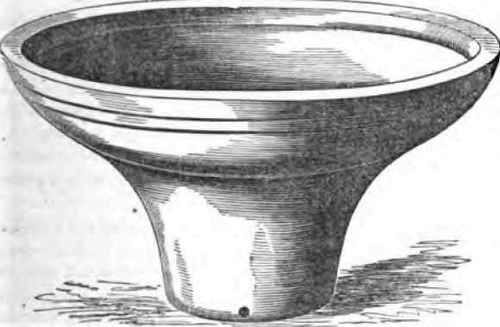
Mr. Editor: - I found, some time since, a description of a verbena pot, and have had one made which I find extremely useful. It has a drain hole, and sufficient depth for the roots, while the surface being large, a mass of bloom may be secured, and combinations, variety of colors, or single colors may be introduced, as taste may indicate.
Bury the pot in the earth, leaving a few small stones around the opening to secure sufficient drainage.
It was invented I think for seedlings, but I use it entirely as a pot for the lawn, etc, etc, and to bring into my plant cabinet in winter. Yours, etc, W. W. T.
Continue to:


My Books

