


Cutting Dawn A Palm-Tree
Description
This section is from "The Horticulturist, And Journal Of Rural Art And Rural Taste", by P. Barry, A. J. Downing, J. Jay Smith, Peter B. Mead, F. W. Woodward, Henry T. Williams. Also available from Amazon: Horticulturist and Journal of Rural Art and Rural Taste.
Cutting Dawn A Palm-Tree
One morning, our party obtained permission from the owner of a coffee plantation to cut down a Royal Palm, in order to get the much esteemed cabbage. Taking a workman, we found a moderate-sized tree, which soon yielded to the strokes of the axe; the wood is coarse-grained, and presents, in the centre, a pithy appearance. It was somewhat of a hazardous re-quest, for this Palm is held to be almost sacred from such desecration, meeting, as it does, so many of the wants of man; the head is sometimes wantonly cut off by marauders, to procure the cabbage, and the tree inevitably dies in consequence. When the tree fell, the stem was divided at the well defined point of junction of the green and light lead-colored bark; the green or top portion was about eight feet in length when the plume was removed. Our axe-man shouldered this, and took it to the house, and we enjoyed the pleasure of unrolling the sheath, which extends from the bottom of the lowest branch, and enfolds the green stalk. Each branch or leaf has a sheath extending downwards, and enfolding the cabbage in the most extraordinarily white successive layers, each of which represents a footstalk and leaf. Unwinding these (if the expression may be allowed), we come at last to the colorless younger embryo leaves constituting the cabbage.
These are sufficiently soft and delicate to be eaten raw, tasting something like an uncooked cauliflower, but more delicate. The leaves, as they expand, are strongly attached to the sheath, and fall in succession, about monthly, one at a time, and cover the ground, being from ten to twenty feet in length; the leaf at the outer end is formed like the feathers on a quill, and the broad stem, which we have called a sheath, having acquired the strength and consistence almost of a board, and as a substitute for a board, it is used for thatching, for making inclosures, and the thinner portion as we see it around seroons of tobacco. There are fifteen or twenty forming the lovely, tuft-like plume - the younger leaves at top. The dropped lower leaf leaves a ring around the stem, which soon assumes the lead color of the bark, the ring remaining distinctly visible, and marking the successive falls. A broom-like seed-vessel shoots out, of a pale yellow, from the top of the lead-colored trunk and base of the green sheaths above it; as this blossom falls, a green berry is formed, and this gradually becomes the small brown drupe forming the principal food of swine. Another and another bunch is produced, and we have blossoms and ripe fruit in perpetual succession, each tree with bushels on it.
Here is the food, boards, fuel, and thatching. Palms, taking the whole family, yield, in addition, fibre of great variety, oil, wax, starch, sugar, daily food, a mild and an intoxicating drink, or, as the poet has it -"The Indian-nut alone ls clothing, meat and trencher, drink and pan, Boat, cable, sail, and needle, all in one".
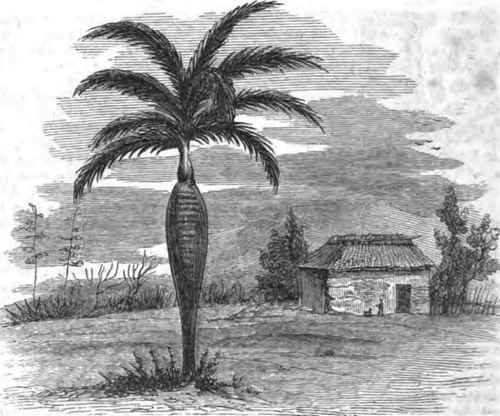
Palm, with swelled trunk, common near Trinidad de Cuba. Height, 25 to 40 feet.
The Palms belong to the Endogens, the woody matter being constantly developed, in the first instance, towards the interior of the trunk. That Palm-trees grow in this way, was known so long since as the time of Theophrastus, who distinctly speaks of the differences between endogenous and exogenous wood. The longevity of Palms is inconsiderable when compared with that of exogenous trees. Two or three hundred years are estimated to form the extreme extent of life in a Date-Palm, and in many others.
We had the "cabbage" dressed for dinner aa we dress a cabbage at home, with vinegar, in which state it was much relished. A portion of the large mass was boiled, bat so badly cooked, in our estimation, and mixed with such desperately bad butter or oil, that a little was enough. The whole of the cutting down, the unrolling process, and examination of the delicate white folds, offered an example of vegetable structure on a large scale, of very great interest, and we are very sure that none of the American party will ever forget or regret the morning thus employed.
At Mr. Monson's (the old coffee plantation), we had fine opportunities of observing the novel insects, which are abundant in all tropical countries. A kind of wood lice, called comehen, build enormous deformities, of the consistence of a wasp or hornet's nest, on the stems of trees as well as their branches; the paperlike layers are extremely thin, and easily attacked by birds, which feed upon them with avidity. The nests are so large as frequently to contain a bushel of insects; these the natives carry off, to feed and fatten their chickens. The beautiful cuccu-lios, or great fire-flies, had not arrived when we left, so that we missed this famous sight. Spiders, lizards, centipedes, and tree-frogs, are abundant; the little lizards are quite pretty, and seem to have no fear of man, whom they look at with their beautiful and cunning eye, and allow him to scratch their heads. Birds, except a parrot-billed blackbird, were not numerous at this early season, though flocks of partridges occasionally flew up with their well known whir.
The wild dove was plentiful in market, and a favorite food.
About this region, but more especially on the southern side of the island, one of the great annoyances to the botanist is a vine not inaptly called the wait-a-bit. It pervades every uncultivated woods, where it makes a pedestrian progress very difficult. A short hooked spine at every bud and every joint of the tough branches, and even of the leaves, not very unlike a fish-hook or a short hooked thorn bent backwards, and very sharp, tears one's clothing, and is really a formidable enemy. The compensation for all this, is the quantity of gorgeous flowers at every step; among these is the vanilla vine, with a bright green stem, the flowers white, of a lily shape, and waxy appearance. Sometimes, in such rambles, you come to orchideous plants large enough to fill two wheelbarrows.
Continue to:


My Books

