


De Tongres Pear
Description
This section is from "The Horticulturist, And Journal Of Rural Art And Rural Taste", by P. Barry, A. J. Downing, J. Jay Smith, Peter B. Mead, F. W. Woodward, Henry T. Williams. Also available from Amazon: Horticulturist and Journal of Rural Art and Rural Taste.
De Tongres Pear
This fine fruit originated in or about the very old city of Tongres, in Belgium, and was first described in the Album de Pomologie, Vol. 3, 1849-50.
Fruit large, pyriform, or obovate-elongated, depressed or curved towards the stem. Color dull green, with large russety waves or spots, turning to a gold or brown yellow towards maturity; with a dull red cheek, and an uneven and rough appearance. Flesh white, melting, with sufficient sugar and aroma and a vinous sub-acid taste; best. It is one of the few foreign pears which have retained their original qualities in this country. Reports from Kentucky state it to be as "ranking among our best." At Charles Downing, Esq.'s, where it fruited in 1858, it proved to be a very fine fruit also. So that there can be little doubt as to its adaptation to at least our Middle States.
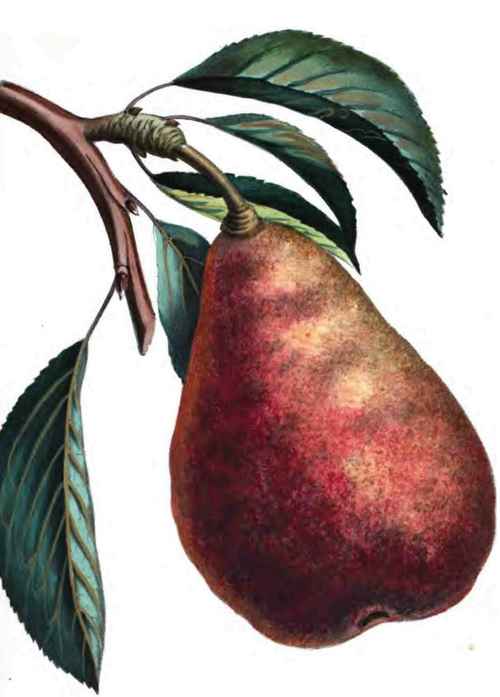
De Tongres Pear.
Lith. by Goo Hayward..l80 Water St.N.Y.
Tree vigorous enough, of a pyramidal form; bark brown-reddish; buds conical, prominent, sharp, with a stripe extending from the base of one bud to the next lower bud.
It has been already sent under false names; the Vicomtc de Spaelberg was received for it, and is somewhat extensively diffused in the place of the genuine variety; but the longitudinal, prominent stripe extending from one bud to the other, is a peculiar character by which this variety can easily be distinguished from spurious varieties. The fruit ripens in Belgium about the middle of October, but here it is about three weeks earlier, and more than a month earlier farther South.
L. E. Berckmans.
Continue to:


My Books

