


Description Of Ornamental Crabs And Apples
Description
This section is from "The Horticulturist, And Journal Of Rural Art And Rural Taste", by P. Barry, A. J. Downing, J. Jay Smith, Peter B. Mead, F. W. Woodward, Henry T. Williams. Also available from Amazon: Horticulturist and Journal of Rural Art and Rural Taste.
Description Of Ornamental Crabs And Apples
Mr. Downing - I take the liberty to forward you the following descriptions of our collections of apples for ornament. I beg you to give a place in your Journal to them, if you think them acceptable. I am Tory respectfully,
B. Desportes.
Among the numerous collections of ornamental trees and shrubs of any sort, that Mr. Andre Le-roy cultivates in his large nurseries, there is a genus that we have not met with any where else so complete. It is this of the ornamental apples, including the series of Baccata, [Siberian Crabs.] All the following kinds are not eatable, except the Siberian Crabs, which are very suitable to make good preserves, but we use them more generally in the ornamental plantations of the parks and pleasure grounds. They are so productive that the fruits touch each other on the branches; their brilliant color makes them of the most ornamental objects. The fruit hangs upon the tree a very long time, and does not fall till after the frosts in November. We use the fruits very agreeably to decorate a desert table.
No. 1. The Purple Siberian Crab
Baccata fructa purpurea or rosea. Fruit, about one inch high, and one and a half broad, oblate towards the two extremities, roundish on the other side; stem, two-thirds of an inch long, slight slender, curvate, inserted within a profound cavity; color, beautiful reddish purple on the sunny side, covered with fine white flower like that of the plums, the shaded side is less brilliant, and all the surface is speckled with same gray dots; flesh, is like all the crabs, coarse and acerb.
No. 2. Large Siberian Crab
Baccata macro-carpa. Fruit, about one inch long and a little more in diameter, compressed towards the eye, roundish towards the stem; this is one and a half inches long, slender, almost right, covered with asperities towards the upper part. It is inserted within a narrow and deep cavity; eye small, closed outside of the surface, inserted upon some small wrinkles reunited together; color, rose violet on the sunny side, covered with a white bloom, and green on the shaded side.
No. 3. Striped Siberian Crab
Baccata fructa striata. Fruit, one-third of an inch high and one and a half inch in diameter; form, roundish oblate towards the eye, round towards the stalk; this is half an inch long, large at the upper end, obliquely inserted in a profound cavity; eye, small, closed; segments of the calyx united in a bundle; color, rose yellowish, red striped every where, car* mine on the sunny side, more yellow towards the stem; covered with a fine white bloom. This is an extremely ornamental tree.
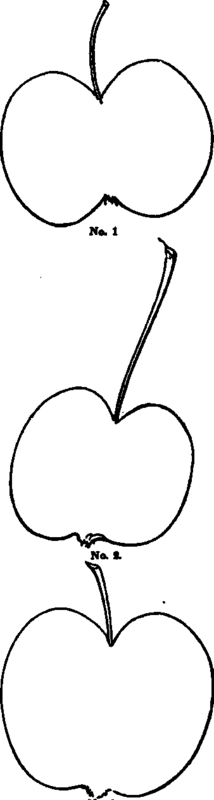
Ornamental Crabs And Apples
No. 4. Rouen Transparent Siberian Crab
Bacca~ ta transparent de Rouen. Fruit, about one inch high and one-third of an inch in diameter; form, oblate, compressed towards the eye, round towards the stalk, irregular; stem, slender, sometimes very long, ordinarily one and a half inches, curved obliquely, inserted in a deep but very wideca-vity; calyx, small, inserted at the surface, between several small wrinkles; color, red carmine everywhere, except in the place wholly covered by shade, then the color is yellowish, covered upon all the surface with a while fine bloom, which makes it very beautiful and transparent. No. S. Oblong Siberian Crab - Baecatafmc-lootongu. Fruit, one and a half inches high, and little more than an inch in diameter; form, oblong ovoid, irregular; a lip surmounts the insertion a side of the stem, and another the eye; the talk is long, slender, curved, larger at the upper art; calyx, small and almost wholly covered by be lip, and crowded by small wrinkles; color, red rimson everywhere, speckled with small gray ots; the time of ripening is earlier than for the ther kind; this time arrives generally about the nd of September. The figure shows two sped-imens of different size, of the same kind.
No. 6. The Double White Siberian Crab
"lure plena alba. Fruit, three-fourths of an inch high, and ne and a quarter inches in diameter; form, compressed, ound, irregular, more swollen on one side than the other; talk, one-third of an inch long, larger at the upper extremity, obliquely inserted at the surface; eye, large,even with he surface, closed; color, red carmine on the sunny side, een on the shaded side, covered with white bloom.
This kind is worthy of notice, not only by the fruits but y the flowers, which are large, double white rosy. It is a rilliant and very ornamental crab.
No. 7. The Fragrant Flowered Siberian Crab
Odorata. Fruit, small, about three-fourths of an inch high and one inch broad; form, compressed at the two extremities, rounder towards the stem than the eye; stalk, half an inch long, slender, right, inserted in a shallow cavity, hut very open; eye, small, set in a cavity formed with small wrinkles; color, green everywhere, speckled with gray whitish dots. The flower is very fragrant; the odor is the same as that of the violet.
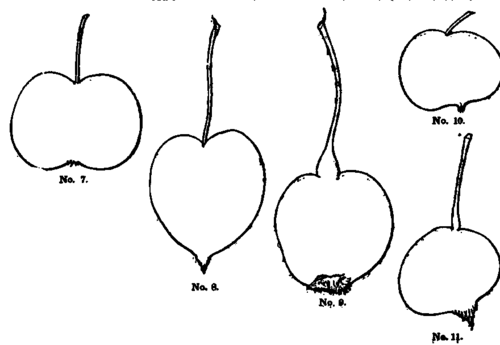
No. 8. Cherry Apple
Fruit, one inch high, three-fourths of an inch in diameter; form, ovoid, cordifprm towards the stem, conic towards the eye; this is terminated by a small stalk, long, slender, curved; eye, large, projecting out of the surface, formed with a bundle of small wrinkles, crowded by segments of calyx; color, yellowish lemon uniformly, nevertheless a little spotted with red on the sunny side.
No. 9. The Showy Crab
Spectabilis. Fruit, about three-fourths of an inch high, and three-fourths of an inch in diameter; form, very irregular, almost square; stalk, three and a half inches long, larger at the upper part, large, fleshy at the base, inserted at the surface and crowded by wrinkles; eye or calyx, very broad, large profound segments, numerous and but the surface; the cavity is formed by small wrinkles, irregular; yellow color, slightly spotted with rose on the sunny side, speckled with white dots upon the surface.
NO. 10. Astbacan, Or Evergreen Apple Crab - Fruit, two-thirds of an inch high, and three-fourths of an inch broad; form, oblate, compressed, irregular; stalk, short, one-third of an inch long, obliquely inserted in a shallow cavity, crowded on one side by a lip; eye, broad, formed by several small wrinkles out the surface; segments, long; color, deep green, speckled with white dots. The leaves are evergreen, and remains on the tree during the winter.
No. 11. The Double Flowering Grab
Fruit, two-thirds of an inch high, and three-fourths of an inch in diameter; form, roundish, but very irregular; stalk, one inch long, larger at the two extremities; eye, very large, out the surface, formed with five small wrinkles united together, and terminated in a bundle by the segments of the calyx; color, rose violaceous on the sunny aide, ashy green on the shaded side, covered with a white ornament flour on the rose color. It is very ornamental by its double white flowers in the spring.
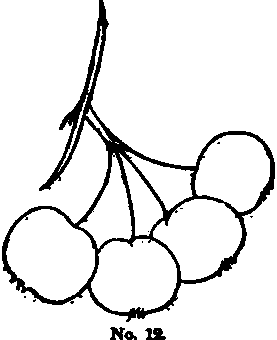
No. 12. The Currant Crab
Pomme groseille. The fruits of this kind of apple are of the size of the currants, and are borne like them, in clusters. They are round, a little compressed towards the two ends; the stem is about half an inch long; the eye is large; red colored, slightly striped with deep red; it is ornamental in its flowers as well as its fruits.
I can add to the above list some other kinds, which are not less ornamental as trees of decoration in the pleasure-ground, and as desert fruits; nevertheless, they take place generally among the citable fruits'.
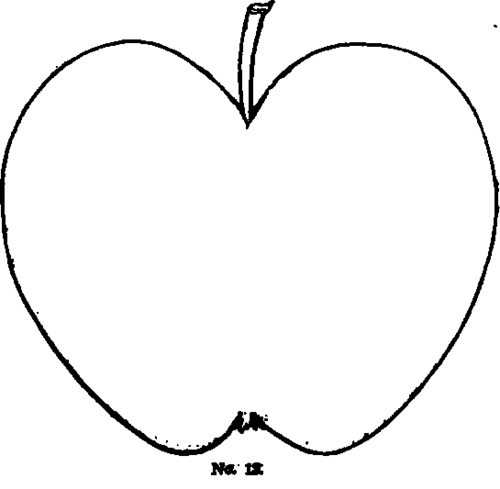
No. 13. Transparent De Zurich Apple
Fruit of two inches high, and two and a half inches in diameter; form, obovate, larger towards the stem, and narrower towards the eye; stalk, slender, half an inch long, curved, inserted in a profound cavity; eye, compressed, closed, set in a wrinkled cavity; color, white, like the Wax, of which this apple has the appearance, and the brilliant coloring, without the smallest spot; skin, very fine; flesh, white, like the snow, and not different from the skin; dry, acidulous; it is only of third rate, but I do not know another, a more pretty or more Ornamental desert apple. It ripens in September and October.
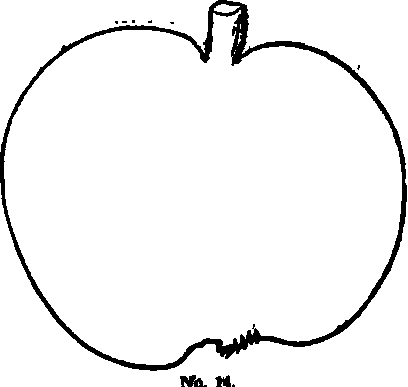
No. 14. Black Lady. Apple
Fruit, one and one-third inches high, and one and three-fourth inches in diameter; form, roundish, irregular; stalk, short, inserted in a shallow cavity; eye, small, closed, set in a profound cavity; color, deep black everywhere, speckled with some gray dots towards the stem; flesh, tender, breaking, acidulous, first rate; ripens from November to March. It is very curious, and very suitable as a desert fruit.
1 am very respectfully,
B. Desportes.
Angers, Frazed, September 21, 1851.
Continue to:


My Books

