


Description
Description
This section is from "The Horticulturist, And Journal Of Rural Art And Rural Taste", by P. Barry, A. J. Downing, J. Jay Smith, Peter B. Mead, F. W. Woodward, Henry T. Williams. Also available from Amazon: Horticulturist and Journal of Rural Art and Rural Taste.
Description
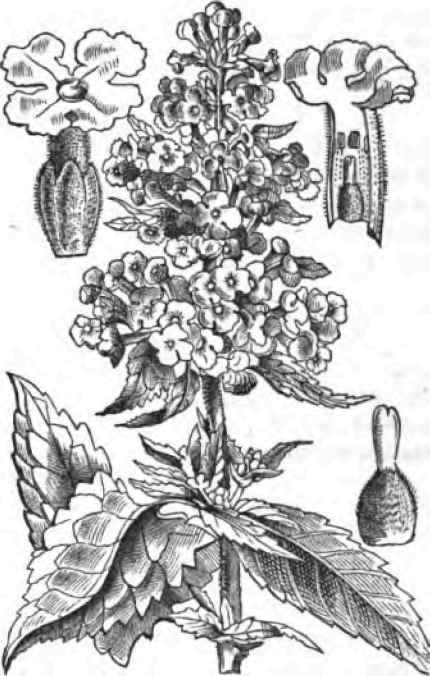
A shrub, twelve or fourteen feet high. Branches opposite, obtusely tetragonal, the younger ones densely covered with tawny or ferruginous down. Leaves on wooly petioles, ovate or oblong, the lower ones cordate at the base, upper ones cuneate, thick, tomentose, densely so beneath; the margins toothed and crisped, rarely entire, except in the upper leaves. Flowers arranged in capitula, or in dense whorls, constituting spikes or racemes, and forming panicles. Corolla, salver-shaped, lilac, with a white eye. Stamens four, inserted below the middle, and quite included; filaments short, anthers short, oblong. Pistil quite included. Ovary ovate, downy, except at the very base. Style very short; stigma clubbed, bifid.
Description #1
Fruit large, ovate, pretty regular and uniform in size, (not cockscomb shaped;) surface of berry not highly polished; seeds only slightly imbedded; color, rich red; flesh, solid, with a high vinous flavor; quality, first rate in all respects. Fruit stalk tall, strong, unusually hairy; calyx quite hairy. Leaves borne upright, on long, rather slender stalks. Hardy, and bears abundantly. Ripens at middle season.
Description #2
Size, medium. Color, red, obscurely striped. Flesh, yellowish, a little coarse, juicy, mild, subacid, sprightly. Quality, " very good".
The following persons contributed specimens of fruit for the examination of the Society:
A. C. Hubbard, Detroit: Jeremiah Stanard, Ionia; Samuel Johnson, Kalamazoo; J. T. Wilson, Jackson; D. McKee, Kalamazoo; Joshua Clemens, Leoni; Geo. W. Taylor, Kalamazoo;
B. Hathaway, Little Prairie Ronde; E. Merrill, Kalamazoo; T. T. Lyon, Plymouth; George D. Rice, Kalamazoo; S. S. Cobb, Kalamazoo: A. Buell, Kalamazoo.
The thanks of the Society were tendered to the corporation and citizens of Kalamazoo, for the free use of the rooms, tables, fuel, lights, etc, during their sessions. Adjourned.
Hezekiah G. Wells, President. T. T. Lyon, Secretary.
Description #3
Tree, a vigorous grower. Young shoots, a dark brown, with a slight reddish tinge, and partly covered with a slight fuzz. Fruit, medium size, conical, and frequently a little one-sided. Skin, a waxy yellow, resembling the Porter, with a red cheek when exposed to the sun. Stalk, medium in length and size, inserted in a rather deep cavity. Calyx, open, set in a shallow basin. Flesh, yellow, tender, rather juicy, rich and sugary, with a slight spicy flavor - superior for the dessert, and unsurpassed for baking. A good bearer, with a tendency to overbear every other year. Quality, best. Season from November to February. The fruit is called here the Holmes's Sweet.
Description #4
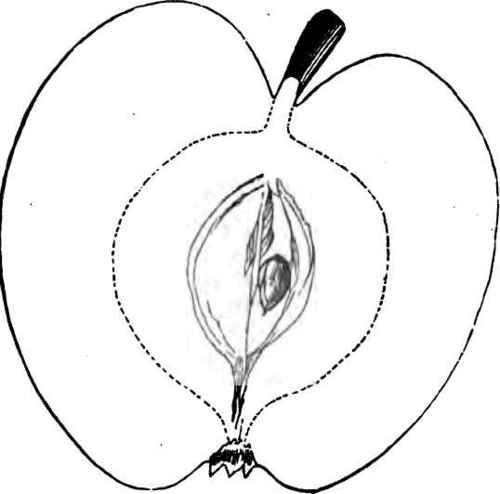
Fruit, medium, roundish oblate; skin, quite rough; color, reddish russet yellow, with large light colored specks; stalk, long and stout; cavity, open, deep; calyx, only marked; basin, open, broad, deep; flesh, coarse, gritty, with consistence much like a quince and somewhat of its aroma; core, with an open center. October to February.
Description #5
Fruit, medium size, globular, generally smooth and regular; but some specimens are broadly corrugated. Skin, smooth, glossy, almost oily, like Belmont. Color, clear light yellow, with brownish red blush when fully exposed to sun - small gray dots in some of the specimens; these dots seem to present an appearance in part as of decay. Stem, very slender; cavity narrow, smooth, moderately deep. Calyx, closed, with long-pointed divided segments; basin moderately deep, abrupt, slightly furrowed. Flesh, white, crisp, very tender, fine grained, mild, pleasant, rich, subacid - "best." Core, medium, slightly hollow in center. Seeds, broad, very dark brown. Season, late fall and early winter. This is an extremely delicate amateur apple, too tender for market shipping. Of great promise for private use.
Continue to:


My Books

