


The Curculio (5). Continued
Description
This section is from "The Horticulturist, And Journal Of Rural Art And Rural Taste", by P. Barry, A. J. Downing, J. Jay Smith, Peter B. Mead, F. W. Woodward, Henry T. Williams. Also available from Amazon: Horticulturist and Journal of Rural Art and Rural Taste.
The Curculio (5). Continued
"Hoping that you will continue your interesting and important observations, I am Yours, sincerely, "William A. Hammond".
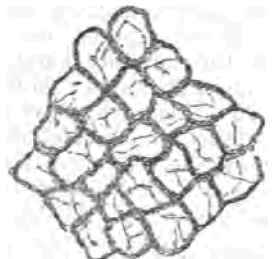
Fig.1.
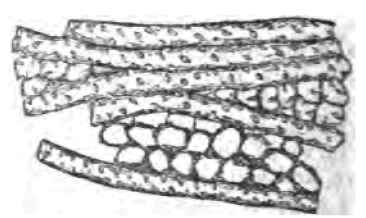
Flg.2
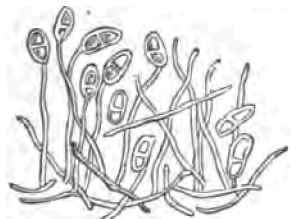
Fig. 8.
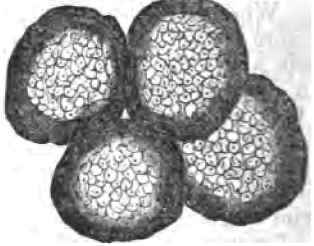
Fig. 4.
Several other* insects form their nests in the tumors of the cherry and plum-trees after they are filled with sap, some of which are mentioned in Harris's treatise on insects: - these I propose to figure and describe in a future number.
Dear Sir: - In the previous notes, I promised a sequel to the history of the plum and cherry-tree knots, and the insects which feed in them, which I now have great satisfaction in furnishing, believing that the different species of insects observed by entomologists, and described at various times in the last thirty years, have all passed, under my notice this year, and developed, from both cherry and plum tumors, under my bell-glass.
In Dr. Harris's Treatise on Insects, I find the statements of observers so conflicting, that I shall pass all by, and give only the history of my bell-glass and its inhabitants, with the dates as I find them in my note-book.
In the first week of April, I noticed the swellings on the branches of both plum and cherry-trees, but, on examination, could detect no signs of insert life, or any of the fungus which some writers have thought the cause of the swelling, but which Dr. Hammond has so conclusively proved to be an aftergrowth on the tumor, not the cause of it. It is probable that the eggs of the curculio were there hatched, and the young grubs too small to be detected without a microscope.
On the 28th of June the swellings had grown to their full size, and filled with sap; in one tumor I found five larvae of the curculio (Rhynchoenus nenuphar), three-tenths of an inch long.
I then placed a number of branches with their knots under a bell-glass, resting on a board covered with garden earth, and secured around the edges to prevent entrance or escape. On the 10th of July, many of the larvae of the Rhynchoenus left the knots and entered the earth; on the 29th of July they had become pupae, and on the 2d of August twelve perfect beetles rose from the earth, and returned to the branches on which they had fed while in the grub state. On raising the bell-glass, I found, 1st, That four larvae of the coddling-moth (Carpocapea pomondla) had fed in the tumors, and were then in the winged form, and resting on the branches; this is a small brown moth of the Tortrix family, which may be seen in June and July, hovering over the young fruit, seeking a place where the eggs may be placed to the best advantage; the securest retreat is found in the middle of the blossom end, where the skin is thinnest; there is no puncture made, but one or two eggs are deposited on the outside of each apple.
When the grubs are hatched, they immediately enter, and penetrate to the core; when the time of their change approaches they creep out of the fruit, and seek a retreat under the loose bark of the tree, where they remain during their change, unless found by the crab-like spider whose home they have invaded, or the prying beak of the wren or nut-hatch.
The head and thorax of the codling-moth is brown, mingled with grey; the four wings expand three-quarters of an inch, having the appearance of brown watered silk, crossed by numerous grey and brown lines; near the posterior angle is a dark brown oval spot, edged with bright copper color; the hind wings and abdomen are light yellowish brown, with the lustre of satin. 2d. The male Aegeria exitosa, the common peach borer. 3d. Three flies whose wings expand half an inch; these are undescribed. 4th. Three distinct species of ichneumon, one of them the celebrated Ceraphron destructor of Say, the enemy of the Hessian fly (Cecidomyia destructor). And, 4th, a swarm of minute dipterous flies, the perfect insects of numerous maggots that had fed exclusively on the castings of the JRhyncJiamus, Aegeria, and coddling-moth (Carpocapaa pomonella).
On a further examination of the trees, on the 23d of August, I found new swellings on the young branches, and, on opening some of them, I found the half-grown larvae of the plum curculio (R, nenuphar), feeding, as their parents had done in June: and in the same tumor were two larvae of the codling-moth.
On many of the newly-grown branches were unmistakable marks of the plum curculio, where it had wounded the bark before depositing its egg, and on one branch there were seven punctures in a row, with an interval of about a quarter of an inch between each puncture, thus leaving no doubt that they were the cause of the swelling, while the other insects had taken advantage of the banquet provided for them in the juicy tumor which the Rhynchaenus had caused.
Continue to:


My Books

