


The Downing Monument
Description
This section is from "The Horticulturist, And Journal Of Rural Art And Rural Taste", by P. Barry, A. J. Downing, J. Jay Smith, Peter B. Mead, F. W. Woodward, Henry T. Williams. Also available from Amazon: Horticulturist and Journal of Rural Art and Rural Taste.
The Downing Monument
We have been informed that the fund now collected for this monument amounts to about one thousand dollars. The design is a vase of pure white marble, on a pedestal of five feet in height, the whole to be nine feet The vase is to be elaborately carved, and the pedestal to bear a suitable inscription. It is contemplated, we believe, to place it in some of the public grounds at Washington. If the New Yorkers had succeeded in their great central park project, that would have been the place for it, we think. We would rather place it on the Boston Common than on any of the public grounds at Washington, in their present state. They might do for the monument of a soldier, but not for that of a man of such tastes as Dowking's.
The Downing Monument #1
It will be vividly remembered by the readers of this periodical, how sincerely horticulturists mourned the death of Downing. We all felt as if a friend and brother had left us; even those who had not entirely appreciated the bright, particular star that rose on the heretofore barren heath of our garden literature, soon felt that a luminous planet had set; its light, however, still shines, and, while gardening is an elegant pursuit among us, which it will always be, all thinking and reading men will refer to Downing as the pioneer mind of America.
Much has been said regarding him, and much that is true continues to be said, but there is one point that is left us to say, in introducing to the pages of his own journal the engraving of the monument, which testifies the affection of the many who contributed to itserec-tion: Downing taught us how to live. When he commenced his career of authorship, the fine old domestic country establishments which the American Revolution had seen, had mostly fallen into decay with the decadence of their owners; the large properties on which so many wealthy planters and farmers had lived in hospitable munificence and European grandeur, had been divided by the abrogation of the law of entail, and other causes. From the commencement of this century, one example after another of the old style of living, which we may characterize as "the four in hand," the style of the "Republican court," paled before the paternal divisions of land, particularly at the North. The democratic feeling took possession of the country, happily for its permanent prosperity. Country style faded away; people looked around them, in their country houses, on mere farms; to produce the necessaries of life, was the countryman's ambition.
To embellish his home, and make it a desirable residence for his family and his successors, seemed to be no part of his duty or pleasure. To say, " a farmer," was equivalent to expressing awkwardness of manners, roughness of speech and dress, and almost ignorance. The citizen went to the country to board in the farmer's family, in summer, or to dance at Ballston or Saratoga; between the two classes there was no fellow feeling, and, with a few stately exceptions in the several divisions of our country, there was, properly speaking, no elegant rural life. Downing now began to impress people with an idea that there were higher enjoyments to be found in the country than raising corn and poultry, which could be added to the attractions of rural life. A taste for horticulture was soon implanted in the rural population; their houses were made comfortable and elegant; glass structures brought fruit and flowers; the study of scenery, and the proper arrangement of the grounds, followed as a matter of course. In his books, and every month in his periodical, our rural Socrates gave us new inducements and instructions regarding worthy objects to expend our money, time, and taste, upon.
Before his untimely end, ladies and gentlemen had ceased to talk exclusively of "teste and the musical glasses," and had found in trees, rocks, waterfalls, gardens, and scenery, something else to admire than curtains and Parisian furniture. It was truly surprising to discover that the same income that must be spent on a lot of twenty-five feet by an hundred in the city, would, in a rural neighborhood, with knowledge of country things, enable the expender to have a lawn and pleasure-ground, a horse, a cow, a plentiful vegetable and fruit garden, and, perhaps, a greenhouse or grapery, with their never-ending pleasures.
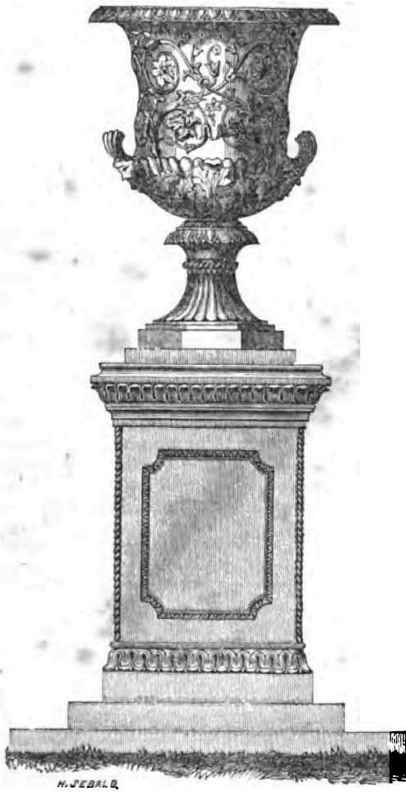
The "revolution" was rapid in its progress; villas grew up in every section; cities were voted a bore by a large class; we can now visit country residents who do not sit down to dinner without a coat on their backs, and we find books and pictures, billiards, and rare flower-beds, where but yesterday were weeds and stable-yards - in the country.
That that revolution came in our time, we mainly owe to the individual to whom we have just erected a suitable memento, the tribute of our just appreciation to his merits, genius, and originality. There it stands, in the grounds he was so actively employed in embellishing, in Washington, at the time of his decease - a shrine, where the lover of his country may make a pilgrimage, and shed a tear for all future time - an evidence that he was appreciated-by his contemporaries, a monument less ambitious than our attempt to commemorate the fame of Washington, but, in its own line, pointing to the works of a most useful individual. Long may it stand a memento of a country's gratitude to its able teacher; long may the moistened eyes which read the following inscriptions, read the lessons he instilled; and, so long as it is visited in the proper spirit, so long as his lessons are remembered, so long shall our country be far removed from that semi-barbarism which threatened the inland dweller when Downing's spirit roused itself, and threw off the apathy to the love of the beautiful, which was fast overtaking us.
The monument was designed by Calvert Vaux, Esq., Architect, and Downing's partner at the time of his death, and is given above, with the,inscriptions as kindly furnished by himself.
Continue to:


My Books

