


A Few Hints On Pinching
Description
This section is from "The Horticulturist, And Journal Of Rural Art And Rural Taste", by P. Barry, A. J. Downing, J. Jay Smith, Peter B. Mead, F. W. Woodward, Henry T. Williams. Also available from Amazon: Horticulturist and Journal of Rural Art and Rural Taste.
A Few Hints On Pinching
"Train up a child in the way he should go" is a venerable maxim, and One that all good parents endeavor to carry into practice. Trees, like children, require training in their youth; the wise and skillful cultivator should aim at giving every shoot and branch the right direction while young and pliable, and nip every defect or deformity in the bud. The practice of too many who plant and cultivate trees, is either to prune them once a year, say in winter or spring, or else leave them entirely to nature; the consequence is that unless in rare cases where nature has endowed a tree with remark-able qualities as to regularity of growth, they grow up without that balance and symmetry which is always pleasing to the eye and necessary to their vigor, longevity, and productiveness. It should be well understood by every man who plants a tree, that from the moment it begins to unfold its leaves and develop new shoots, it requires constant care. This is especially the case with garden trees, which ought always to be beautiful as well as useful.
We do not mean that a man should continually busy himself among a few trees, or waste his time in frivolous operations, as though they were a hobby-horse which he had nothing to do but ride; we can countenance nothing of this sort, but we insist upon constant discriminating care, a look over the trees once or twice a week, in order that every defect of growth, attack of insects, accidents, or diseases, may be timely discovered and the proper remedy applied. There is economy in this, if people but knew it, and all experienced cultivators do know it.
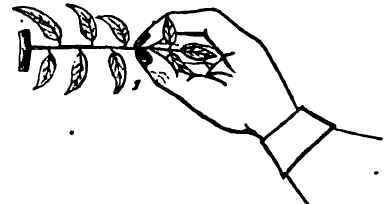
The chief remedy for defects of growth during the growing season is the operation termed pinching - nipping with the finger and thumb (fig. 1) the soft young shoots.
The practical part of this operation is plain enough, but the particular time at which it ought to be performed requires both judgment and experience, in order that it may accomplish the end aimed at. Pinching is applied to all trees and plants to improve or modify their forms. The plant grower who aims at producing strong, bushy, well formed plants, arrests the tendency to grow tall and lean by commencing with his young plant when only a few inches high; and he follows up this pinching or stopping at regular intervals in the plant's growth, unti secured such a profusion and regularity of lateral branches as to make his plant a wonder. Such plants are the most striking examples of the influence of the pinching process that we can find in the whole range of horticulture. But this plant grower applies the finger and thumb in season - he does not wait till his plant has grown tali and misshapen, and then go to work to reform it. As soon as he sees well formed buds in the axils of the leaves, he knows that by stopping the terminal growth these buds will be forced into growth, and produce lateral shoots.
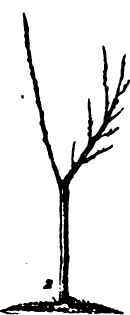
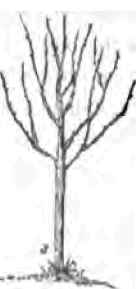
In the management of trees we find it very common for one or more branches to start with an undue share of vigor, and weaken all other parts of the tree by drawing and appropriating all the nutriment to themselves. A slight bruise or a bend, perhaps, will lead to the development of one of these branches at a point where no branch is required. Fig. 2 represents an instance of this kind. The tree became slightly bent, and this arrested the continuous flow of sap toward the summit; the consequence was the development of a very strong shoot, what the French designate very properly as a "gourmand." It controlled the whole tree, and left it at the end of the season in the misshapen condition represented in the cut. Now the careful cultivator would have observed the first symptoms of these results; that strong shoot pushing out with such undue vigor would at once have attracted his attention, and be would have placed his tree in an upright position, to aid the regular ascent and free circulation of the sap, and have checked this misshaped shoot, and thus secured an equal distribution of growth that would have left him at the end of the season with a tree something like fig. 3.
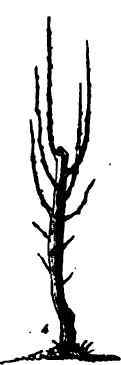
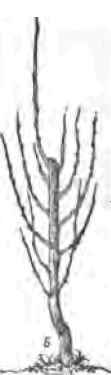
In the management of trees trained as dwarfs, pyramids, or espaliers, pinching is an indispensable operation. In almost all trees there is a natural tendency to grow most vigorously towards the top and at the extremeties of the branches, and this requires to be kept in continual check during the growing season; for if one portion of a tree be permitted but for a short time to grow more vigorously than the others, the balance is destroyed and much time and severe measures are required to restore it In the case of young trees that have been cut back for the purpose of producing the pyramid form, it often happens that three or four buds at the summit push so vigorously as to draw all the sap by those below them, and a tree somewhat like fig. 4 is produced. Now if the upper shoots next the leader had been checked by pinching, the lower branches would have been favored, and we would have got a tree like fig. 5.
In this way, under a great variety of circumstances, pinching is applied to counteract the defects of pruning and of growth. At this time the young shoots of trees are pushing vigorously, and when they have attained say two inches in length, a selection may be made of such as ought to be preserved, and all others that have a vigorous appearance may be checked at once. All superfluous shoots, however, do not need pinching; there are a large number that never attain any considerable dimensions, and may be left entire. These are easily distinguished by the slenderness and smallness of their base. It would be improper to pinch these, as they do not affect the growth of leading shoots, and aid in maintaining the growth and strength of the parts where they are situated; besides, they generally assume the character of fruit branches in a year or two, and may be turned to good account.
It should be remembered that pinching has always a greater influence when applied early. If we wait until we see plump, well formed buds on the shoots, the pinching will have comparatively little effect, as the bud nearest the pinched end will immediately push, and the prolongation of the shoot will be but little retarded. But if pinched before the buds are formed perfectly, it takes them some time to effect their growth, and by this time the flow of sap has been, in a great measure, diverted into other channels; and even if the buds do break, the shoot does not acquire much extension, as it most generally becomes a fruit branch. It is on this principle that pinching is performed to promote fertility; sometimes very bad results follow late pinching. Towards autumn a shoot furnished with well formed buds is checked, and immediately several of these buds push, and make weak, watery shoots that are killed by the winter. These results are often produced by cutting scions for buds in the months of August and September. In some cases when the tree is naturally disposed to early fruitfulness, the buds become fruit buds; but in very many cases they start into growth. Grape vines are very often urged into this anticipated growth by stopping the canes at an improper period.
This is a point that demands particular care in the management of both trees and vines.
We have touched somewhat minutely upon this subject in order to answer the queries of several correspondents. We should gladly give more ample explanations if space permitted, but we think that the hints we have thrown out will enable intelligent amateurs to prosecute the summer management of their trees with some measure of success. One thing we must impress upon all who attempt to control the growth or forms of trees, which is, that they must study well the laws of growth in general, and the particular mode and habits of growth and bearing of both species and varieties. This will appear quite evident to all who will take the trouble to observe how much difference there is between the opening of both leaf buds and blossoms on different varieties of the same species. One variety of apple will have made shoots two inches long before another has opened a bud. The Northern Spy . is as much as ten days leafless after many other sorts are green. The Belle d'Orleans cherry is in leaf and blossom ten days before many others.
We quote these instances merely to draw attention to this interesting an ortant point.
Continue to:


My Books

