


Fairie's Venus' Slipper, (Cypriped1um Fairieanum.)
Description
This section is from "The Horticulturist, And Journal Of Rural Art And Rural Taste", by P. Barry, A. J. Downing, J. Jay Smith, Peter B. Mead, F. W. Woodward, Henry T. Williams. Also available from Amazon: Horticulturist and Journal of Rural Art and Rural Taste.
Fairie's Venus' Slipper, (Cypriped1um Fairieanum.)
(From the Revue Horticole).
The tropical orchids have for a long time been objects of intelligent culture, and amateurs have not feared to make considerable sacrifices for the acquisition of these choice plants. It is desirable, also, that we should have introduced into our gardens some of the more remarkable kinds of native growth. Why, therefore, have we not hitherto had attempts in this direction with our indigenous species? Those persons who are familiar with the Orchis fusca, militarise galeata, and ustulata; the Anacamptis pyram-idolis, and the Ophrys, the charming flowers of which imitate the forms of different insects, will agree with us that these species would be a treasure for the ornamentation of our borders.
This omission of the indigenous orchids arises principally among us, from the fear so generally felt that these plants do not without difficulty succeed under cultivation. But if we are to credit the statements of persons who have experimented upon them for a long time, this fear is perhaps exaggerated. Not only do many of the handsomest kinds succeed without much trouble, but in reference to others an intelligent observation of their constitution and of the surroundings which they require, can furnish valuable information as to the course to follow in their cultivation. As an example of this, we will state a curious fact observed several years since by M. Aug. Riviere, head gardener of the Luxembourg, who has since directed so skilfully, in connection with his venerable uncle, M. L'Homme, the cultivation of the garden of the Faculty of Medicine, in which the collection of Tropical , Orchids is one of the most complete now existing.
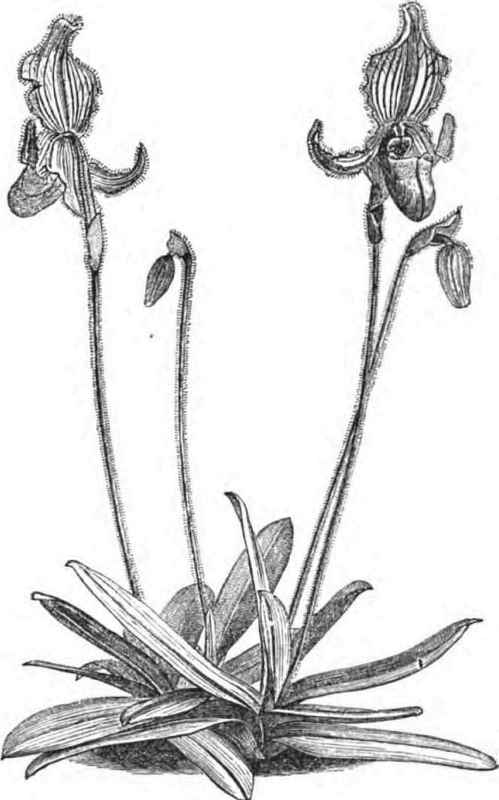
PLANT OF CYPRIPEDIUM FAIRIKAKUM, HALF THE NATURAL sier.
M. Riviere, with indefatigable perseverance, has also tried the culture of indigenous orchids. For a long time he was baffled by several species, notwithstanding all the care he bestowed upon them. Most of the plants died immediately; hardly one passed the second year of cultivation. M. Riviere then conceived the idea, that perhaps their growth or existence required that they should be in company with other plants. The experiments made by him for the purpose of determining this question had not at first any success. The grasses, among others, which he supposed particularly favorable to the orchids, from seeing them in nearly every locality where the latter were growing, were found to overpower them by the rapid development of their roots.
One day he observed on a tuft of Iris florentina which had been thrown aside a small orchid germinating; ho separated carefully this portion of the tuft, placed it in a pot, and, to his great astonishment, saw it develop a vigorous plant of Spiranthes autumnalis. A happy chance had sown some seeds of this plant among the Iris. The Spiranthes was just one of the plants which had up to this time most obstinately refused to adapt itself to cultivation: the problem was therefore solved. He had at last found a companion acceptable to the capricious orchid. Subsequently, he replaced the Iris florentina by the Iris nana, more in conformity with the orchids, on account of its smaller growth, and from this time his Spiranthes, far from perishing, took a development and a condition of health and vigor, superior to any thing exhibited by them in their natural places of growth. The plants of these experiments are still flourishing in the garden of L'Ecole de Mede-cine, after eight years' cultivation, while experiments in cultivating this species by itself in heath mould, sand, and virgin earth, have constantly failed.
M. Riviere informs us that he has also associated this Iris nana with several other refractory species, and that they find themselves quite at home and thriving in this society.
This interesting fact proves in an evident manner how much an intelligent observation of nature is useful in cultivation; it teaches us, at the same time, that obstacles supposed to be insurmountable, are sometimes overcome in a very simple manner. If then, as is our conviction, we should, never forget to draw the ornaments of our gardens from the treasures of our indigenous flora, we believe we are acting in the interests of horticulture in recommending warmly the field orchids to those of our readers who admire not only rarity, but above all beauty of vegetation.
After this long digression, inspired by our constant wish to place in view the value of our indigenous flora, let us examine the charming exotic of which we now give a representation, drawn from a plant that MM. Thibault and Keteleer, with their habitual complaisance, have allowed us to use for the purpose at their place. The Cypripedium Fairieanum (see figure), originating in the East Indies, probably in Assam, was introduced into England nearly two years ago. The species was established by Mr. Lindley, and was named Fairieanum, in honor of Mr. Fairic, of Liverpool. It has some similarity to the Cypripedium insigne, of which, however, the flowers are smaller, and it approaches more nearly the Cypripedium superbiens of Riechenbach.
It is an acaulescent plant, of which the distichous leaves are close to the soil, rather broad, pointed at the summit, and carinate at their base. The scapes, each bearing one flower, have a length nearly double that of the ! leaves; they are upright, cylindrical, green, and hairy. The large and handsome flowers issue from a bract, ovate-lanceolate, pointed and hairy like the scape. This bract envelops the inferior portion of the ovary, which is elongated, deep purple, and covered with glandulous hairs. The perianth is much spread. The large superior sepal is cordiform, greenish white, veined with stripes of dark green and deep purple; its summit is obtuse or somewhat crenated, the edges are undulated. The two inferior sepals adhere in one, of an oval obtuse form, showing also at the base, green and purple stripes. The two lateral sepals, curved in a singular manner like the horns of a buffalo, are undulated on the edges, white, and ornamented with purple and green stripes. The third sepal, or labellum, is very large, of a brownish green, reticulated with purple.
The sterile stamen is orbicular, crescent-shaped, green, purple, and white, hairy, and has in the middle, between the horns of the crescent, a downy extension.
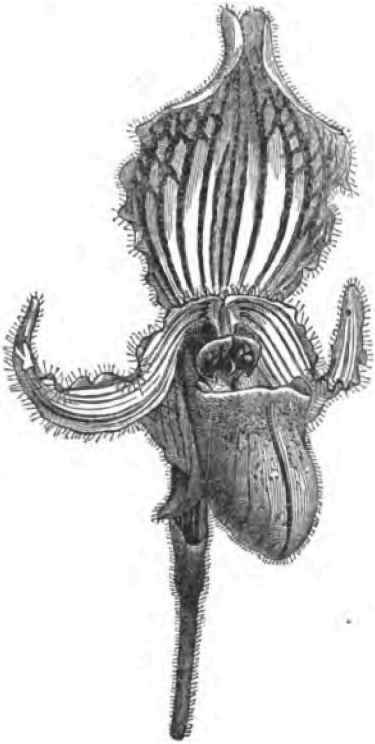
FLOWER - NATURAL BIB.
The Cypripedium Fairieanum flowers with Messrs. Thibault and Keteleer in September. The treatment of it is precisely analogous to that of the other species of the same genus.
Continue to:


My Books

