


Fumigation, Labelling, A Novel Suggestion
Description
This section is from the "Kitchen Gardening Made Easy" book, by George M. F. Glenny. Also see Amazon: Kitchen Gardening Made Easy.
Fumigation, Labelling, A Novel Suggestion
Fumigation
This has hitherto been one of the most unpleasant operations attending the cultivation of plants under glass, such as cucumbers, melons, vegetable marrows, etc, and one always dreaded by gardeners and amateurs - the difficulty of getting the material to burn, sometimes involving the necessity of remaining in the house until the operator has been nearly choked, on account of the inefficient means at his disposal for the purpose, the usual method being to use pots, and placing red-hot cinders in them, and filling up with the fumigating material, although attended with the danger of flaming or giving off sulphur from the embers, and sometimes proving a total failure, often seriously injuring the foliage of the plants above mentioned, and proving such a severe check to the fruit that their recovery is very doubtful. We have seen frames of fine healthy vegetable marrow, cucumber and melon plants, and many a house of cinerarias, verbenas, primulas, etc. (but flowers do not engage our attention in this work, and therefore we have nothing at present to say on the subject), entirely singed and almost destroyed by this makeshift method adopted.
We have had many fumigators brought under our notice, but all have been more or less complicated and costly: some with blowers and cog-wheels, necessitating the operator remaining in the house during the operation; others less complicated, but only to be used once or twice, and then set aside as cumbersome and useless for the purpose. One invented and patented by Mr. Tebbs, of which we give several illustrations, entirely does away with the danger and unpleasant consequences hitherto attending this important operation. "We have tried them, and consider them the beet yet introduced: they do their work thoroughly. No cinders are used in lighting; this entirely does away with the danger arising from sulphureous vapour; they are economical to use, as all the material put into them is consumed and given off in dense smoke, and the simple manner in which they are instantly set going makes one long to use them. They are made in four sizes, so that the largest cucumber or melon house, or frame, can all be equally and effectually fumigated. The small size will also prove a great boon for outdoor use.
Our readers will see by the engravings that by covering a tree or bush with some thin cotton material (which should be damped before using'), as represented at Fig. 30, and tying it round the stem as at Fig. 21, when fully charged with smoke, the purpose can he most effectively attained. Gooseberry and currant hushes, which frequently adorn a kitchen garden, in most seasons suffer terribly from caterpillar, etc, and this fornicator is invaluable as a remedy against them. Fig. 22 shows the operator in the act of placing one of the fumigators in a three-light frame. No gardener or amateur for the future need allow his plants to-become infested with aphis or any other vermin, the moderate price of this handy apparatus being such as will cause them to be universally used.

Fig. 19. The Fumigator.

Fig. 20. A standard currant-tree covered and being filled with smoke.

Fig. 21. The tree tied up after being filled with smoke.

Fig. 22. Placing the fumigator in a frame.

Fig.23.

Fig. 24. Tebbs'b Registered Combination Label.
Labelling
Nothing attending the many operations connected with gardening is of more consequence than the correct naming and labelling of everything you may either sow or plant: it not only adds to the pleasure of others, but it also shows at a glance what you have sown or planted, makes one familar with the names of vegetables, plants, and fruit trees, and forms a record of the successes and failures of the past season, thus enabling the grower to discard or continue certain varieties. In other words, it teaches him what kinds are best suited to his soil or locality. Tebbs's Combination Labels, of which we introduce two, Figs. 23 and 24 (the former for pots or the borders, and the latter for suspending to trees, &c), are in every way suitable to the purpose, and will be found both economical and durable.
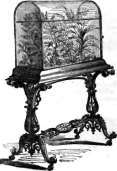
Fig. 25.
A Novel Suggestion
Although fern cases are not. exactly legitimate adjuncts to the kitchen garden, we give illustrations of two very pretty and useful ones. It occurred .to us they, might (when not occu-. pied by ferns) be turned to profitable .account, for growing small salads, watercreases, and other subjects interesting in a double sense, being nice to look at and eatable at the same .time. The Rat-tail Radish (Rafanus eau-datm) is a curiosity and good eating, and would look by no means out -of place under one of these shades. Whether they will; ever become popular for such a purpose we cannot say; we merely throw out the hint.

Fig. 26.
Continue to:


My Books

