


Fern Pools
Description
This section is from the "Ornamental Gardening In Florida" book, by Charles Torrey Simpson. Also see Amazon: Ornamental Gardening In Florida.
Fern Pools
Down in what is called the "Homestead Country" in lower Dade County the water from the Everglades finds its way through the rocky limestone strata to the sea by underground passages. The carbonic acid in the water dissolves the rock to such an extent that in places the roof falls in, and often the rock, earth and rubbish dam up the stream and form a pool. On the banks of these pools, especially those in the hammocks, many species of ferns and other shade and moisture loving plants spring up and flourish in rare luxuriance and beauty.
On my first visit to this region I became infatuated with them and I wondered if it was not possible to make something like them in my own hammock. Shortly after my return I blasted out a space where there were but a few small saplings, wheeled away the rock to use for paths in the lowland, and finally sank the excavation to a foot or so below water level. I left the sides as irregular as possible, filled earth into the crevices and pockets, planted a lot of ferns and in a short time had a fair imitation of a natural fern pool.
So I am not the inventor of the fern pool but only its discoverer and developer, and I shall not even attempt to patent it. My first pool was worked out near the swamp bordering the bay and I soon had land crabs in great numbers, not merely as visitors but as permanent residents. They didn't come to admire the plants or the beauty of the landscape; they were there strictly for business. They ate nearly all my delicate ferns and what they didn't eat they pulled out and destroyed, and I soon found that I could only grow the stronger and coarser native species in it.
My next venture was made considerably farther away from the bay in high, dense hammock, and there I have been able by watching and occasional poisoning to keep my unwelcome visitors pretty well in check, and to grow plants with reasonable success. There is only a small pool sunk some ten feet in the rock, and it is well shaded by overhanging trees. On its sides I have, however, perhaps twenty-five species of ferns, Alocasias, Anthuriums, Zebrinas, Pellionia, Dieffenbachias, Pothos, Fit-tonias, Peperomias, Begonias, Selaginellas and a variety of other things. Ficus repens and other creepers are beginning to cover the walls in places and a Monstera starting from down near the water will eventually climb up one of the trees outside the pool.
I have put native fish in all my pools and they not only prevent the breeding of mosquitoes but at the same time add to the Diagram of a fern pool such as the one described in the text. The spaces indicated by T are terraces. (Fig. 17) attractiveness of the place. It is a great resort for butterflies and many of the woodsy insects. And in a seat which I have worked out in the rocky side which can be reached by an irregular path 1 can sit and enjoy it all to the utmost.
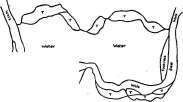
How To Make A Fern Pool.
Any one can have a pool who has rocky hammock or even pine land that is never overflowed and that does not lie too high above standing water. In many parts of the state rock comes to or near to the surface and where it is overlaid with soil or sand this may be cleared away to the rock, the latter blasted out to the necessary depth, and from it an irregular wall can be laid up to the level of the surface. At least a considerable part of the surface of the whole should be shaded by trees. These In general they have been excavated down to the water level or a little below it, and abandoned because of the difficulty of getting out material under water. Land on which these abandoned pits are located is greatly depreciated in value as it is almost impossible to fill them. But how easily any one having such a pit on land at his home could make a thing of beauty of it! If its outline is not sufficiently broken and irregular he could easily make it so by blasting out here and there along the edge of it. Small bays and nooks could be worked out and the whole could soon be sheltered by planting rapid growing trees and shrubs, and along the walls in such spots an infinite variety of ferns and other plants requiring shade, shelter and moisture would flourish. Rich soil could be put into the water in places and aquatics planted. All the Thrinax palms will flourish in such places in the lower end of the state and Agaves, Aloes, Rhoeo and perhaps Saxifraga. Our native Ampelopsis or woodbine and Ficus repens, also many other vines and creepers might be employed in screening, and they would soon turn an eyesore into a thing of beauty.
Many of the places where phosphate has been mined might be skillfully treated in a somewhat similar way and the same remark applies to natural sinks or any excavation in the rock.
Any one who loves his home and enters heartily into the spirit of cultivating plants and who has taste can devise almost innumerable schemes for adding to the beauty of his place and doing away with what is unsightly in his surroundings.
Continue to:


My Books

