


January - Third And Fourth Weeks. Continued
Description
This section is from the book "The Garden Week By Week Throughout The Year", by Walter P. Wright. Also available from Amazon: The Garden Week by Week Throughout the Year.
January - Third And Fourth Weeks. Continued
Garden Paths
People who are laying out new gardens often find the walks a rather harassing problem. They see gravel paths in most places which they visit, and, lacking experience suppose that two or three inches of gravel laid on the soil will make a path. No, the gravel is little more than the ornament; the path itself is formed of two or three layers of rougher material underneath. At the time of writing these notes, labourers are widening a drive in my garden, and I will describe the method of working. The surface soil lies over chalk, and this is first of all bared by removing all the soil, which is about fifteen inches deep above it. The next step is to lay on six inches or thereabouts of other chalk, which is drawn from a heap made through levelling a slope for a tennis lawn. I may say here that some roadmakers are averse from the use of chalk as under-ballast, on the ground that, whatever is put above it, the chalk works through, and makes the surface greasy. That is not my experience. I find that if it is well rammed and covered it makes an excellent bottom layer. Above the chalk comes a 4-inch layer of clinkers, the finer parts, or ash, of which are kept at the top as a "binding" material. The clinkers and ash are rammed, levelled, and rolled. Thirdly, there comes a 3-inch layer of flints, which are also rammed and rolled, so that they are well bedded into the ash. Lastly, there is a 2-inch coating of gravel, which is neatly levelled and rolled. A drive made up like this will stand all the strain which is likely to come upon it, and it will last. It will not be naturally weedy, and what weed shows (there is sure to be some) can be easily overcome by a watering with weed-killer in spring, the effects of which will last throughout the summer. Walks that really are walks - i.e. that are only subject to the wear of foot traffic - can be made somewhat cheaper by allowing an inch less of each layer.
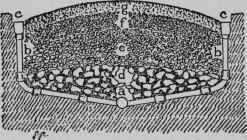
Fig. 19. - Section of Garden Path.
a. Main drain.
bb. Pipes to conduct water to main drain from catch-pits (c).
d. Broken bricks, clinkers, etc.
e. Flints. f. Rough gravel. g. Finer surface gravel.
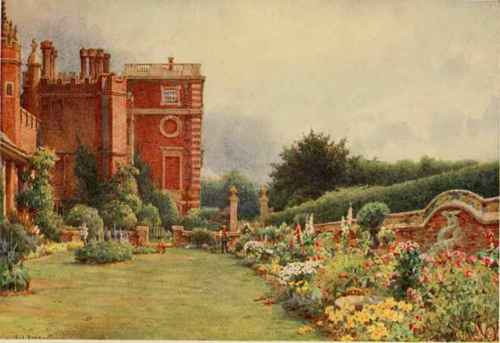
From a Water Colour Drawing by E. A. Rowe. The Private Garden.at Hampton Court.
Drives and walks alike should be made with a suitable "camber," i.e. a slight fall from centre to outsides, so that water may run off freely. And there should be a grated drain at every few feet to carry the rain down. With a chalky or sandy subsoil, the water will find its own way out quickly; but if the soil is clay, it is wise to lay horizontal drain pipes in the bed of the walk to carry off the water.
It is not everybody who has to make walks and drives on chalk; but I need only say that if I were situated other than I am, I should still try and find something firm to build my walk on. If the subsoil were naturally loose, I should have it well rammed before putting in the ballast.
Continue to:


My Books

