


June - Third And Fourth Weeks. June 16-30. Flowers. Continued
Description
This section is from the book "The Garden Week By Week Throughout The Year", by Walter P. Wright. Also available from Amazon: The Garden Week by Week Throughout the Year.
June - Third And Fourth Weeks. June 16-30. Flowers. Continued
Insuring Fine Roses
With the Rose season close upon us, we can do a great deal to insure fine flowers by thinning the buds and feeding the plants with liquid manure. The flower buds generally come in clusters, the central or "crown" bud being the largest. This bud makes a much finer flower if the outer buds are picked off than it would do if the whole of the cluster were left. But the grower should only disbud a selected number of show varieties; to make a general practice of it would deprive Rose gardens of much of their beauty.

Fig. 44. - Disbudding Roses.
a. Main or central bud to be retained.
b. Small side buds to be removed at the dark lines.
It should certainly not be adopted with distinctly garden Roses like Gruss an Teplitz, nor with climbers.
Propagating Mal-Maison Carnations
The Malmaison Carnation has a large following still, although it may have suffered somewhat owing to the rise of the American section. When grown successfully, the Mal-maisons have immense white, blush, pink, rose or crimson flowers, sweetly scented. Princess of Wales, Mrs. Trelawny, Lady Carlisle, and Thora are good varieties. Growers of them who have plants may multiply them by layering the young growths on the outside of the old ones. It facilitates this operation if a bed of loam, leaf mould, and sand can be made in a frame, and the Carnations planted in it. A slit an inch long may be made by running a knife along half-way through the stem, and pegging the latter down to the soil. When roots have pushed freely, the stem can be cut through, and the young plant thus severed from its parent.
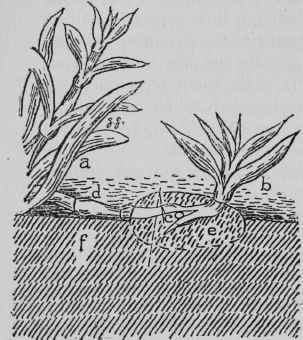
Fig. 45. - Layering Carnations.
a. Part of the old plant. b. The layer.
c Stem cut and pebble inserted.
d. Stem denuded of leaves.
e. Soil in which the layer is pegged.
f. Original soil.
Azaleas, Camellias, Deutzias, And Lilacs
These plants, grown for spring flowering, will now be out of bloom, and it benefits them, as well as saves labour in watering, to stand them out of doors with the pots plunged in ashes.
Privet Hedges
Its capacity for establishing itself in the poorest of soils, its rapid growth, and its reputed evergreen nature (it is not a genuine evergreen) cause the oval-leaved Privet to be largely used as a hedge plant. It is benefited by being pruned twice a year, the first time at the end of June, and the second about the end of September. This is exclusive of the cutting-back at planting time - a practice that ought never to be neglected, as it conduces to making the plants thick at the base.
Pruning Flowering Shrubs
The great majority of the flowering shrubs bear their best flowers on shoots made the previous year. This means that the proper time for pruning them is after they have bloomed, because then the wood which has borne flowers can be removed, and the plant will have several months before it in which to make fresh shoots for blooming the following season.
Continue to:


My Books

