


Stage 3: Commencement of Internal Massage. The Use Of Massage And Early Movements In Recent Fractures
Description
This section is from the book "Lectures On The Use Of Massage", by William H. Bennett. Also available from Amazon: Lectures On The Use Of Massage.
Stage 3: Commencement of Internal Massage. The Use Of Massage And Early Movements In Recent Fractures
Stage 3: Commencement of Internal Massage. - After preliminary smooth massage, as described in Stage 2, one hand of the manipulator is insinuated between the toes of the affected side and the footpiece of the splint (fig. 3). Dorsal flexion is then effected as much as possible by rotating the hand forwards and downwards (vide fig. 4). This movement is repeated from five to ten times, the fracture being steadied by the grasp of the other hand of the manipulator. The date of the commencement of this stage may be any time after the second day. The objects are, early slight movement of the flexor tendons at the back of the ankle to prevent adhesions. Movement of the toes separately instead of en bloc may be substituted at discretion. At the end of this stage the side-splints are replaced as in fig. 1.

Fig. 3. - Massage in Recent Fracture of the Leg
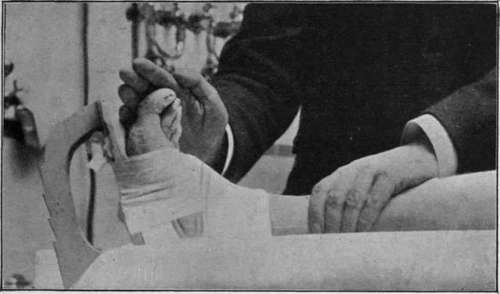
Fig. 4. - Massage in Recent Fracture Of the Leg
(See fig. 3)
Immediate muscular spasm having been allayed in the manner indicated, the side-splints at the end of two or three days are loosened and the limb is left exposed on the back-splint as this man's is (vide fig. 2), and every day the massage is employed, at first mainly to get rid of the effused blood round about the fracture. At the end of the third day, again, after practising this smooth massage for ten minutes, passive movement of the muscles and tendons at the back of the ankle and in the calf should commence. In order to effect this you begin very gently by moving the toes only. The foot is still bandaged and the splint remains in the way you see here. The hand is insinuated under the toes in the way I am doing (vide fig. 3) and dorsal flexion of the toes en bloc is made (vide fig. 4). Every time the toes are bent in that way the flexor tendons are pulled upon, and so a little movement is produced. The movement thus produced in the calf accomplishes the beginning of what is called 'internal massage,' by which I mean that there is a little rubbing movement up and down of the deep muscles in the calf of the leg. This proceeding not only stimulates the circulation, but it makes sufficient movement to prevent immediate adhesions from forming about the fracture, which would otherwise occur. The first passive movement then concerns the toes : this is begun on the third day and continued for two days - say, until the fifth day. If all goes well passive movement of the ankle may be commenced from the fifth to the seventh day. For this purpose the limb is allowed to lie quite comfortably, as it will do now, on the back-splint, the side-splints having been removed and the bandage around the ankle taken off, the bandage above the knee remaining undisturbed (vide fig. 5). The foot is now firmly grasped with one hand and freely moved at the ankle-joint, the fracture being at the same time steadied by the opposite hand. After a few days the patient may be allowed to make voluntary movements of the ankle as it lies on the splint, the fracture being steadied by the surgeon's hand. Having arrived at this stage of the process all fear of adhesion about the ankle-joint or the parts behind the fracture ceases. It may happen in exceptional cases that the patient is so over-sensitive or the damage to the soft parts so extensive that the plan cannot be carried out with safety, but if employed with intelligence you will rarely find any case in which it cannot be profitably used. For the passive movements from three to five minutes at each sitting are sufficient. The passive movements are always preceded by a quarter of an hour's smooth rubbing, by which the patient is generally made most comfortable, and should be followed by voluntary movement, the region of the fracture being supported by the hand. These manipulations are repeated day by day, extending at the end of the first fortnight to as much as half an hour for each sitting. At the end of a fortnight-a little more or less, according to the state of union-attention should be given to the joint above the fractured point. The joint below the fracture is, however, naturally the most important, because it is that which is most interfered with if adhesions form. At the end, then, of a fortnight or less, after having done what is necessary for the leg, the knee may be profitably subjected to passive and voluntary movements. In bending the knee great care must be exercised, because the fracture being only a fortnight old, or a little more, is not in a condition of anything like firm union. The bending of the knee may be carried out in one of two ways. It may be done (1) by simply taking the leg, as you have often seen me do, with one hand under the limb just above the heel and the other grasping it under the thigh in the way shown in fig. 6, and then lifting the knee from the splint. By degrees, as the case goes on, the knee may be raised more and more until at the end of three weeks it is bent up to a right angle. During the whole of these manipulations it must be constantly borne in mind that a recently broken limb is being dealt with. Although that is the plan I adopt in managing these fractures myself in private work or when my masseur or masseuse is managing them for me, it is safer for hospital purposes at this stage, after the massage for the foot and leg has been finished, (2) to put on a pair of short side-splints, retained in position with straps or webbings, and then to bend the knee and ankle in the way I show you (vide fig. 6). This brings the treatment up to about the end of the third week after the receipt of the injury, and by this time in the majority of cases treated on this plan the fracture is nearly sound - not sound enough for walking, but sound enough for the patient to be left without any splint. The patient can lie in bed if so disposed, or if he prefers to be getting up and sitting on a couch or chair he may do so after having been provided with a case of poroplastic felt or leather to be worn around the calf over the seat of fracture, as a protection. At the end of three weeks you will find that complete ordinary muscle massage may be thoroughly carried out in order to develop the muscles throughout the limb.

Fig. 5. - Massage in Recent Fracture of the Leg
Continue to:


My Books

