


The Cervical Fascia
Description
This section is from the book "Lessons on Massage", by Margaret D. Palmer. Also available from Amazon: The Book Of Massage: The Complete Stepbystep Guide To Eastern And Western Technique.
The Cervical Fascia
The cervical fascia not only covers the soft parts of the neck collectively, but forms separate sheaths for the muscles vessels, and glands. It commences as a thin layer at the back of the neck, where it is attached to the ligamentum nuchae, and to the spinous and transverse processes of the cervical vertebrae.
It passes forward to the posterior border of the sterno-mastoid, where it splits into two layers, which invest the muscle and re-unite at its anterior border ; it then goes to the middle of the neck and meets its fellow of the opposite side. It is attached above to the inferior maxilla, the zygoma, the mastoid process, and to the superior curved line of the occiput. Below it is attached to the clavicle and upper border of the sternum. The layer which passed beneath the sterno-mastoid is continued behind the pharynx to join the fascia of the opposite side. Above it is attached to the angle of the lower jaw, the mastoid process, and the temporal and occipital bones. Below it is attached to the first rib, and in the chest it is continuous with the pericardium.
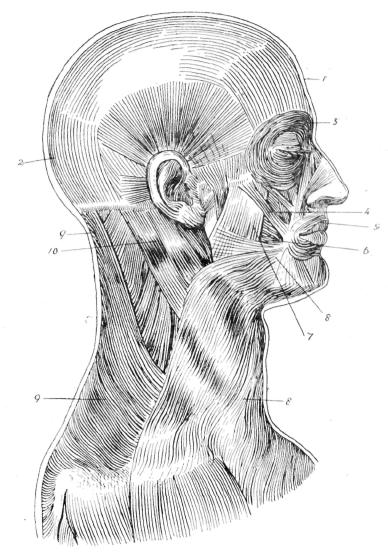
Fig, 92.—Muscles of the Head.
1, Frontalis; 2, occipitalis; 3, orbicularis palpebrarum; 4, zygomaticus major ; 5, orbicularis oris ; 6, buccinator ; 7, masseter ; 8, platysma myoides ; 9, trapezius ; 10, sterno-mastoid.
Continue to:


My Books

