


The Vascular System
Description
This section is from the book "Lessons on Massage", by Margaret D. Palmer. Also available from Amazon: The Book Of Massage: The Complete Stepbystep Guide To Eastern And Western Technique.
The Vascular System
The organs of circulation are the
1. Heart. 4. Capillaries.
2. Arteries. 5. Lymphatics.
3. Veins.
The heart lies in the thorax between the lungs, rather to the left side ; it is a hollow muscular organ, and by its contractions the blood is forced through all the bloodvessels of the body.
The blood consists of a colourless watery fluid (plasma or liquor sanguinis), containing minute bodies called corpuscles ; they are of two kinds—red and white, the red being by far the more numerous. The colour of the blood is due to a substance in the red corpuscle called haemoglobin, which has the power of combining with oxygen ; this substance contains iron oxide in small proportions.
The heart is divided longitudinally into two halves—right and left ; there is no communication between these ; the right contains venous or impure blood, the left arterial or pure blood.
Each half is also divided transversely, thus making four chambers ; the upper are called auricles, the lower ventricles. These chambers communicate with each other by the auriculo-ventricular orifices, which are supplied with valves to prevent the return of the blood passing from the auricles to the ventricles ; the valve in the right side consists of three flaps, and is called the tricuspid valve ; the valve in the left side has two flaps—it is the bicuspid or mitral valve. The blood is carried from the heart by the arteries, and returned to it by the veins. The arteries and veins are connected in the tissues by the capillaries, which are exceedingly small vessels, with very thin walls, formed of a layer of endothelium.
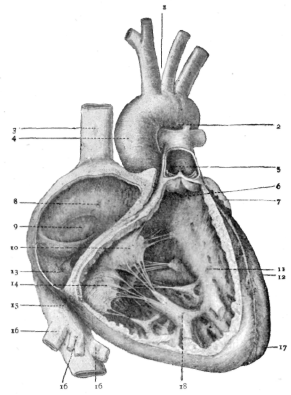
Fig. 18.—The Heart. (Broadbent.)
1, Innominate and left carotid arteries ; 2, transverse part of arch ; 3, vena cava superior ; 4, ascending part of arch of aorta ; 5, pulmonary artery; 6, pulmonic valves; 7, appendix of left auricle; 8, inter-auricular septum ; 9, fossa ovalis with Eustachian valve below; 10, left segment of tricuspid valve; 11, inter-ventricular septum; 12, left ventricle ; 13, coronary vein ; 14, right segment of tricuspid valve ; 15, inferior vena cava ; 16, hepatic veins ; 17, left ventricle ; 18, anterior papillary muscle.
The walls of the arteries are very strong and elastic ; they have three coats ; the outer coat is composed of connective tissue ; the middle coat of muscular and elastic, in proportions varying according to the size of the artery. The inner coat is a layer of fibrous and elastic tissue lined with endothelium. Arteries are contractile and elastic.
Veins have also three coats, but their walls are thinner and less muscular than those of arteries. There are two sets of veins—a deep and a superficial set, the former accompanying the arteries.
Veins are nearly all supplied with valves at short intervals ; they are most numerous in the limbs ; they are folds of the internal coat of the veins ; their free edges are turned toward the heart, so a backward flow of blood is prevented.
Arteries are deeply set generally. The walls of arteries and veins are supplied with bloodvessels, which are called vasa vasorum. They are also supplied with nerves—the vaso-motor. The veins that accompany arteries are called venae comites.
Arteries anastomose, or unite, at intervals, which admits of communication of blood, and promotes equal distribution.
Veins anastomose more frequently than arteries, and the deep and superficial veins communicate with each other.
Continue to:


My Books

