


IV. Exercises For The Rotators Of The Trunk. Part 8
Description
This section is from the book "Massage And Medical Gymnastics", by Emil A. G. Kleen. Also available from Amazon: Massage and medical gymnastics.
IV. Exercises For The Rotators Of The Trunk. Part 8
Sacral-beating (Fig. 123).
In the first two positions the patient usually turns the heels slightly out. The gymnast stands at the side of the patient and with one hand supports the patient's abdomen just above the symphysis pubis, with the other hand gives beating in small series (five to seven strokes), going from the middle line obliquely outward and downward over the sacrum and gluteal region, on each side alternately.
Effects And Uses
According to the force with which beating is given and the starting position, the effects are various. If given strongly and in Arm-lean-stride-standing position, it strongly repletes the abdominal and pelvic organs (Brandt) and relieves constipation, the latter according to old gymnastic tradition. Given lightly and in Arm-lean-stoop-stride-standing or -sitting position, it stimulates the organs of the true pelvis and nerves supplying them, partly by reflex action and partly by the shaking of the whole pelvis, while stoop position counteracts too great a supply of blood to the pelvis (Brandt).
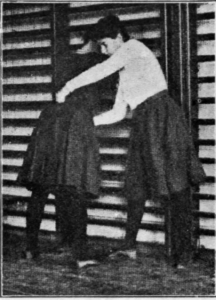
Fig. 123.
Used in treatment of debilitated conditions of the abdominal and pelvic organs and in constipation.
Shaking and Vibration.
These, both in character and effect, closely resemble tapote-ment. They consequently stimulate the parts worked upon - i.e., increase the activity of the cells, and assist the dissolution and absorption of the products of inflammation. They are specially used in cases where great sensitiveness or tenderness does not allow any stronger treatment.
On account of their power of acting even upon the deep-lying parts and on organs which by means of a more or less complete bony covering are prevented from being influenced in any other way, they are of great use in treating changes in the abdominal or thoracic organs, and in diseases of the brain and spinal cord. The effect of vibrations on the peripheral nerves is spoken of in connection with nerve pressures and nerve frictions. Applied to mucous membranes they assist in the manner above described in loosening and carrying away the mucus, and possibly also diminish congestion (by their effect upon the blood vessels and their nerves). On this account they are much used in treating various catarrhs. Crook-half-lying Stomach-pit-shaking (Fig. 124). - The gymnast stands in front of the patient with the palmar surfaces of the hands and the fingers close together. The finger-tips are placed in the pit of the patient's stomach (half-way between the umbilicus and the ensiform process), and, when the patient breathes out, are pressed inward and slightly upward while continuous shaking is performed. Repeated three to four times. If the patient has a tendency to contract the abdominal wall the shaking is introduced by a gentle kneading of the pit of the stomach.
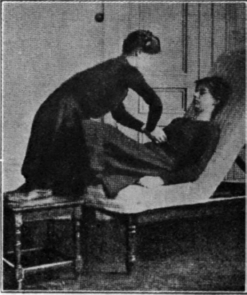
Fig. 124.
Effects And Uses
The shaking comes in contact with the pyloric end of the stomach and has the above-mentioned effects there. But if given sufficiently strongly it may exercise a stimulation on the coeliac plexus and the nerves going from it. The results of such stimulation are not very well known, and may consist of either an inhibitory or a stimulating effect on the activity of the organs influenced by these nerves, but it is supposed that the stimulating effect predominates. On this account Stomach-pit-shaking is used, in the treatment of chronic gastritis and dyspepsia, etc., in atony and other relaxed conditions, and in nervous diseases of the stomach.
The same contra-indications obtain as for abdominal massage (acute inflammation in the alimentary canal and peritoneum, gastric ulcers, malignant tumours, etc.).
Crook-Half-Lying Stomach-Shaking
One or both of the gymnast's hands are placed on the patient's abdomen so that the finger-tips lie about 5 cm. below the left lower costal margin. As the patient breathes out the fingers are pressed inward and upward while shaking is performed, so that the pressure is directed upward toward the stomach. Repeated, with small pauses for breathing, four to eight times.
Effects And Uses
This shaking comes in contact with the stomach over a larger area than the preceding, and is therefore more effectual both as regards increasing peristaltic action and promoting the secretion of gastric juice. On the other hand, the coeliac plexus is not affected.
Details with regard to the above effects have been already given by Dr. Kleen in connection with abdominal massage and its use, but I will briefly recall them.
By stimulation of the non-striated muscle fibres peristaltic action in the stomach is increased, so that the gastric juice is better mixed with the contents and digestion aided, as well as the emptying of the stomach hastened. Moreover, the muscle after some time becomes, as it were, "trained," so that it is developed and becomes stronger, and thus disturbances of function in connection with weak stomach muscle in certain cases, as in early atony, may be definitely cured, and in any case much improved.
By stimulation of the glands of the mucous membrane it is possible that a more active secretion of gastric juice may be caused.
It has already been pointed out that mucus is loosened and absorption of the products of inflammation is aided.
It is used nearly always in the gymnastic treatment of gastric complaints.
Crook-Half-Lying Transverse-Abdominal-Shaking
The gymnast places one hand on the patient's abdomen and performs shaking from side to side, first lightly and with small movements, then more strongly and with larger movements, finally more gently again and with smaller movements, while the pressure of the hand similarly is first increased and then diminished. Repeated three to four times.
Transverse-abdominal-shaking acts upon the intestinal canal in a similar way to Stomach-shaking on the stomach, and is used in treatment of chronic intestinal catarrh and in atony and other conditions of slackness in the intestines.
It may also have a stretching effect on adhesions between the intestines themselves, or between them and the abdominal wall.
If the shaking is extremely fine and light, it has in many cases been proved effective in stopping diarrhoea, or at least diminishing it.
Continue to:


My Books

