


Fractures of the Upper Extremity Treatment. Part 5
Description
This section is from the book "Massage Its Principles And Practice", by James B. Mennell. Also available from Amazon: Massage It's Principles and Practice.
Fractures of the Upper Extremity Treatment. Part 5
Fractures of one bone of the forearm present, as a rule, little difficulty. Union of the lower end of the radius or of the upper third of the ulna is usually firm enough to allow great freedom of relaxed movement in eight or ten days, and active movement may almost always be indulged in with ever - increasing freedom from the end of the fortnight, provided it is painless and no swelling or tenderness follows use.
As the site of fracture ascends the radius or descends the ulna the time required for union to take place increases steadily, till a maximum is reached for the lowest inch of the ulna, where a fracture frequently requires some three weeks to unite.
Fractures of both bones of the forearm are the bete noir of all methods of treatment. After operation they frequently fail to unite, the same fate often awaits the use of ordinary splintage, while treatment by mobilisation is sometimes not much more satisfactory. Certain it is that great risk is involved by those who are unfortunate enough to sustain this injury. Until union is complete in both bones the main function of the masseur is to attend to the circulation of the arm, and to see that the fingers remain supple. One of the most efficient methods of applying splintage is to fix one splint from shoulder to finger-tips posteriorly and another from wrist to shoulder anteriorly (see Fig. 79). In applying the splints it is essential to note that the "carrying angle" is maintained. This entails the use of a very broad or suitably bent posterior splint. Massage of the forearm should only be applied with the posterior splint in situ, the patient being fully recumbent and the shoulder abducted to about 45°. The patient must remain in bed with the limb elevated on a pillow between treatments. This method of splintage produces an appearance in the limb that would seem to be deplorable, and the restoration of movement is very troublesome unless performed in one way. Commence with slight pronation of the forearm, and flexion of the elbow follows naturally: attempt flexion without this preliminary, and endless trouble will ensue. In treatment of these fractures it is more essential perhaps than in any other case, medical or surgical, to insist that the whole responsibility should rest on the medical man. When union is nearing completion the forearm may be allowed to rest at a right angle across the chest, where at first it is slung in supination, as shown in Fig. 158. A very full account has been given in the previous chapter of the treatment applicable to a simple fracture through the lowest inch of the radius without displacement. If there is displacement, or if it has been present and has been reduced, treatment must follow the same lines, but progress should be somewhat slower at the outset. The vital importance of reduction of gross deformity is frequently overlooked. The best way to effect it is shown in Fig. 80. Whenever possible impaction should be respected, and regarded as the first stage in repair. Impaction and severe displacement rarely occur simultaneously. In these cases pain over the styloid process of the ulna will be a source of great trouble to patient and masseur alike, so local treatment of the internal lateral ligament should always find a very definite place in the seance from the first, even though the patient may not complain of pain there for some time after the commencement of treatment. Local kneading and friction are called for, and it is important that these should be administered in every position from full pronation through all the stages of supination as they are day by day secured (see Fig. 81). The importance of loosening all the joints in the neighbourhood of the head of the ulna is dealt with later (see p. 220).

Fig. 79. - To show the application of long anterior and posterior forearm splints. The posterior splint is bent so as to allow for the "carrying angle."
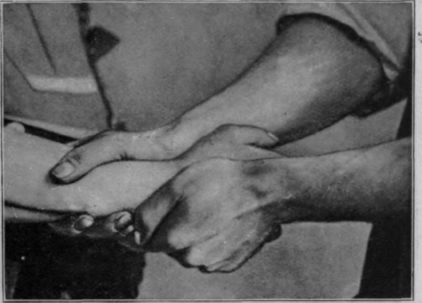
Fig. 80. - To show the method of reducing a Colles' fracture practised by Sir Robert Jones. By this means it is often possible to reduce deformity a very considerable time after fracture has taken place. No further damage is done to the already seriously injured tendons, tendon-sheaths and ligaments.

Fig. 81. - To show the administration of local treatment to the internal lateral ligament of the wrist-joint.
Fractures of the carpus with displacement must be dealt with by the surgeon: after operation, or if there is no displacement, treatment should follow the lines laid down for fractures through the lowest inch of the radius. Fractures of the scaphoid in particular should receive a free dose of mobilisation from the outset whenever there is any reason to suppose that synovial fluid has leaked in between the fragments. This treatment adds greatly to the chance of satisfactory union taking place.
In all cases of carpal fractures it is wise to splint the hand in dorsi-flexion. If this movement is limited by bony deformity, operation should be considered.
Fractures in the hand call for treatment on general lines. The long bones of the hand are concave on their palmar surface, and therefore flat splints with full extension of the fingers tend to produce a palmar convexity at the site of fracture. If surgeons would recognise this fact, many hours of labour would be saved for the masseur, and many hands would be perfectly sound which are now doomed to permanent incapacity, of greater or less degree, despite endless work in the massage departments of our hospitals. A pad of wool or dressing about the size of an ordinary tennis-ball forms an efficient splint. It need not be spherical - the "tennis-ball" in fact should not be fully inflated. It may be well to emphasise that for fractures involving the hand, no less than for similar injuries in other portions of the limb, massage to improve the circulation is one of the chief agents by which repair may be hastened, and therefore that treatment of the arm is just as important as treatment nearer the site of fracture. Were these hand fractures treated more regularly by mobilisation than is at present the case there would be fewer cases of ununited fracture of the metacarpals, and many an operation - only too often unsatisfactory in the end - would be obviated.
Continue to:


My Books

