


Massage Treatment In Neurasthenia. Part 6
Description
This section is from the book "Massage Its Principles And Practice", by James B. Mennell. Also available from Amazon: Massage It's Principles and Practice.
Massage Treatment In Neurasthenia. Part 6
The treatment may be given sitting up or lying down. In either case the stroking should extend from the level of the hair to the point where the treatment of the back ceased, and should resemble it in all respects, except that it is quite easy to use the two hands together when the patient is sitting down.
Treatment of the front of the neck is performed with the two hands, if the patient is sitting, the stroke starting just below the chin and extending right out on to the shoulders (see Figs. 131, 132, and 133). The head rests against the masseur's waistcoat supported by a thin pillow or folded towel. The rapidity of movement must be rather slower than on the trunk; and, in spite of the shorter "sweep," only ten or twelve movements a minute should be performed. Three or four minutes should suffice.

Fig. 130. - Deep stroking over the dilated stomach.
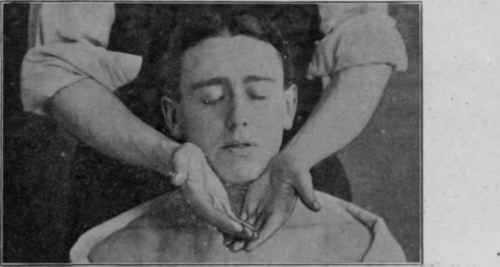
Fig. 131. - Stroking the neck: patient sitting. The beginning of the stroke.
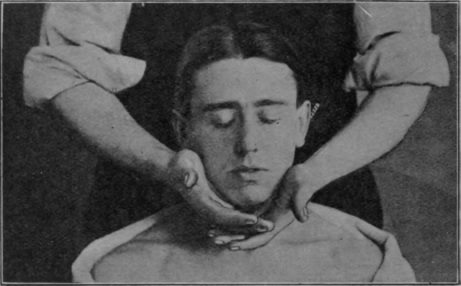
Fig. 132. - Stroking the neck: patient sitting. The middle of the stroke.
The touch becomes lighter and lighter till finally the patient should be barely conscious of its cessation. Success has been attained if the patient remains motionless for a few moments after treatment has ceased and draws a deep breath before moving.
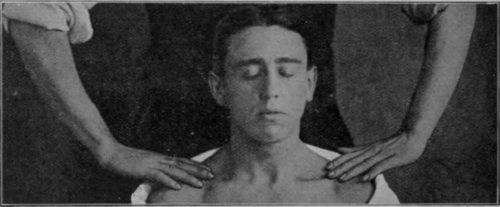
Fig. 133. - Stroking the neck: patient sitting. The end of the stroke. The back of the patient's head should rest on a pillow or towel, which, in turn, rests against the masseur's waistcoat.
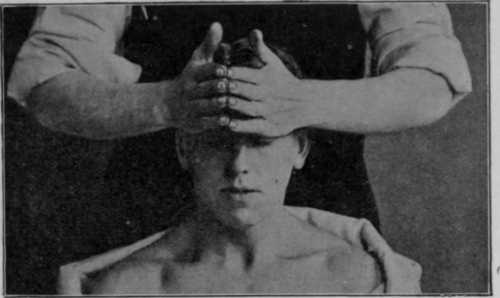
Fig. 134. - Forehead stroking: patient sitting. Commencement of the movement.

Fig. 135. - Forehead stroking: patient sitting. The ulnar borders of the fingers crossing the eyes.

Fig. 136. - Forehead stroking: patient sitting. The end of the movement. The patient's head should be supported on a pillow or towel which rests against the masseur's waistcoat.
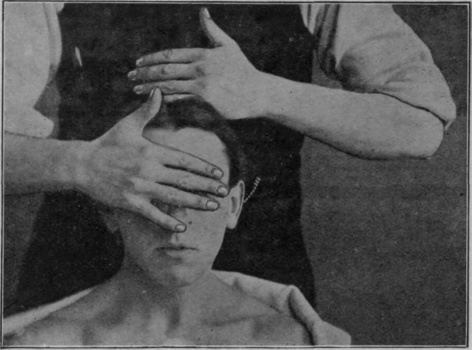
The forehead may then be treated for a similar, or perhaps rather shorter, length of time by each or either of two movements. The first starts from the middle line (see Fig. 134); the ulnar borders of each finger in turn pass over the eyes with the lightest possible touch (see Fig. 135), and the movement ends over the temples (see Fig. 136). The second consists of plain upward stroking from the level of the eyebrows, passing over the top of the head throughout its anterior half at least (see Fig. 137). The second movement can be performed equally well, of course only with one hand, if the patient is recumbent, but the first movement then calls for material alteration, and is easily combined with the down stroking of the front of the neck. The masseur kneels on the opposite side of the patient to that which is under treatment. The ulnar border of the hand just touches the patient near the middle line of the forehead, and the hand is then pronated so that all the fingers come in contact with the forehead and the ball of the thumb rests over the eye of the patient. On this the hand pivots so that the fingers sweep across the forehead, pronation becoming less marked. The ball of the thumb then gradually rises and sweeps across the eye while the fingers descend the face in front of the ear. As soon as the fingers reach the lower level of the jaw the hand pronates again and is carried downwards and outwards across the neck to the shoulder. An attempt to illustrate the movement is made in Figs. 138 to 141. This is an excessively difficult movement and calls for great skill. If clumsily performed it is a source of great irritation.
Fig. 137. - Second movement for forehead stroking: patient sitting. The right hand is commencing the movement; the left is just finishing.
Some patients greatly value head massage and respond to it very readily. This particularly applies to insomnia patients.
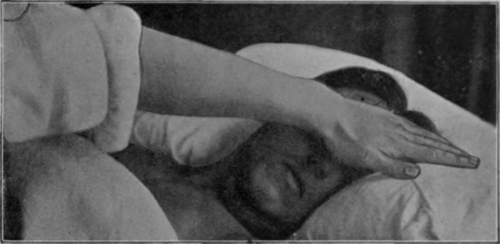
Fig. 138. - Head stroking: patient recumbent. Note position of masseur and patient. The movement begins with the passing of the hand over the pillow. This can be made to produce a slight swishing sound, which, being rhythmically repeated, acts as an additional suggestion via the sense of hearing.
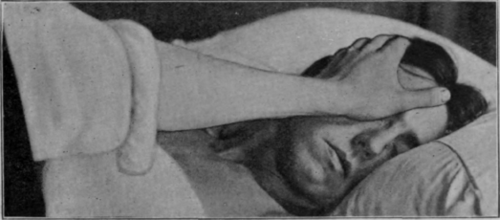
Fig. 139. - Head stroking: patient recumbent. The hand pivots round the ball of the thumb which rests over the eye.
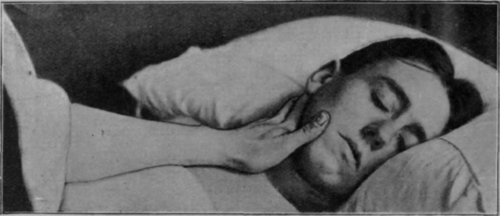
Fig. 140. - Head stroking: patient recumbent. The hand has supinated to reach the angle of the jaw.

Fig. 141. - Head stroking: patient recumbent. The hand pronates to embrace the side of the neck and then sweeps down to the shoulder, and thence on to the sheet, thus producing at the end of the stroke a slight "swish" exactly comparable with that heard during the earliest part of the movement.
Continue to:


My Books

