


The Use Of Apparatus For Exercise. Part 3
Description
This section is from the book "Massage Its Principles And Practice", by James B. Mennell. Also available from Amazon: Massage It's Principles and Practice.
The Use Of Apparatus For Exercise. Part 3

Fig. 59. - The converse of Fig. 58. Here the muscle is doing a considerable amount of "work."
In performing all exercises care should be taken that the patient stands strictly "to attention" throughout. General fixation of the whole body, except of the part exercised, adds greatly to the value of all exercises. The general rigidity of the body tends to give the contracting muscles a fixed, rather than a variable, point from which to obtain a purchase. It also ensures that the patient uses his muscles in the manner prescribed, and does not merely perform the movement "anyhow," chiefly by use of accessory muscles.
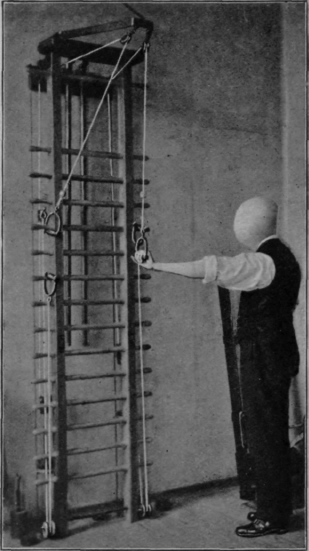
Fig. 60. - In this position the clavicular and acromial portions of the deltoid contract and relax in unison.
It sometimes happens that contraction of one muscle is a cause of pain, owing to adhesions between it and another adjacent muscle. Considering the deltoid once more, it can sometimes be noted that pure abduction and pure flexion of the shoulder both cause pain at a certain point in the muscle during the movement, which can be located between the clavicular and acromial elements. If weight and pulley exercises are commenced so that the limb moves in a plane mid-way between flexion and abduction, no pain is experienced (see Fig. 60). By adding an infinitesimal element of flexion and abduction alternately, it is often a simple matter to free the offending band - an operation which cannot be performed by any amount of movement under an anaesthetic.
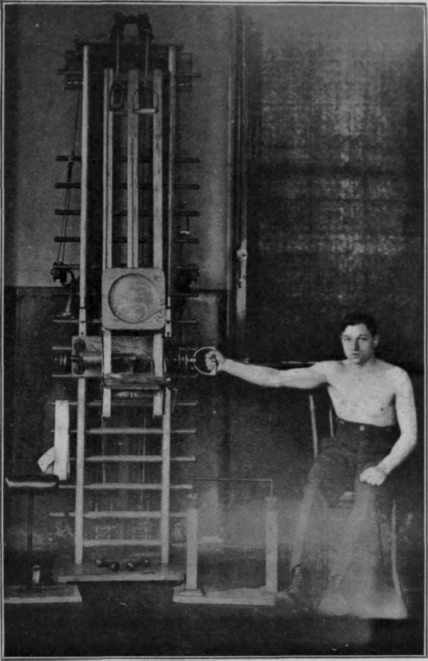
Fig. 61. - To show the position adopted when using the rotator for shoulder rotation. The apparatus here figured is built by Messrs. Spencer, Heath and George.
The ordinary weight and pulley apparatus requires to be supplemented by a roller and rotator apparatus as shown in the appendix, and it is much better that this should be controlled by weights rather than (as is usual) by friction. Rotation of the shoulder can be performed by seating the patient at the side of the apparatus, the handle of the roller being at the same level as that of the shoulder (see Fig. 61).
Some patients lack rotation of the forearm, and so it is difficult for them to exercise on the ladder. The detachable upright rods were supplied to the apparatus at the Special Surgical Hospital, Shepherd's Bush, to overcome this difficulty, and also to provide rigid poles for pole exercises.
A nautical wheel, or a bar slung from its centre, is of great service in exercising the trunk, shoulder, and arm muscles. Resistance must be arranged by friction.
A stationary bicycle helps to develop co-ordination in the muscles of the leg. The value of this apparatus for building up muscle strength is negligible. If, in ordinary life, we wish to exercise our legs in this way, we go for bicycle rides of at least eight or ten miles. If the idea is to get into training, we should be in the saddle for several hours daily. No one can expect a patient to exercise on a stationary bicycle for the same length of time, and, if we tighten the resistance so that the exercise is equivalent to riding up a hill, fatigue will set in so quickly that no benefit will accrue.
An ideal equipment would include an instrument for circumduction of the arm and another for the ankle. Anything that will serve to improve the grip may be added. A simple device is shown in Fig. 62. We owe its introduction to military work to Mrs. Guthrie Smith, I believe.
Given these things, there is no necessity whatever for any Zander or Pendulum apparatus. It is imposing, and perhaps it may add novelty to treatment; but exercises, which cannot be devised with the apparatus previously mentioned, cannot be performed by any mechanical agency.
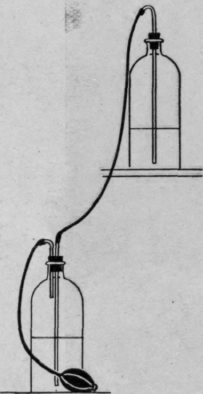
Fig. 62. - To show a simple form of apparatus devised to strengthen the grip. The upper bottle is shown in the process of being emptied into the lower by syphon action.
I have often been asked why I do not make use of Zander apparatus and whether I have any objections to urge against it. In fact, in one of the reviews given to the first edition of this book, the question was accorded a prominent position. My attitude is quite easily defined. I have only seen two fully-equipped Zander establishments at work. In January, 1916, I was one of a party of three medical men who were sent over by the British Red Cross from London to France to see and report upon the work being done amongst the wounded at the Grand Palais at Paris and at the Anglo-Beige Hospital at Rouen. The views I had preconceived of the use of a Zander installation were confirmed by both visits, namely, that there was little which could be done with the apparatus that could not be accomplished equally well, if not better, by other means of physico-therapy, provided that adequate skilled assistance was forthcoming. Then, second, it had long been fairly clear to me that, as regards the use of apparatus of all sorts in remedial work, the exact nature of the apparatus was comparatively unimportant provided that the use made of it was intelligent. Thus I believe that, to restore function, there is little or nothing to choose between the various methods which have been devised, if the patient is fully instructed in the raison d'etre of the work he is called upon to perform.
Continue to:


My Books

