


Salpingitis
Description
This section is from the book "Intra-Pelvic Technic OR Manipulative Surgery of the Pelvic Organs", by Percy H. Woodall, M. D., D.O.. Also available from Amazon: Intra-Pelvic Technic OR Manipulative Surgery of the Pelvic Organs.
Salpingitis
Chronic salpingitis is nearly always the result of the acute form.
Pathology
The tubal epithelium is diseased the walls are infiltrated and thickened by inflammatory exudate which may have become organized into connective tissue. The inflammation may have closed one or both ends of the tubes, the fimbriated end, usually first. Any serous exudate which had accumulated within the lumen of the tube may have become absorbed, or similar pus collections become sterile, unless due to streptococcus infection. Should these changes not have occurred a hydro-salpinx, pyo-salpinx or ovarian abscess may remain. Again the conditions within the tube may have subsided leaving as sequelae peritoneal adhesions which may bind tubes and ovaries into a distorted and displaced or immobile mass. (Figs. 45, 46.)
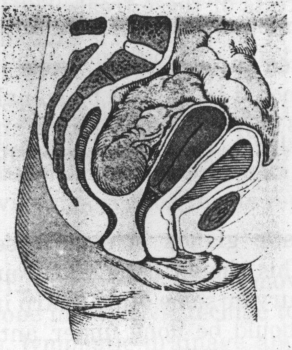
Fig. 45. Left-sided Pyosalpinx.
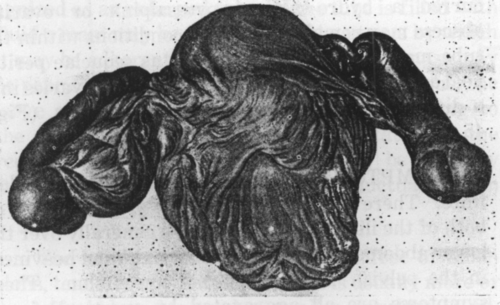
Fig. 46. Double pyohydrosalpinx, Chronic Adhesive Perimetritis and Oophoritis. Both tubes are almost filled with pus, the fimbriated ends, walled off both from the isthmus and from the peritoneal cavity, are transformed into cysts. (Schaeffer, Atlas and Epitome of Gynecology.)
Symptoms
These are often vague and indefinite. There is usually tenderness or pain in one or both of the iliac fossae, or perhaps generally over the lower abdomen, with a sense of weight and heaviness in the pelvis. Backache is not uncommon. These symptoms are all aggravated by exertion of any kind, or by standing, and usually by the onset of menstruation. Leucorrhoea is often present. Sometimes there may be an occasional gush of muco-purulent fluid, perhaps due to the discharge of an accumulation of fluid in the tube. Menstrual disturbances are common. Sterility is to be expected. There is usually some deterioration of the general health with loss of flesh and strength and often neurotic symptoms. Acute exacerbations of the symptoms may occur from time to time from various causes.
Diagnosis
This is determined finally by a bimanual examination. In mild cases the tubes may be found in a thickened or nodular condition as slightly tender cards passing out from one or both cornua of the uterus. Again a sausage shaped sensitive mass will be detected, more or less mobile, and easily recognized as an enlarged tube. If the tube is filled with fluid a mass may be found beside the uterus by which it may be adherent to the pelvic wall. The mass may be pear shaped, the small end toward the uterus, the large end formed by the dilated tube adhering to the ovary. Often the tube has gravitated to the recto-uterine excavation where it may be fixed by adhesions. When it contains fluid, fluctuation can usually be elicited.
The ovary can sometimes be felt free of adhesions, tenderness or swelling, but it is usually more or less affected, and in tender, swollen, involved in adhesions and matted to the tubes.
A recto-abdominal examination is of aid in making a diagnosis.
Treatment
This has been discussed in the Chapter on Adhesions.
Continue to:


My Books

