


1. Inflammatory Skin Eruptions
Description
This section is from the book "A Manual Of Pathology", by Joseph Coats, Lewis K. Sutherland. Also available from Amazon: A Manual Of Pathology.
1. Inflammatory Skin Eruptions
The affections included under this designation consist in various inflammatory affections of the skin due in some cases to local irritation, and in others to general irritation from conditions of the blood. In most of them individual peculiarities play a very important part, so that slight irritations which have no effect in some people produce eruptions on others. Indeed the tendency in many cases is so great that the conditions are regarded as idiopathic. There is no doubt also that nervous conditions have an important influence. The beginning of a skin eruption is often accompanied by itching, and the scratching which the itching induces not infrequently assists in the development of the eruption.
Character Of The Lesions
The inflammatory process occurring in the various structures of the skin produces the changes which occur elsewhere under like circumstances. There is hyperemia, exudation of serous fluid and leucocytes, parenchymatous changes chiefly in the epidermis, and, if the inflammation be prolonged, new-formation in the true skin. Various names are applied to the anatomical conditions thus brought about.
A Wheal is a limited swelling of the skin due to an oedema of the superficial layers of the cutis. It is temporary, and in all cases the nervous system is concerned, as evidenced by the itching which is usuallv characteristic. A Papule is a small solid elevation of the skin, "due generally to inflammatory exudation which infiltrates the papillary layer of the cutis and the epidermis. There is often proliferation of the epidermic cells as well. The term Tubercle is sometimes used, not in the histological sense, but to indicate an irregular rounded solid elevation from infiltration of the skin. In the Vesicle we have an accumulation of serous exudation raising the epidermis. The fluid is not between cutis and epidermis, but the separation takes place amongst the softer cells of the Malpighian layer, so that there is epidermis both below and above the fluid. The vesicles may be very small or so large as to form considerable Blebs or Bullae. A Pustule is like a vesicle but contains pus, and is due to a more intense inflammation. Scales or Squamae are composed of epidermis which has been produced in excess and is less firmly attached than normally. The rapid production of epidermic cells is due to a parenchymatous inflammation, and the epidermic cells do not undergo the horny transformation to the same extent as normally.
The individual skin affections have received various names which only in part represent the pathological characters.
(A) Sudamina Or Miliaria
In this there are multitudes of minute vesicles, which are at first filled with clear fluid (miliaria crystallina) which afterwards may become turbid. The condition arises in cases where there is excessive sweating and more particularly in acute rheumatism. The vesicles originate in the terminal parts of the sweat-ducts. In a case examined by the author the cause of dilatation was the obstruction of the spiral part of the duct by leucocytes (see Fig. 475), this narrow twisted part of the duct being incapable of giving passage to these cells. The disease was thus inflammatory from the outset, and its inflammatory nature was further proclaimed by the increasing accumulation of leucocytes as the vesicle increased (see Fig. 476). This was in a case of acute rheumatism, where presumably the irritant in the blood, in being secreted in the sweat, was the cause of cutaneous affection. In cases where, from excessive sweating, there is an eruption of sudamina, there is probably an irritant in the sweat which may be less of a general pathogenic agent than that of acute rheumati.

Fig. 475. - First stage in the formation of a sudamen. The terminal part of the sweat-duct is obstructed, and distension is beginning in the portion of the duct in the deeper layers of the epidermis. X 100.
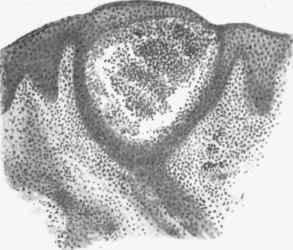
Fig. 476. - Sudamen formed by dilated sweat duct. It is largely occupied by leucocytes attracted thither, x 80.
(B) Erythema And Roseola
These names are applied to mild inflam matory conditions in which the chief, and sometimes the only apparent change is hyperemia. The inflammatory nature of the condition is, however, often indicated by the existence of more or less swelling, due to ceclema of the superficial layers of the skin (erythema nodosum and papulosum). The attacks are often followed by de squamation.
These very mild inflammations are frequently somewhat generalized, and appear in many cases to be, like urticaria, related to special conditions of the nervous system, especially, perhaps, of the vasomotor nerves. They may also be produced by external irritants, especially in susceptible persons.
(E) Eczema
This name is applied to localized inflammations of the skin, usually of a subacute or chronic character. The mere fact of the local nature would indicate that the irritant here comes from without; but external irritation is hardly ever the entire explanation of the attacks. In no other disease do individual peculiarities and special states of the organism play a more important part. The external irritant may be very various, such as medicinal ointments, stuffs used by the patient in his. occupation, as in dyeing, parasites which induce scratching, etc. The intensity of the inflammation depends on the susceptibility of the patient and the character of the irritant. The various degrees of intensity are, to a great extent, distinguished by the characters of the eruption, so that we have papules, vesicles, pustule-, etc., characterizing different cases of eczema. From these differences are derived the names Eczema papulosum, vesiculosum. and pustu losum.
In chronic cases a condition is brought about somewhat comparable to catarrh of mucous membranes, and sometimes called Catarrh of the skin The inflamed surface keeps on discharging serous fluid, in varying quantity. The epidermis is softened, and, to a considerable extent, lost, so that the cutis is exposed or covered with irregular crusts. The cutis itself is red, and it is thickened both by the serous exudation and by accumulation of round cells.
Continue to:


My Books

