


2. Fatty Infiltration Of The Heart
Description
This section is from the book "A Manual Of Pathology", by Joseph Coats, Lewis K. Sutherland. Also available from Amazon: A Manual Of Pathology.
2. Fatty Infiltration Of The Heart
The normal hearth well known to present on its surface a certain amount of adipose tissue (see Fig. 208). This fat is beneath the pericardium, lying between it and the muscular substance of the wall. It is normally most abundant along the course of the coronary arteries, along the inferior border of the right ventricle, at the apex, and at the origins of the great vessels. In different individuals the amount of the adipose tissue and the extent to which it covers the muscular substance so as to conceal it from view, vary greatly, but it may be said generally that a considerable part of the surface of the right ventricle and the greater part of that of the left are usually free of fat. Sometimes this fat increases greatly, both in superficial area and in thickness, so that the entire right ventricle may be covered while a portion of the left is still free, or the whole heart may be coated with a thick mantle of fat.

Fig. 208. - Wall of heart showing normal condition of adipose tissue on surface, to contrast with next figure, x 12.
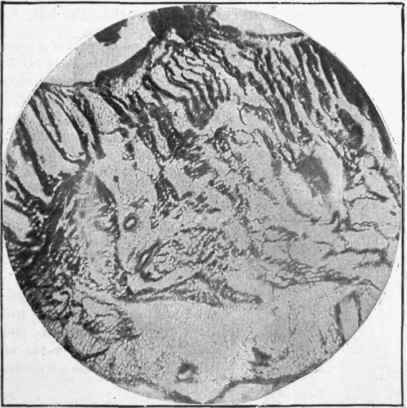
Fig. '209. - Fatty infiltration of heart. The illustration shows the whole thicknes of the right ventricle. Adipose tissue extends amongst the muscle through the entire thickness of the wall, x 12.
The adipose tissue does not always confine itself to the pericardium, but frequently extends into the connective tissue lying between the muscular fasciculi in the proper muscular wall of the heart. The superficial layers of the muscular wall may thus be largely replaced by adipose tissue, which may even appear in isolated patches immediately beneath the endocardium. It is not uncommon to find the proper muscular substance of the right ventricle largely replaced by adipose tissue, only a thin layer of red muscle appearing inside the thick layer of fat, and even this interrupted by areas of adipose tissue. The accompanying photograph (Fig. 209) shows the most extreme degree of fatty infiltration. It is from a section of the right ventricle whose muscle is dissociated and encroached upon by adipose tissue which extends even to the internal surface under the endocardium. Of course, in such cases, there is great loss of the muscular power of the heart, the right ventricle being more affected than the left.
In some cases the increase of the external fat is merely part of a general obesity, in which the fat in all its various localities throughout the body takes part. But sometimes its significance is much more serious, and this applies especially to the cases in which adipose tissue forms between the muscular bundles. The space occupied by the fat must be obtained at the expense of the proper muscular substance, and the question arises whether the atrophy of the muscles is the primary condition or the fatty infiltration. We have to take into consideration the fact that a fatty infiltration of an exactly similar character occurs, as we have already seen, in voluntary muscle, and is there associated with disuse of the muscle. In this case the loss of function is the primary condition and the fatty infiltration is secondary. And so in the case of the heart, we meet with fatty infiltration in cases where there is no general obesity, often in old debilitated persons, or even in those who have been subject to some emaciating disease such as cancer. In that case we may infer that the atrophy and weakening of the muscle have been primary and the infiltration of fat secondary.
Continue to:


My Books

