


3. Pyonephrosis
Description
This section is from the book "A Manual Of Pathology", by Joseph Coats, Lewis K. Sutherland. Also available from Amazon: A Manual Of Pathology.
3. Pyonephrosis
This term is used when, along with or following a hydronephrosis, suppuration occurs in the dilated structures. This is usually the result of an extension upwards of decomposition and inflammation from the bladder, such as has been just referred to. It may be followed by suppurative inflammation of the kidney, and in that case is usually fatal.
Such extension upwards will usually occur in cases where the primary condition, which probably corresponds to the seat of obstruction, is in the bladder or urethra, hence it may be bi-lateral, and in that case is almost certainly fatal. However, it is not uncommonly uni-lateral, the extension having only occurred up one ureter. In that case there may be an abscess-like cavity formed, the dilated pelvis and calices being filled with pus.
If the affection of the lower urinary tract is recovered from, healing may take place in the kidney. One of the most constant results in this case is obliteration of the pelvis or upper part of the ureter, so that the kidney is shut off from the latter. By the obliteration of the pelvis the kidney is converted into a series of cysts, each independent of the other, and representing dilated calices (see Fig. 433). In these cysts pus is at first present, but as the corpuscles die and the fluid is absorbed, the pus dries-in and leaves a pultaceous matter in which lime salts are abundantly present (a in figure). It is not uncommon.to meet with a kidney thus converted into cysts filled with putty-like matter, and it is remarkable that along with these there may be some cysts in which clear serous fluid is present. Compensatory hypertrophy of the other kidney may complete the cure.
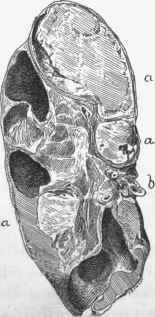
Fig. 433. - Healed pyonephrosis. 6, obliterated pelvis; a, a, a, cavities filled with pultaceous matter. There are other cavities which contained serous fluid.
The above is believed by the author to be the course of events in cases of the kind referred to. The description is based chiefly on cases which have come under his own observation. In one such case there was obstruction in the urethra in a female, with hypertrophy of the bladder. One kidney was found in the healed condition described above, while the other showed compensatory hypertrophy. This patient died from bronchitis without, latterly, any renal symptoms. In another case one kidney showed pultaceous masses, while the other presented a recent suppurative inflammation which had proved fatal. There was a prolonged affection of the bladder, with, apparently, an extension first to one kidney, producing a pyonephrosis partly recovered from, and then to the other, leading to a fatal result. It is not to be denied, however, that somewhat similar appearances may result from healing of a tuberculosis of the kidney. In this case, however, there will be signs of tuberculosis in the ureters, and probably in other parts of the genitourinary tract.
Continue to:


My Books

