


I. Malformations And Misplacements Of The Kidney
Description
This section is from the book "A Manual Of Pathology", by Joseph Coats, Lewis K. Sutherland. Also available from Amazon: A Manual Of Pathology.
I. Malformations And Misplacements Of The Kidney
1. Congenital Malformations
These are frequently such as to produce comparatively little interference with the function of the organs. This does not apply to the extreme cases where both organs are absent or extremely small, but as this only occurs with serious malformations of the body as a whole, the child does not survive.
Defect of one kidney is not infrequently met with in well-formed adults without any sign of disease of the kidneys. It is mostly the left kidney that is defective, and it may be entirely absent, its vessels and a diminutive ureter ending in a piece of connective tissue. The other kidney in these cases undergoes a compensatory hypertrophy.
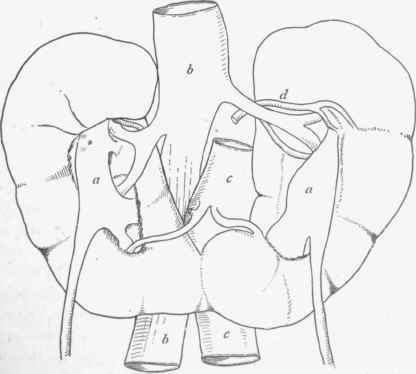
Fig. 419. - Horse-shoo kidney, a, a, pelves with ureters, the latter coming off from the external instead of the internal borders; b, b, vena cava; c, c, aorta giving off two renal arteries; another artery, d, came off higher up.
The kidney also not infrequently shows some trace of the Foetal lobulation which in some animals is normally retained throughout life.
Coalescence of the two kidneys across the middle line is one of the most frequent malformations. Various degrees of it are presented. It may be a simple elongation of the inferior extremities of the kidneys which are united by a fibrous band passing across the vertebra?. Or there may be a proper isthmus of renal tissue uniting the two kidneys into one and forming the well-known Horse-shoe kidney (Fig. 419). From this we have various grades on to complete coalescence of the kidneys into an elongated or square body across the vertebrae. In almost every case there are the regular two ureters, or they may even be increased in number. This form of kidney is often depressed in position, even coming as low in some cases as the hollow of the sacrum. When depressed the arteries usually have abnormal origins, as from the common iliac, hypogastric, etc.
Continue to:


My Books

