


General Examination. Part 4

Description
This section is from the book "Diseases Of The Rectum And Pelvic Colon", by Martin L. Bodkin. Also available from Amazon: Diseases of the rectum and pelvic colon.
General Examination. Part 4
OâNeill rectal speculum and many others, are ordinarily associated with so much pain when an attempt is made to open the valves of the speculum, that their use, without an anesthetic, becomes less as one gains in the practical knowledge of examination. Conical defenestrated specular are intended to permit the mucous membrane or hemorrhoid mass to enter the opening in the speculum for injection or other forms of treatment.
The blades of the bivalve speculum are very apt to pinch the folds of mucous membrane or hemorrhoid mass, causing considerable pain. These instruments ordinarily give but an imperfect view of the lower four inches of the rectum. The vaginal Sims's speculum, when small, can be introduced on the side opposite to the lesion in the rectum or anal canal and permits a good view of the affected region. This instrument cannot be used satisfactorily excepting with the patient in the knee-chest position.
The Van Burnâs rectal speculum is a modification of Sims's vaginal speculum by the removal of one end and the addition of a straight handle, so that the buttocks will not interfere with its introduction.
The Ferguson tubular vaginal speculum was formerly used by introducing the rectal bogie through it as an abjuratory, and removing it when the instrument was passed to the desired point in the rectum. It served as a very satisfactory instrument, similar to the recent instruments devised by Kelly.
Spectroscopes. The inflation of the rectum with air for the purpose of introducing these instruments was first suggested by the experiments of Marion Sims in 1845, when he demonstrated the possibilities of inflating the vagina for examination, and our rectal surgeons at once applied it to the examinations of the sigmoid and rectum. Van Burn, Oppenheimer, Tut-tel. Appalling Otis. Law and many others have popularized this method by modifications which have made these instruments of practical utility.
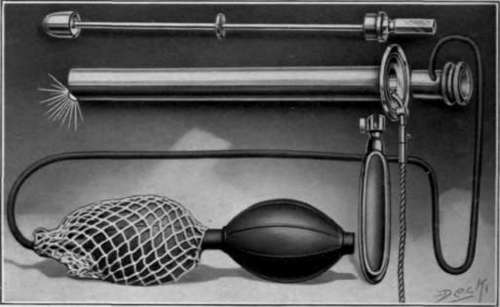
Fig. 8. Tittleâs pneumatic proctorial
The Law, Pennington and Beach spectroscopes are closed with glass caps through which the operator may view the interior of the rectum or sigmoid and at the same time keep the organs inflated by means of a rubber tube and bulb. Tittleâs proctorial is a modified Kelleyâs tube, the abjuratory is small so as to give its end the Mercer curve, which, it is claimed, lessens the difficulty in rounding the sacral promontory when entering the sigmoid.
Spectroscopes and oscilloscopes of any variety should always be provided with an abjuratory which is round on top and well fitted to the tube. Otherwise, the instrument when introduced will cut and injure the rectal wall and prove most dangerous. Force should never be used in their introduction as there is danger of rupturing either the rectal wall or the anal canal.
These instruments are made with different lengths of tubes for the examination of the rectum and sigmoid or colon, and of differing diameters most valuable in the treatment of the affections found in this region. The knee-chest position is always essential when the ordinary proctorial is used. The Law's instrument has proved satisfactory to me. as it is simple in its construction and very easily cleaned and repaired.

Fig. 9. Kelleyâs instruments for examining the sigmoid and rectum. A. kaleidoscope; B, proctorial; C, dilator; D, curettage; E, applicator; F, sponge holder; G, scoop.
Spectroscopes and kaleidoscopes are made with a small electric lamp, screwed to the end of the lamp carrier. The carrier is made long enough to reach the end of the tube and when the lamp is in position it illuminates the portion of bowel inflated beyond the lamp.
Probes of various lengths and thicknesses are necessary for the examination of fistula in order to measure the depth and the course taken by these tracts. Ordinarily a short probe of five or six inches length is sufficient, but occasionally when extensive burrowing has taken place which is also very tortuous, the silver bullet probe is almost indispensable. The bullet probe, when made of silver, can be rolled up and easily fitted into the ordinary pocket instrument case.
Fig. 10. Wales's soft rubber rectal bogie
Bogies in graduated sizes are indispensable in the determination of rectal strictures, as they indicate the diameter of the bowel lumen and also the distance from the anal orifice at which the stricture is located. The Wales soft-rubber bogie is the one in common use, made in various diameters and about twelve inches in length. The bogie is hollow in the center so it may be used to carry an irrigating fluid above a stricture or impaction. These instruments should not be used blindly or forcibly introduced into the rectum as there is great danger of rupturing the wall. Sometimes the bogie will curl upon itself in the same manner as the ordinary rectal tube When this occurs the bogie should be introduced through the proctorial
Dilators for the purpose of examination are seldom of any benefit, as stretching the sphincters to the degree necessary to view all of the anal canal, without a general anesthesia seldom proves a success. The metallic conical dilator devised by Dr. H. A. Kelly, is a most satisfactory instrument, as the dilatation is gradual from the cone-shaped top to the broader base. This instrument, however, has proved most useful to me while the patient was under a general anesthetic prior to rectal examination.
Dilatation with the fingers is the old method, but owing to the uneven pressure, it is very painful and will not assist one in finding a lesion at the upper limit of the anal canal. Dilatation at the anal orifice for any purpose will not permit a view of the rectal wall sufficient to give any correct idea of lesions in that region, and when it is intended to overcome the forcible contraction of the sphincters due to a fissure or ulcer, the method is so painful that it can hardly be approved of unless under general anesthesia.
Continue to:


My Books

