


Hemorrhoids. Part 7

Description
This section is from the book "Diseases Of The Rectum And Pelvic Colon", by Martin L. Bodkin. Also available from Amazon: Diseases of the rectum and pelvic colon.
Hemorrhoids. Part 7
The hemorrhoid becomes very much distended and it may be necessary to puncture large ones to allow the blood to escape, in order to prevent sloughing. The tumor should be replaced above the sphincter and a firm compress applied so as to prevent it prolapsing. Rickets claims that it is not necessary to ligate all of the hemorrhoids which may be present, as an strophic change takes place, which will often obliterate some of them. Sub mucous ligation should not be done on hemorrhoids situated closer than one-half to one inch apart.
This method is open to the possibilities of infection, and subsequent abscess may follow buried ligatures in the rectal wall. Should the ligatures overlap or loop into one another it will result in a certain amount of contraction in the lumen of the gut.
Mathews' Method. The patient is placed in the Sims's position, the sphincter dilated and the hemorrhoids are brought into view with the aid of forceps or small detractors The large tumors are caught with forceps, drawn out and held by an assistant. A curved needle, threaded with strong, double silk ligature, is passed through the base. The needle is cut away and the ligature is tied first on one side, then on the other.
After the tumor is tightly tied on each side, the pile is cut off with a pair of scissors. The amount of the hemorrhoid to be cut away is a matter of individual judgment, but only so much of the mass should be left as will firmly hold the ligature. External hemorrhoids are incised around the base and transfixed the same as with the internal hemorrhoid, the ligature being held in the groove made by an incision around the base of the mass. A suppository of morphine or opium should be administered and gauze compress and a T-bandage applied. Mathews claims that if a good sweeping cut is made around the skin tabs to be removed, the patient will be much more comfortable afterward, and there will be very little danger of anal stricture.
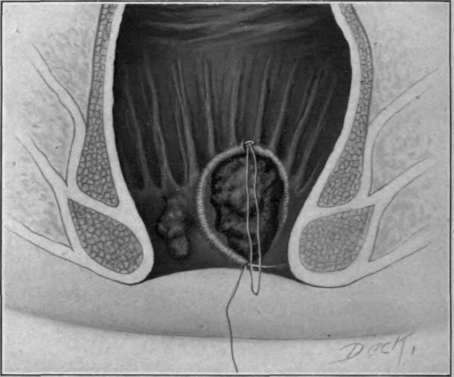
Fig. 61. Sub mucous ligation of hemorrhoid ( Ricketsâs method).
The Ligature Operation is the oldest known scientific method of treating hemorrhoids and was practiced centuries ago by the ancients. Surgeons of the last century recon-mending its use are the eminent Sir Ashley Cooper, Van Burn, Maidenhair, Lyme and Appalling and, with the exception of the clamp and cattery, originated by Cu sack of Dublin, is preeminently the ideal operation for simplicity and safety to the patient. The ligature operation can be very well adopted in the office treatment of cases when one or two hemorrhoids are the only cause of trouble to the individual, and it is well to bear this in mind and to be familiar with the technique. The ligature operation is easily performed under the use of local anesthetics. This method of treating office patients who refuse a more radical operation, and when only a single pile presents itself, has become my only method of treatment under local anesthesia.
The technique is the same as under general anesthesia and the surgeon who has performed the operation under local anesthesia will find it quite easy under any form of anesthesia. The only difference is that under local anesthesia the sphincters cannot be dilated and the hemorrhoid must be pulled down by the finger or made to protrude by the injection into the rectum of an ounce of equal parts of glycerin and water, about an hour previous to the operation.

Fig. 62. Mathews' method of trans fixation and ligation of hemorrhoid.
Ligature Operation under Local Anesthesia. The hemorrhoid should be forced to protrude sufficiently to allow the certain introduction of the hypodermic needle into the center of the mass. The anesthetizing solution should be slowly forced into it, so as to avoid a sudden, painful distention of the tissue. After the needle has been inserted it may be turned in different directions without withdrawal and the barrel of the syringe may be refilled if necessary by simply unscrewing the needle while in position. If more than one puncture is made into the surface of the hemorrhoid the fluid sometimes runs out quite as fast as it is introduced. The distention should be sufficient to turn a portion of the hemorrhoid white, exhibiting at that point complete pressure anesthesia which will be followed later by the anesthesia of the particular drug used for the purpose. Often this single point of anesthesia indicated by the white spot will permit the grasping of the mass at once with an artery forceps and allow the inspection of the hemorrhoid for further manipulation.
Within about five minutes the mucous membrane sulfurs for the ligature may be cut around the base of the hemorrhoid and a strong linen ligature firmly tied within it. The portion of the hemorrhoid external to the ligature should then be cut away, care being taken to allow a sufficient stump to remain so that the ligature will not slip later. To doubly ensure against the slipping of the ligature some surgeons transfix the hemorrhoid mass with a double ligature which is tied within the sulfurs on both sides. After the hemorrhoid is cut, the escape of the anesthetizing fluid allows the mass to shrink, and unless the ligature has been drawn tight enough to allow for this shrinkage it will soon fall off and permit bleeding. The use of a heavy linen thread will prove most satisfactory as its strength will permit a good tight constriction of the mass without cutting through it.
Cocaine in various solutions is commonly used for this local anesthesia, but its strength should be of the minimum quantity so as to allow the free use of the fluid for the purpose of pressure anesthesia without the injurious effect of the drug on the patient, and also as cocaine is sometimes very unreliable in producing local anesthesia, even when a sufficient quantity has been introduced to excite the constitutional symptoms of an overdose.
Continue to:


My Books

