


Mechanical Function
Description
This section is from the book "Diseases Of The Stomach", by Max Einhorn. Also available from Amazon: Diseases of the Stomach.
Mechanical Function
Under the mechanical function of the stomach we understand those changes which arise in the physical condition of foods and are produced by motions of this organ. These motions are of two characters: (1) active (peristaltic) and (2) passive (transmitted, respiratory, and pulsatory). Both motions shake the contents of the stomach and cause all parts of the food to come into direct contact with the gastric mucosa.
The Gastrograph
Until recently there was no way of ascertaining this mechanical function of the stomach in the living. All the experiments made with regard to this subject have been performed on laparoto-jnized animals. These, however, scarcely permitted any conclusions as to the manner in which peristalsis of the stomach normally takes place; for animals prepared for such experiments (after being chloroformed or etherized) are certainly not normal.
As the mechanical action consists in the churning of the contents, and as by estimating the latter we may determine the first, I have constructed an apparatus which indicates every motion to which it may be subjected. The whole apparatus comprises: 1. The ball (being the principal part). 2. A few electric cells. 3. The ticker.
The ball (Fig. 36) consists of two hollow metallic hemispheres (a), which are screwed together; within it is lodged and attached to the upper hemisphere, but perfectly insulated from the same at the attachment, another ball provided with spikes (6) radiating in all directions, but not touching the inside walls of the hemispheres; another very small platinum ball (c) lies within the large ball and can freely move in all directions, knocking at the spikes (see Fig. 37). Two insulated wires - one connected with the hollow ball, the other with the spiked ball - are encased in a very fine, thin rubber tube, forming the cable, and separate at the end into two branches, which must be attached to an electric battery. As soon as the platinum ball touches one of the spikes an electric circuit is made; when, however, the platinum ball moves a little way and ceases to touch the. spike the current is broken.
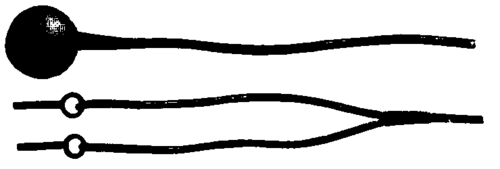
Fig 36. - The Ball Apparatus of the Gastograph (Einhorn). Natural size.
At each motion of the ball apparatus a rolling of the little platinum ball tabes place and the electric current is either closed or broken. When the apparatus is at rest there is no change in the current. On connecting the "ticker" with the battery and the ball, each motion of the latter will be recorded on the paper in showing the "breaks" and "makes" of the current.
If the ball is swallowed and brought into the stomach, the motions of the former - which are caused by the active and passive motions of the stomach - can be recorded in the way described.
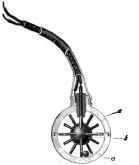
I have railed this apparatus "gastrokiuesograph," or, shorter, "gastrograph".
From numerous tests which I have made, it appears with certainty that the gastrograph works in the desired manner - i.e., it indicates the motions of the ball and can thus be utilized for the valuation of the motions of the stomach or the mechanical action of this organ.
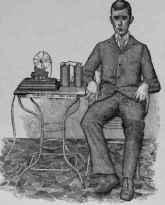
Fig. 38. - A Patient Undergoing Examination with the Gastrograph.
1The gastrograph maybe obtained of Richard Kny & Co., New York.
Method
The ball is dipped in lukewarm water, introduced into the pharynx of the patient, and the latter told to swallow. The patient-may drink some water. After a short while (front a minute to a minute and a half) the ball reaches the stomach. It is advisable to let the ball slip far down into the stomach, so that the instance from the mouth to the ball (length of cable) is about 50 cm. The cable is then connected with the battery and the indicator and the latter set agoing for three minutes (Fig. 88). The patient during this pro-cwlure sits quietly on a comfortable chair. At the end of three minutes the indicator is checked, the cable disconnected from the battery, and the ball withdrawn from the stomach. When at the introitus oesophagi, it is necessary, here in the same way as when using the bucket' or the deglutable electrode, to have the patient swallow, and to utilize the moment when the larynx goes upward and forward, to withdraw the ball without using any force whatever.
The strip of paper which has rolled off from the reel is cut off and the marks are then perused. The black line shows when the current was closed, the empty places when there was no current. As an instance I give a few gastrograms (reduced ten times) (Fig. 39). It is practical to enter the marks of the strips into a copy-hook. This is done in the following way: Each one is divided into three equal spaces - each space corresponding to one minute - each space (or minute) into ten divisions, and the "breaks" and "makes" of the current marked with dots at the corresponding place. In this way the number of current changes can very easily be looked over and comparisons made.
1 Max Elnhorn, Medical Record. July 19th. 1890
Continue to:


My Books

