


Characteristics Of Induced Mammary Cancers
Description
This section is from the book "The Scientific Contributions Of The Ben May Laboratory For Cancer Research", by The University of Chicago. Also available from Amazon: The Scientific Contributions Of The Ben May Laboratory For Cancer Research.
Characteristics Of Induced Mammary Cancers
The mammary cancers in intact rats are ecru in color and rather firm. Hemorrhage and necrosis are observed in very large tumors but are absent at earlier stages. The growths, differing in physiologic properties, show a considerable similarity of cytologic pattern. The tumors consist of acini, surrounded by myo-epithelial cells, lined with many layers of epithelial cells and are arranged to form glandlike structures (Figs. 12 and 13). The earliest neoplastic changes in the mammary glands were observed 14 days after feeding the carcinogen; at this time a considerable proliferation of epithelial cells was observed in areas of the mammary gland, with penetration of the neoplasm through the normal acinar confines.
The mammary cancers induced by polynuclear hydrocarbons observe the first law of cancer; they have the high aerobic and anaerobic glycolysis (157) that Warburg discovered are metabolic characteristics of all malignant tumors (Warburg, O. Metabolism of Tumours. London: Constable & Co., 1930). Arranged quantitatively, the soluble pyridine-nucleotide-linked dehydrogenases form individually unique patterns, which are characteristic, respectively, for mammary cancer and for normal mammary glands. Malic dehydrogenase (DPN) had the greatest activity in the normal breast; lactic dehydrogenase occupied the first rank in mammary cancer (157). The level of malic enzyme (TPN) was low in cancer of the breast.
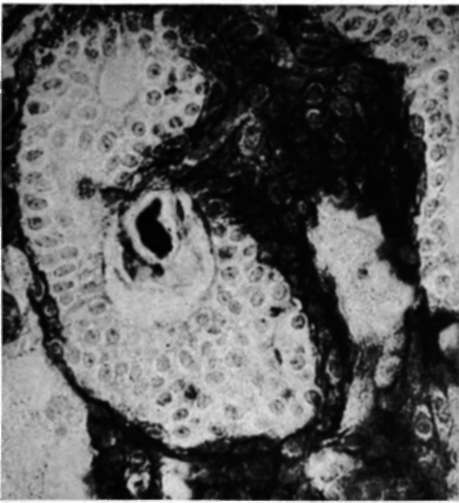
Fig. 12.
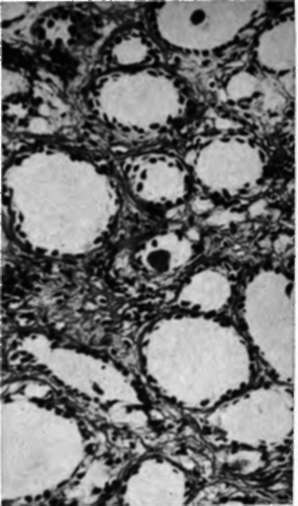
Fig. 13.
Fig. 12.-Mammary cancer induced by a single feeding of polynuclear hydrocarbons in an intact rat Fig. 13.-Hormone-withdrawal atrophy in a mammary cancer 33 days after ovariectomy.
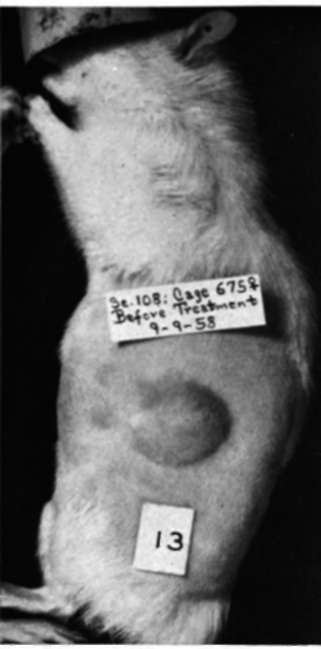
Fig. 14.

Fig. 15.
Fig. 14.-Mammary cancer induced by a single feeding of DMBA Fig. 15.-The same rat 80 days after hypophysectomy.
Suppression Of Mammary Cancer
It was found possible to suppress many of the mammary cancers at an early stage by hormonal means (53). The experiment rests on two considerations: (1) under appropriate conditions (these were fulfilled) the incidence of mammary cancer is invariable, and (2) the cancer is present fourteen days after a solitary feeding of an effective polynuclear hydrocarbon.
At age 50 days, normal female rats of the Sprague-Dawley strain were fed a single dose of 3-MC, 100 mg., and divided into groups. The controls were maintained as virgins and all developed mammary cancer. The endocrine status of other groups was modified at age 65 days.
The expected incidence of mammary cancer was lessened notably in rats which had become pregnant 15 days after the solitary feeding; pregnancy had obliterated cancer. Other groups were treated with progesterone, 4 mg., together with estradiol-17β, 10 /xg., beginning at age 65 days. This combination of steroids induced the characteristic gestational type of proliferation of the mammary glands; yet few mammary cancers developed in these very hyperplastic mammary glands (53). It was obvious that pregnancy or the administration of ovarian steroids frequendy destroyed many young cancers struggling for a foothold and rats in this class never suffered a recrudescence of cancer of the breast.
Continue to:


My Books

