


Fatty Acid Oxidase System Of Animal Tissues
Description
This section is from the book "The Scientific Contributions Of The Ben May Laboratory For Cancer Research", by The University of Chicago. Also available from Amazon: The Scientific Contributions Of The Ben May Laboratory For Cancer Research.
Fatty Acid Oxidase System Of Animal Tissues
Munoz and Leloir (50, 44) were the first investigators to demonstrate fatty acid oxidation in cell-free preparations of liver. Using preparations of particulate material from guinea pig liver, they found that butyrate oxidation by molecular oxygen occurred if the preparations were supplemented with Mg", cytochrome c, orthophos-phate, adenylic acid, and an intermediate of the Krebs tricarboxylic acid cycle. The ketone bodies appeared to be the main product of oxidation. The system was found to be extremely labile, and inactive preparations were often obtained. Although butyrate was readily oxidized, oxidation of higher fatty acids, such as octanoic, could only occasionally be demonstrated. Nevertheless, it was of considerable significance that the process involved cofactors already known to be involved in the oxidation of pyruvate. Independently, Lehn-inger (34, 35) using homogenates of rat liver in Ca-free saline was also able to demonstrate oxidation of saturated acids from C4 to C16. Under his conditions, the system was considerably less labile and was far more amenable to systematic study. It was shortly found (37) that the oxidative activity resided in the easily sedimented particulate fraction of the homogenates which, after separation and washing, oxidized fatty acids in the presence of ATP, Mg", and orthophosphate without significant endogenous O2 uptake. This situation therefore permitted the study of the products of oxidation, and it was soon found that octanoate was oxidized to two moles of acetoacetate which accumulated quantitatively, since the system showed no ability to oxidize acetoacetate (39). The important observation was made (36, 39) that if oxalacetate or an oxalacetate precursor was also added, then the yield of acetoacetate was diminished and some of the fatty acid carbon accumulated in the form of citrate, a-ketoglutarate, and succinate, indicating entry of some of the fatty acid carbon into the tricarboxylic acid cycle. Work of Breusch (8) and of Wieland and Rosenthal (65) had earlier indicated that acetoacetate could condense with oxalacetate to form citrate in certain tissue extracts, and it was therefore expected that acetoacetate was the active intermediate in the entry of fatty acid into the Krebs cycle in the liver system. A direct test of acetoacetate in the liver system showed, however, that it was completely unre-active, and could therefore not be an intermediate between fatty acid and citrate. In view of this finding, and the isotope work of Wein-house, Medes, and Floyd (63) which indicated fragmentation of octanoate to G units, it was postulated that the active intermediate in both acetoacetate formation and citrate formation was a C2 intermediate, derived oxidatively from the fatty acid chain. The fact that pyruvate oxidation in such preparations followed the same pathways suggested a common C2 intermediate (39). Tests of a long series of pertinent compounds, including acetate and acetyl phosphate, however, have not disclosed any compound which can form acetoacetate or citrate at rates even remotely approaching those occurring during active fatty acid oxidation.
It is now known from the work of Stadtman, Doudoroff, and Lipmann (58) and from the work of the Ochoa group (60, 51, 6l) that the two-carbon compound involved in the formation of acetoacetate and of citrate is the acetylated form of coenzyme A. Evidence that acetyl-CoA is a thioester in which the acetyl group is bound to the /3-mercaptoethylamine moiety of the coenzyme has been presented by Lynen, Reichert, and Rueff (48), who have isolated the active acetyl compound in partly purified state. It follows, therefore, that the process of β oxidation described above must generate acetyl-CoA, two molecules of which may condense to form acetoacetate, or in the presence of oxalacetate may alternatively form citrate, thus entering the Krebs citric acid cycle as shown in Fig. 1.
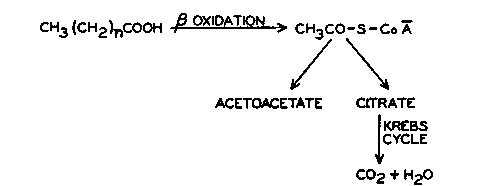
Fig. 1.
Properties of the enzyme system. With the nature of the gross pattern and products of oxidation defined, the properties of the fatty acid oxidase system may be considered in more detail. Although the washed particles of liver used by Lehninger appeared to be considerably more stable than those of Leloir and Munoz, and could in addition oxidize long chain acids (up to C16), it was soon found that the activity did not survive attempts at further fractionation, however mild the conditions. The preparations could be stored at O° for some hours without much loss in activity; however, incubation of the particles in absence of substrate and ATP at 38° resulted in complete loss of activity in 20 minutes or less. The system shows optimum activity at pH 7.4. Oxidation is very strongly inhibited by fluoride, Ca++, 2, 4-dinitrophenol, methylene blue, arsenite, arsenate, and also certain phenyl-substituted fatty acids. The system is also inhibited by higher concentrations of fatty acids, especially the longer members of the series, presumably by surface effects (37). Representative optimum concentrations are butyrate, 0.01 M; octano-ate, 0.001 M; palmitate, 0.00025 M.
The necessity for preserving approximate isotonicity for enzymatic activity has caused Potter (52) to conclude that the system was associated only with unbroken cells in the particulate preparations. Further investigations by Lehninger and Kennedy (42) showed the activity could actually survive exposure of the particles to distilled H2O for short periods, but the oxidation occurred only after restoration of approximate isotonicity by either salts such as NaCl, KC1, LiCl, or by certain non-electrolytes (sucrose, glucose, xylose). Although microscopic examination of active particles showed essentially no intact cells, the oxidase system nevertheless depended upon maintenance of approximate isotonicity. These observations led Kennedy and Lehninger (26, 27) to examine the fatty acid oxidase activity of cell nuclei, mitochondria, and supernatant separated from rat liver homogenates in sucrose solutions by the then newly described method of Hogeboom, Schneider, and Pallade (22), and it was found that isolated mitochondria contained essentially all the oxidase activity, no other single fraction possessing appreciable activity. It was shown also that the saline-washed preparations used earlier were active because of their content of agglutinated mitochondria. Schneider (54) independently came to the same conclusion. Isolated mitochondria have since been found to catalyze all reactions of the Krebs cycle and coupled phosphorylations. The Qo: of fatty acid oxidation in fresh mitochondria may be as high as 90.
While many efforts to dissociate fatty acid oxidase activity from intact mitochondrial structure have proved unsuccessful, Drysdale (14) in an interesting preliminary communication has reported active fatty acid oxidation in completely soluble enzyme extracts from acetone powder preparations of rat liver mitochondria. The importance of work along these lines is obvious, and is a necessary preliminary for detailed investigation of the fatty acid oxidase enzymes from animal tissues.
The general properties of the fatty acid oxidase system, as revealed by the study of the saline-washed residues described by Lehninger or by later work with isolated mitochondria, are also shown by the " cyclophorase " preparations described by Green and his colleagues (2, 19,13,30). These workers have investigated in detail the process of fatty acid oxidation and the oxidation of Krebs cycle intermediates, using the well-washed, easily sedimented particulate matter of liver and kidney as enzyme sources. The preparations are thus roughly equivalent enzymatically to the saline-washed particles employed by other experimenters. More recently, Harman (21) has presented evidence that in the " cyclophorase " enzyme system, the activity is also due to the presence of mitochondria, a finding essentially in accord with the conclusions of Kennedy and Lehninger (27).
Continue to:


My Books

