


Mechanism Of Acetoacetate Formation
Description
This section is from the book "The Scientific Contributions Of The Ben May Laboratory For Cancer Research", by The University of Chicago. Also available from Amazon: The Scientific Contributions Of The Ben May Laboratory For Cancer Research.
Mechanism Of Acetoacetate Formation
That acetoacetate is formed in liver slices by more or less random condensation of active acetate intermediates arising during oxidative removal of 2-carbon fragments from the fatty acid, was shown by Weinhouse et al. (63) with the use of carboxyl-labeled octanoate. On incubation with liver slices, it yielded acetoacetate containing isotope in the carboxyl and carbonyl carbon atoms in equal amount. This experiment, therefore, appeared to exclude the classical β-oxidation hypothesis under which acetoacetate was postulated to arise from the last 4-carbon atoms only, after oxidative removal of 2-carbon fragments, and also multiple alternate oxidation in which the fatty acid was visualized as being cleaved into 4-carbon fragments directly. Stadie (55) has pointed out that this experiment does not rigidly exclude multiple alternate oxidation as the pathway, since it is conceivable that the oxidation actually occurred by a 4-4 cleavage resulting in carboxyl-labeled acetoacetate, which then might break down to C2 fragments, with subsequent randomized recondensation leading to the production of symmetrically labeled acetoacetate. This objection has been removed by the work of Buchanan, Sakami, and Gurin (9), who have incubated carboxyl-labeled acetoacetate, prepared synthetically, with liver preparations. Reisolation of the acetoacetate at the end of the experiment revealed that no isotope redistribution had taken place, indicating that there is no reversible cleavage of acetoacetate accompanied by randomization of 2-carbon fragments occurring in the liver. It was therefore concluded that the £-oxi-dation-condensation hypothesis describes the essential pattern of acetoacetate formation from fatty acids.
More recent investigations on isotope distribution in acetoacetate following oxidative attack on labeled fatty acids by liver slices or washed particles have revealed that the simple picture drawn above is not completely accurate. The results of two other groups of investigators have shown that the isotope distribution in acetoacetate formed from carboxyl-labeled fatty acids is not completely symmetrical. Using carboxyl-labeled octanoate in both liver slices and washed liver particle preparations, Buchanan et al. (9) have found that the carboxyl group of the isolated acetoacetate contained significantly more isotope than the carbonyl group. In this connection, it must be recalled that although Weinhouse et al. (63) had found an equal distribution using carboxyl-labeled octanoate, they had in fact found that carboxyl-labeled butyrate yielded acetoacetate with considerably more isotope in the carboxyl group (49). Geyer, Cunningham, and Pendergast (16) have also observed asymmetry of labeled acetoacetate after oxidation of carboxyl-labeled octanoate in tissue slices.
Table 1. Distribution Of Isotopic Carbon In Acetoacetate
Authors | Isotopic fatty acid oxidized | Position of Isotope | Preparation | Rate of isotope in carbonyl group to isotope in carboxyl group of acetoacetate formed | |
Weinhouse et al. | (1944) | Octanoic | 1 | Rat liver slices | 1.00 |
Medes et al. | (1945) | Butyric | 1 | Rat liver slices | 0.43 |
Buchanan et al. | (1947) | Octanoic | 1 | Rat liver slices | 0.65 |
Crandall et al. | (1949) | Octanoic | 1 | Washed liver particles | 0.66 |
Crandall et al. | (1949) | Octanoic | 3 | Washed liver particles | 0.50 |
Crandall et al. | (1949) | Octanoic | 7 | Washed liver particles | 3.30 |
Geyer et al. | (1950) | Valeric | 1 | Rat liver slices | 0.31 |
Geyer et al. | (1950) | Hexanoic | 1 | Rat liver slices | 0.47 |
Geyer et al. | (1950) | Heptanoic | 1 | Rat liver slices | 0.53 |
Geyer et al. | (1950) | Octanoic | 1 | Rat liver slices | 0.74 |
Geyer et al. | (1950) | Nonanoic | 1 | Rat liver slices | 0.76 |
Geyer et al. | (1950) | Decanoic | 1 | Rat liver slices | 0.95 |
Geyer et al. | (1950) | Octanoic | 3 | Rat liver slices | 0.65 |
Chaikoff et al. | (1951) | Palmitic | 1 | Rat liver slices | 1.04 |
Chaikoff et al. | (1951) | Palmitic | 5 | Rat liver slices | 1.23 |
Chaikoff et al. | (1951) | Palmitic | 11 | Rat liver slices | 1.29 |
Although the reason for the difference between the data of Weinhouse and his colleagues and those of other groups is not clear, the balance of evidence does seem to indicate strongly that the isotope distribution in acetoacetate is actually asymmetrical (see Table 1). In order to examine the possibility that the 2-carbon units derived from the fatty acid chain are not all metabolically identical (which could thus account for the asymmetric distribution in acetoacetate), Crandall and Gurin (12) and Crandall, Brady, and Gurin (11) studied the oxidation of octanoate labeled in the carboxyl, the 3, and 7 positions. It was found (Table 1) that the C*O/C*OOH ratio with carboxyl-labeled octanoate was 0.66 and with 3-labeled octanoate this ratio was 0.50, indicating a predominating tendency for 2-carbon units from these positions in the octanoate molecule to enter into the carboxyl half of the resulting acetoacetate. On the other hand octanoate-7-C14 upon oxidation yielded acetoacetate with a C*O/C*OOH ratio of 3.3, demonstrating a strong preferential incorporation into the carbonyl moiety of the acetoacetate formed. The possibility was considered by these workers that the preferential labeling of acetoacetate in the carbonyl position from octanoate-7-C14 arose from direct conversion of the terminal 4-carbon atoms of the octanoate to acetoacetate. This could be excluded by the data from 3-labeled octanoate and carboxyl-labeled octanoate, since these substances could not both give rise to acetoacetate preferentially labeled in the carbonyl position unless there was a substantially complete fragmentation of the terminal 4-carbons into C2 units.
To explain these data, Crandall, Brady, and Gurin suggested that the oxidative breakdown of fatty acids leads to the formation of two different species of C2 units. One of these types of C2 fragments is derived solely from the terminal 2 carbon atoms of the octanoate molecule and may be described in this discussion as the omega type of Cs unit. It is characterized by its formation of the CH3CO- or acetylating half of the acetoacetate formed during the course of fatty acid oxidation. The other three C2 units derived from octanoate (carbons 1 + 2, 3 + 4 and 5 + 6) form identical fragments, which may be designated as the carboxyl type. Fragments of the carboxyl type are preferentially acetylated, giving rise to the -CH2COOH moiety of acetoacetate. It must be assumed that there is a metabolic interconversion of the two types of fragments, which is slow in comparison to the rate of direct conversion to acetoacetate. This theory is illustrated in Fig. 2, which is a slight modification of the scheme given by Crandall, Brady, and Gurin (11) to account for labeling of acetoacetate from carboxyl-labeled and 7-labeled octanoate.
Crandall and Gurin also investigated the behavior of a, β-labeled pyruvate and labeled acetate in washed liver homogenates. When labeled pyruvate alone was incubated with the mixture, the acetoacetate formed had an essentially uniform distribution of isotope. On the other hand, when carboxyl-labeled or 3-labeled octanoate was incubated with unlabeled pyruvate, the C*O/C*OOH ratio was significantly higher than was the case in experiments in which the octanoate alone was tested. The authors concluded that pyruvate gives rise to G fragments predominantly of the " carboxyl " type, which would account for the observed findings. When labeled acetate was tested with the washed liver preparation, only very small incorporation of isotope into the acetoacetate was noted. When labeled acetate was tested in the presence of pyruvate, however, a considerably higher incorporation into acetoacetate could be noted, and under these conditions the C*O/C*OOH ratio was essentially unity. This result may be interpreted as meaning that the acetate and pyruvate give rise to identical G fragments. When labeled acetate was incubated with unlabeled octanoate, the C*O/ C*OOH ratio was 0.47-0.58, values to be expected from the twospecies theory, since the labeled acetate should have essentially the same fate as the " carboxyl " fragments derived from the fatty acid.
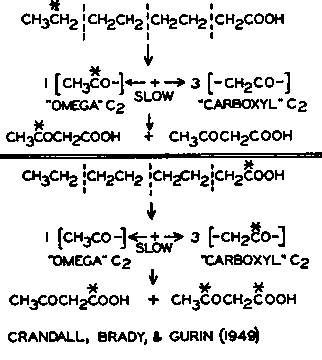
Fig. 2.
Evidence supporting the concept that the β-oxidation of fatty acids gives rise to two types of G fragments may be cited from the work of several other laboratories. Lorber, Cook, and Meyer (47) have compared the rate of incorporation of isotope from carboxyl-labeled and 7-labeled octanoate into liver glycogen following feeding of the acids to intact rats. It was found that the carboxyl-labeled acid contributed about 30 per cent more isotope to the glycogen than did the 7-labeled compound. Assuming that the principal pathway for the transfer of carbon from G fragments arising from fatty acid oxidation to glycogen is the Krebs cycle, these authors have suggested that the terminal " omega " G unit undergoes condensation with oxalacetate less readily than do " carboxyl " G units. Thus a second criterion for distinguishing two species of G units, namely, rate of entry into the Krebs cycle, could be established from these experiments. Data in complete agreement with those of Lorber and coworkers were obtained by Kennedy and Lehninger (28), who showed by conventional chemical techniques in non-isotopic experiments with isolated mitochondria that the proportion of fatty acid oxidation proceeding via the cycle compared to acetoacetate formation (ratio of C02 produced/acetoacetate formed) increases with increasing chain length, when the fatty acids are tested under identical conditions in the presence of a constant amount of oxalacetate precursor. Since the long-chain fatty acids may be expected to furnish a higher proportion of " carboxyl" G units per molecule than the short-chain acids, this is consistent with the view that the " carboxyl " G fragments preferentially undergo condensation to citric acid. These results were confirmed by Weinhouse, Millington, and Volk (64), who studied the oxidation of labeled octanoate and palmitate in washed rat liver homogenates.
Continue to:


My Books

