


Sulfhydryl Groups And Protein Structure
Description
This section is from the book "The Scientific Contributions Of The Ben May Laboratory For Cancer Research", by The University of Chicago. Also available from Amazon: The Scientific Contributions Of The Ben May Laboratory For Cancer Research.
Sulfhydryl Groups And Protein Structure
In the course of the previously described studies on viscosity changes in urea solutions of bovine plasma albumin (28), it was noted that the viscosity immediately after exposure to urea invariably is higher with sulf-hydryl-blocked albumin than with albumin containing a free sulfhydryl group, although the viscosity of the latter soon increases to a higher value because of the secondary interchange process (Fig. 35). This observation suggested that in urea the albumin molecule can unfold more completely when its sulfhydryl group is blocked than when this group is intact, raising the interesting possibility that the sulfhydryl group in some way participates in maintaining the albumin structure.
Further evidence strongly supporting a role of the sulfhydryl group in protein structure came from equilibrium dialysis studies of the interaction of silver ions, and from spectrophotometric studies of the interaction of cupric ions with bovine plasma albumin. It was hoped that measurement of the binding of silver to albumin as a function of silver ion concentration would furnish information both as to the exact number of sulfhydryl groups in the albumin molecule (0.7 or 1.0) and the strength of the silver-sulfhydryl interaction. Since the association of heavy metal ions with sulfhydryl groups generally is considered to be rather strong, it was expected that the argentation of albumin would begin at a low silver ion concentration and follow a curve of type A (Fig. 36) as the silver concentration increased. A plateau was anticipated of a height indicating the number of sulfhydryl groups in the molecule, and, as the silver concentration reached higher values, non-specific cation binding to carboxyl or amino groups was expected.
When the actual binding of silver to bovine plasma albumin was determined by an equilibrium dialysis procedure, using radioactive silver nitrate (Ag110) to permit convenient measurement of silver at low concentration ranges, the anticipated binding pattern was not observed (dI, 114). With 10^-5 M albumin, silver binding does not take place until a silver ion concentration of about 2 X 10^-7 M is reached, and above this value, argenta-tion increases steadily with the logarithm of the silver concentration, with no indication of a plateau or even an inflection at either 0.7 or 1.0 silver ions per protein molecule (Fig. 36, curve B). Similar results were obtained at pH 3.0 and 6.1 in citrate buffer and at pH 10 in borate buffer, the only differencc is that at higher pH the amount of non-specific binding at silver concentrations above 10^-6 M is increased.
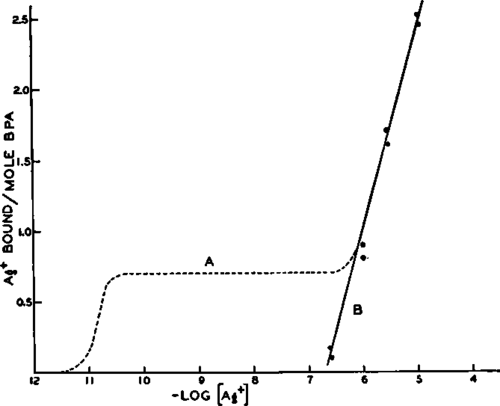
Fig. 36.-Binding of silver ion to 10^-5 M bovine plasma albumin in 0.05 M citrate buffer pH 6.1. A, expected curve; 13, observed curve.
These rather unexpected results gave no indication of the presence in the albumin of a sulfhydryl group which generally is considered to react selectively with such reagents as heavy metal ions, organic mercurials, iodo-acetamide, or N-ethylmaleimide. It was observed, however, that previous treatment of the albumin with iodoacetamide eliminates exactly one mole of silver binding capacity in subsequent equilibrium dialysis. As seen from Figure 37, the maximum amount of silver binding which can be eliminated by iodoacetamide treatment is one group per albumin molecule, and it requires about two moles of iodoacetamide to accomplish this. Thus it would appear that there is one group in the albumin molecule which reacts both with silver and with iodoacetamide but that its interaction with silver is not appreciably stronger than that of certain other groups in the protein.
It is proposed that this unexpectedly weak association of the albumin sulfhydryl group with silver ion results from the fact, suggested from the previous viscosity experiments, that the albumin sulfhydryl group does not exist as such, but rather in strong but reversible combination with another group in the albumin molecule (Fig. 38). Even though the equilibrium for reaction II lies far in the direction of argentation, the intramolecular "sulfhydryl bond" is so stable that the concentration of free sulfhydryl is very low. The over-all affinity of the albumin for silver is determined by the combination of reactionsI and II, so that a rather high silver ion concentration is required before argentation of the sulfhydryl takes place.

Fig. 37.-Reduction in silver binding (at pH 6.1) by pretreatment of bovine plasma albumin (BPA) with varying amounts of iodoacetamide.
The concept of intramolecular sulfhydryl association also provides an explanation for a rather puzzling phenomenon accompanying the interaction of cupric ions with bovine plasma albumin (114, dio). When cupric nitrate is added to a solution of bovine albumin at neutral pH, the first mole of copper gives rise to a rather weak but well-defined absorption band at 530 mµ which does not involve the sulfhydryl group. The second mole of copper has no specific effect on the absorption spectrum, but with the third mole of copper an absorption band appears at 375 mµ, increasing in intensity with increasing ratio of copper to albumin and reaching a maximum at about 12-14 copper ions per albumin molecule. The 375 mµ absorption is critically dependent on the presence of the single albumin sulfhydryl group, since blockage of this sulfhydryl, either by pretreatment of the protein with iodoacetamide or by addition of one equivalent of silver ion to the copper-albumin mixture, completely eliminates the absorption.

Fig. 38.-Proposed intramolecular sulfhydryl interaction contributing to protein structure.
The formation of this 375 mn band with excess copper was first observed by Klotz and co-workers (J. Am. Chem. Soc., 74:1537, 1952; 77:1919, 1955), who postulated that the chromophore is the cupric mercaptide linkage itself. If such were the case, it is difficult to see why so many copper ions are required for maximum absorption, unless the cupric mercaptide bond is highly dissociable and excess copper is needed to insure complete reaction of one cupric ion with the sulfhydryl group. The latter possibility was eliminated when a careful study of the spectral phenomenon showed that the intensity of the 375 mµ absorption follows Beer's law over an eighty-fold variation of copper and albumin concentrations. Furthermore, observations by Klotz and by Benesch (114) that human plasma albumin, which has the same sulfhydryl content as bovine albumin but does not show the 375 mµ absorption band in the presence of copper, cast doubt on the assumption that the chromophore is simply the cupric mercaptide linkage. It would appear that the 375 mµ absorption involves the interaction of several cupric ions per albumin molecule but that in some way the whole phenomenon depends on the presence of a single protein sulfhydryl group.
It is proposed that the sulfhydryl group of bovine plasma albumin exerts an indirect "permissive" effect on the interaction of copper with the protein through its contribution to the secondary structure of the protein molecule (Fig. 38). With this sulfhydryl bond intact, the albumin is held in a configuration permitting cupric ions to interact with other functional groups in the protein (possibly histidine) to form chromophoric complexes at a number of sites. When the sulfhydryl bond is broken by reaction with silver or iodoacetamide, the albumin structure is disrupted to such an extent that the interaction of copper to form the chromophore cannot take place. This explanation raises the interesting possibility that the contribution of sulfhydryl groups to the activity of many enzymes may be indirect in nature, resulting from the participation of the sulfhydryl in maintaining the proper secondary structure of the protein.
Continue to:


My Books

