


Total Synthesis Of Equilenin Derivatives
Description
This section is from the book "The Scientific Contributions Of The Ben May Laboratory For Cancer Research", by The University of Chicago. Also available from Amazon: The Scientific Contributions Of The Ben May Laboratory For Cancer Research.
Total Synthesis Of Equilenin Derivatives
The estrogenic hormones equilin and equilenin are unique substances excreted only by members of the equine family. Because of their relative unavailability, these steroids, which possess unsaturation in ring B as well as in ring A, have been subjected to far less physiological investigation than have the other steroid estrogens, and relatively few of their derivatives and analogues have been prepared. Although several total synthetic routes to equilenin have been reported, these have served chiefly to confirm the chemical structure and have not been utilized for the large-scale production of the hormone or its derivatives.
Table 6. Stilbestrol And Hexestrol Analogues
3-Fluorohexestrol | 4-Methyl-4-deoxyhexestrol |
3-Fluoro-3'-hydroxyhexestrol | 4-Phenyl-4-deoxyhexestrol |
4-Fluoro-4-deoxyhexestrol | 3,5-Dimethylhexestrol |
4-Fluoro-4-deoxy-3 '-hydroxy hexestrol | 3,5-Dimethyl-4'-deoxyhexestroI |
4,4'-D ifluoro-4,4'-bisdeoxyhexestrol | 3-Fluorostilbestrol |
4-Deoxyhexestrol | 4-Fluoro-4-deoxystilbestrol |
3-Hydroxyhexestrol | 4,4'-Difluoro-4,4'-bisdeoxystilbestrol |
3-Hydroxy-4'-deoxyhexestrol | 4-D eoxystilbestrol |
3,3'-D ihydroxyhexestrol | 4- (p-Hydroxyphenyl)-3-(2-thienyl) - |
3,5-Dihydroxy-4'-deoxyhexestrol | trans-3-hexene |
In this laboratory a relatively simple and efficient total synthesis of 6-substituted equilenin derivatives has been developed, based on the fact that the Friedel-Crafts condensation of 1,7-dimethoxynaphthalene with β-methyltricarballylic anhydride gives in one step a compound (Fig. 30, /) possessing in proper arrangement all but two of the carbon atoms of the steroid nucleus. In three steps,I is transformed to a three-ring substance (II), which can be readily converted to a steroidal compound (III) by a simple process previously reported byWilds and his students (Rodig, O. R.
Ph.D. dissertation, University of Wisconsin, 1954), for the series of compounds lacking the 6-methoxyl group. In this way d,l-3,6-dimethoxy-i7-0 carbomethoxyequilenane (III) was prepared in 22 per cent over-all yield from simple and available starting materials, and at present this process is being carried out on a large scale by a pilot plant to furnish /II in substantial quantity.
Conversion of III to d,l-3,6-dimethoxy-17β-acetylequilenane (IV) was accomplished by standard methods. Since methods are well known for the degradation of an acetyl side chain to furnish a 17-ketone or hydroxyl substituent, the transformation of IV to 6-hydroxyequilenin and dihydro-equilenin will be effected as soon as a large supply of III is available.
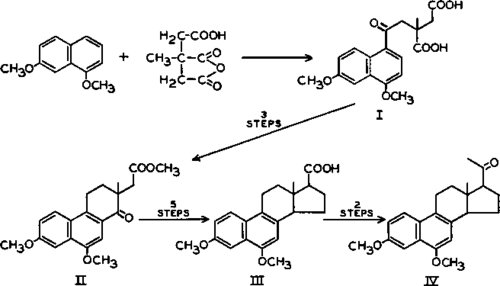
Fig. 30.-Total synthesis of 6-substituted equilenin derivatives.
Continue to:


My Books

