


Chapter VII. Synthetic Tissue
Description
This section is from the "Histology of Medicinal Plants" book, by William Mansfield. Also see Amazon: Histology of Medicinal Plants.
Chapter VII. Synthetic Tissue
Under synthetic tissue are grouped all tissues and cells which form substances or compounds other than protoplasm. Such compounds are stored either in special cavities or in the cells of the plant, as the glandular hairs; internal secreting cavities of barks, stems, leaves, fruits, seeds, and flowers; photosyn-thetic cells or cells with chlorophyll, and the parenchymatic cells which form starch, sugar, fats, alkaloids, etc.
Photosynthetic Tissue
The most important non-glandular synthetic tissue is the photosynthetic tissue, which is composed of the chlorophyll-bearing cells of the plant. These are the so-called green cells of leaves, of stems of herbs, of young woody stems, and in the older woody stems of plants like wild cherry, birch, etc. The greater part of the tissue of leaves is composed of chlorophyll-bearing cells.
Leaves collectively constitute the greatest synthetic manufacturing plant in the world, because the green cells of the leaf produce most of the food of men and animals. The two compounds utilized in the manufacture of food are carbon dioxide (C02) and water (H20). These two compounds are combined by chlorophyll through the agency of light into starch. Chemically this reaction may be expressed as follows:
6CO2 + 5H2 O= 2C6H20O5 + 6O2.
During the day a large quantity of starch is formed. At night through the action of a ferment the excess of starch remaining in the leaf is converted into sugar (C6H22O6) - C6H20O5 + H2O = C6H22O6. In this form it is distributed to the living cells of the plant. The presence or absence of starch in leaves is easily ascertained by placing the leaf in hot alcohol to remove the chlorophyll, and by adding Lugol's solution. If starch is present, the contents of the cells will become bluish black; but if no starch is present, the cells remain colorless.
Glandular Tissue
The glandular tissue of the plant is divided into two groups, according to where it occurs. These groups are, first, external glandular tissue, and secondly, internal glandular tissue. The most important external glandular tissue is composed of the glandular hairs. These are divided into two groups: first, unicellular; and secondly, multicellular glandular hairs.
Unicellular Glandular Hairs
The unicellular glandular hairs are either sessile or stalked.
Sessile unicellular hairs occur in digitalis leaves.
Stalked unicellular hairs of digitalis are shown on Plate 60, Fig. 2.
Unicellular uniseriate stalked glandular hairs occur on the stems of the common house geranium (Plate 61, Fig. 2), on the leaves of butternut, the leaves and stems of marrubium peregri-num (Plate 98, Fig. 5), and in arnica flowers. The stalk varies from two to ten cells; in eriodictyon the cells vary from four to eight cells.
Unicellular multiseriate stalked glandular hairs are not of common occurrence.
Multicellular Glandular Hairs
Multicellular glandular hairs are divided into two groups: first, sessile; and secondly, stalked hairs.
Multicellular sessile glandular hairs occur on the leaves of peppermint (Plate 60, Fig. 3), horehound (Plate 97, Fig. 7), and in hops (Plate 60, Fig. 4). In each of these hairs there are eight secretion cells.
Stalked glandular hairs are divided into two groups: first, uniseriate stalked; and secondly, multiseriate stalked glandular hairs.
Multicellular uniseriate stalked glandular hairs occur on the leaves of tobacco (Plate 61, Fig. 4), belladonna (Plate 61,
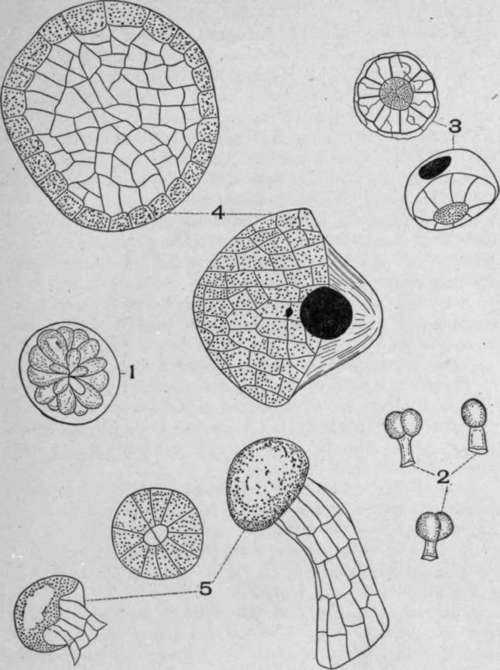
Plate 60. Glandular Hairs.
1. Kamala {Mallotus philippinensis, [Lam.] [Muell.] Arg.).
2. Digitalis leaf {Digitalis purpurea, L.).
3. Peppermint leaf {Mentha piperita, L.).
4. Lupulin.
5. Cannabis indica leaf {Cannabis saliva, L.).
Fig. 1), and digitalis (Plate 60, Fig. 2), and of the fruit of rhus glabra.
Multicellular multiseriate stalked glandular hairs occur on the stems and leaves of cannabis indica (Plate 60, Fig. 5).
In the glandular hair of kamala (Plate 60, Fig. 1) the number of secretion cells is variable and papillate in form, and the cuticle is separated from the secretion cells.
In the glandular hair of hops the outer wall or cuticle is torn away from the secretion cells, and the cavity thus formed serves as a storage cavity. This distended cuticle of the hops shows the outline of the cells from which it was separated.
In the glandular hairs of the mints the secreted products (volatile oils) are stored between the secretion cells and the outer detached cuticle. This cuticle is elastic, and it becomes greatly distended as the volatile oil increases in amount.
In many of the so-called glandular hairs, tobacco, belladonna geranium, etc., the synthetic products are retained in the glandular cells, there being no special cavity for their storage.
These hairs usually contain an abundance of chlorophyll.
The division wall of multicellular glandular hairs may be vertical, as in the two-celled hair of digitalis (Plate 60, Fig. 2); as in horehound (Plate 97, Fig. 6), and as in peppermint (Plate 60, Fig. 3); in this case there are eight cells, and they form a more or less flat plate of cells.
In other hairs the division wall is horizontal; this produces a chain of superimposed secreting cells, as in some of the glandular hairs of belladonna leaf (Plate 61, Fig. 1), etc.
In other hairs the division walls are both vertical and horizontal, as in tobacco (Plate 61, Fig. 4), henbane (Plate 61, Fig. 3), belladonna (Plate 61, Fig. 1).
Other characters to be kept in mind in studying glandular hairs are the following: Color of cell contents; size of the cells, whether uniform or variable; character of wall, whether smooth or rough.
Continue to:


My Books

