


Of The Mechanical Division Of Bodies. Fermentation. Continued
Description
This section is from the book "The London Dispensatory", by Anthony Todd Thomson. Also available from Amazon: PDR: Physicians Desk Reference.
Of The Mechanical Division Of Bodies. Fermentation. Continued
Furnaces differ in construction, according to the particular purposes for which they are chiefly intended; but the following essential parts are common to all furnaces:-1st, The body or fire-place, for holding the fuel and the vessel containing the materials to be submitted to the action of heat. 2dly, The chimney, by which the heated air and the smoke escape. 3dly, The ash-pit, into which the ashes fall, and through which fresh air is admitted to the burning fuel.
In a well constructed furnace, the whole of the air which enters the ash-pit passes through the body of the furnace, and supports the combustion, after which the residue, being highly rarified, passes off by the chimney; on the due height of which, and the proper regulation of the access of atmospheric air from below, the strength of the combustion, and consequently the heat produced, altogether depend. The access of the air is generally regulated by registers; which, in portable and smaller furnaces, are iron plates pierced with many holes of different sizes, which are generally fitted with brass stoppers, so that, according to the number of holes opened, a greater or smaller quantity of air is admitted to the burning fuel. The chimney should be narrower than the body of the furnace, and of such a length that it can be heated throughout by the rarified air which ascends through it; for it is by producing in the chimney a column of air of much less specific gravity than a corresponding column of the external air, that fresh air is constantly forced through the body of the furnace from below, and a strong draught produced.
If the chimney be too short, all the advantage to be derived from the above circumstance is not obtained; and if, on the other hand, it be too long, the air loses its heat before it reaches the summit, and impedes, to a certain extent, the ascent of the rarefied air. According to Macquer, when the internal diameter of the furnace is 12 or 15 inches, and that of the chimney 8 or 9, its height should be 18 or 20 feet.
Of whatever substance furnaces are made, unless they be fixed and built of fire-bricks, they should be coated, to prevent the radiation, and consequent loss of heat: and the best composition for this purpose is clay and sand. It is perhaps better, however, first to put a coating of charcoal and clay next to the sides of the furnace, as was recommended by Dr. Black, particularly if the furnace be made of plate iron. The proportions he recommended were one part, by weight, of fine clay, and three parts of charcoal; which, being reduced to powder, is kneaded together with water, and the mass thus formed divided into balls of a moderate size. These being applied to the sides of the furnace, are to be beat strongly with the face of a broad hammer, until a general coating of about one inch and a half cover the inside of the furnace, and the cavity assume an elliptical form.
A very convenient and useful furnace is that which was contrived by Dr. Black. It consists of an oval iron case, a, about 22 inches in height, 20 inches in diameter in the length of the oval, and 15 inches across; and lined in the body with the coating already described. On the top is fixed an iron plate having two apertures; one large, f, intended to receive a sand bath, a still, or similar apparatus; and the other smaller, e, to which an iron tube, which acts as a chimney, is to be fixed. At the bottom of the body of the furnace, directly under the larger aperture, the grate is fixed; and under it the ash-pit receives the body, resting on a strong ring that encircles it, at about half an inch deep. The ash-pit is furnished with a door, m, which opens on hinges, intended for removing the ashes;

and also a register to regulate the admission of air to the burning fuel. The register is a plate of iron perforated with six apertures, the size of which increases in a geometrical ratio; so that by passing the sliding plate, /, over them, either one or more may be stopped at a time, and the supply of air, and of course the heat to be excited, can be regulated with great nicety. The fuel is introduced at the top; but there is a door also, i, occasionally, in the side of the body of the furnace, through which fuel can be supplied during the conducting of any process; although, unless it be made to shut very close, this door is a disadvantage, as it prevents the admission of the air from being-so precisely regulated. It has also an opening, k, with a sliding door, for receiving a muffle: h is an earthen or an iron tube, which passes through the body of the furnace, and issues at the opposite side, intended for procuring hydrogen gas; or for inserting the nozzle of a pair of bellows. Any thing may be suspended over the furnace by inserting an iron pillar into the eyes, g g, on each side, and stretching a strong bar or wire between them.
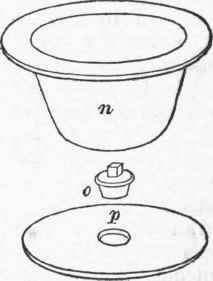
The sand bath, n, is placed in the opening, f, of the furnace, when it is required; but at other times that opening is shut by the cover, p, which has a moveable plug, 0, in its centre. A pair of tongs, r, bent near the points, is a necessary appendage to this furnace. It may be used for a great variety of operations, and may be fitted with a dome for the purpose of throwing down the flame when it is to be used for fusing metals.
For small operations, when a great heat is required, a furnace may be constructed by simply inverting one large black lead, or a Hessian crucible, over another which is perforated with six holes in the bottom, which are intended to serve as a grating. This is placed over the portion of a third, cut off so low as to leave the cavity about an inch deep only, and ground smooth above and below. The upper or inverted pot should have a large perforation to permit the heated air to escape, and the portion on which the second pot stands should also be perforated at the side to admit the external air, or the nozzle of a bellows. No luting is required. A heat sufficient to fuse any metal may be obtained in such a furnace.

A sufficient heat for a great variety of small operations may be obtained from a lamp, on the principle of Argand's, with a double concentric wick. A standard, a, having movable rings, b, b, attached to it, is necessary for supporting the retort or matrass at any height above the flame.
With regard to fuels, the best are undoubtedly charcoal and coke, or a mixture of these. The advantages of charcoal are its kindling readily, burning with a strong clear heat in a small draught, without running into slag, choking the grate, or melting the walls of the furnace; and owing to its containing only matter which is extremely combustible, the flues or chimneys never collect soot or other foulnesses. The chief objection to charcoal is its great price. Coke is much less expensive; but as it contains a mixture of earth and metallic oxides, it is apt in an intense heat to run together into a tough, cohesive slag, which adheres to the walls of the furnace, and to the sides of crucibles, choking up the grate, and of course preventing the proper draught of air for carrying on the combustion. These disadvantages, however, are remedied by mixing it with an equal bulk of charcoal; and this mixture forms the best fuel, when an intense heat is required.
The pharmaceutical operations usually performed by furnaces are -
Fusion.
Distillation.
Sublimation.
The deoxidizement or reduction of metals.
The three first of these have been already described.
Continue to:


My Books

