


Of The Mechanical Division Of Bodies. Part 5
Description
This section is from the book "The London Dispensatory", by Anthony Todd Thomson. Also available from Amazon: PDR: Physicians Desk Reference.
Of The Mechanical Division Of Bodies. Part 5
For small processes, very good evaporating dishes are made of the bottoms of broken retorts and matrasses, which may be cut smooth round the edges by means of a hot iron or ring, d, with a wooden handle, e; and thus, they are converted into semiglobular basins.1 The best evaporating dishes, however, are those of biscuit porcelain made by Wedgewood, and sold in assortments, the largest of which is capable of holding eight or ten pints. They are flat-bottomed, shallow vessels,f, with a lip, g, glazed in the inside; and thin, but of a dense hard texture. They will bear to be heated to the boiling point over a clear hot fire: but are apt to crack when a flame is allowed to play on them, or when the liquor is boiled to dryness, at the moment the last drop of fluid is expelled, unless the fire be much lowered. It is preferable, therefore, when glass or earthenware vessels are employed, to apply the heat by the medium of sand; or, if a still more moderate heat be necessary, by means of boiling-water, over which the evaporating dish should be placed.
The first is denominated a sand bath; the second, a water bath; but for processes on a large scale, shallow iron pots or leaden troughs are used, to which the fire is directly applied.

1 The iron ring for this purpose is made red-hot in the fire, then put upon the matrass which is to be cut; and, when the glass is sufficiently heated, by throwing on it a little cold water, it will generally break exactly at the circle heated by the iron ring.
Exsiccation is a variety of evaporation, producing the expulsion of moisture from solid bodies by means of heat. It is generally employed for depriving salts of their water of crystallization. They are exposed to the action of a fire in an iron ladle or pot, or in a glass vessel; and after dissolving as they are heated, in the water they contain, or undergoing what is termed the watery fusion, the water boils; and, evaporating, leaves the salt in the form of a dry mass. When the substances to be exsiccated are liable to decomposition in a temperature above 212°, as is the case with some of the compound oxides, the process must be conducted by the heat of a water bath.
Distillation differs from evaporation only in the circumstance, that the vapour of volatile matter is elevated, to be condensed in close vessels, and preserved. The mode of conducting the operation, and the regulation of the heat, differ according to the nature of the substances operated on.
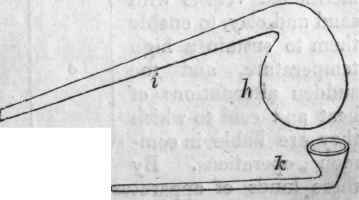
The simplest distilling apparatus for smaller processes is the Retort and the Receiver. The former consists of a nearly globular body, h, with a long gradually tapering beak, i", which is bent nearly at a right angle with the body. This is the simplest kind of retort; and if the materials to be distilled be liquid, they should be poured into the body of the vessel by means of a very long funnel, k, which, by reaching completely into it, prevents any thing from trickling down the sides of the neck. In withdrawing the funnel it is necessary to keep it applied to the upper part of the retort, that the drop hanging from it may not touch the inside of the neck. For nicer purposes the tubulated retort, l, is to be preferred. The bottom of either kind should be very thin, and of a uniform degree of thickness, so as to bear the sudden application of heat from an Argand lamp, or even from a naked fire. The receiver m, should be larger than the retort, and of a globular form, so as to allow of a large surface for cooling the condensing vapour: and it may be either jointed directly to the retort, by the neck of the latter passing into it, or by the intervention of a third piece, n, denominated an adopter; and in either case the joinings are usually protected by lutes.
When the substance to be condensed is of a very volatile nature, as ether, for instance, the receiver must be artificially cooled, and kept during the whole process at the temperature of the atmosphere, either by surrounding it with ice or snow, or allowing water to trickle slowly over it, brought down from a trough placed above the receiver by means of worsted threads. The constant evaporation which the water suffers, on the surface of the receiver, keeps it at the requisite degree of temperature for condensing the ether. Both the retort and the receiver may be tubulated.


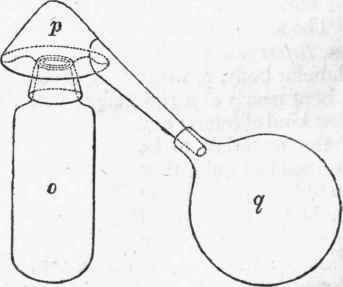
Sometimes, instead of the retort and receiver, the stone ware cucurbit, o, with its capital,p, and receiver, q, is used. It is necessary, occasionally, to coat the retort and the latter-mentioned vessels with sand and clay, to enable them to sustain a high temperature, and the sudden alternations of heat and cold to which they are liable in common operations. By these kinds of apparatus, acids, and other substances which arise from chymical decompositions, aided by heat, are distilled; and the process is named distillation per latus; but if the products be highly volatile, or of a gaseous nature, the pneumato-chymical apparatus, to be afterwards described, is required.
For the preparation of alcohol, and of distilled waters, the common still is employed. It consists of two parts-the boiler, b, and the head or capital, a. The boiler, which is the part to which the fire is applied, and contains the materials, is generally of a cylindrical shape, and may be sunk into a furnace, or immersed in a water bath, a, when the temperature requires to be nicely regulated. The head or capital is a large hollow globe, the upper part of which is drawn out into a tapering pipe, c, bent to a curve or arch, and terminating in the serpentine, or worm, e. These parts are generally, made of copper; but the worm is a long pewter pipe, of a decreasing diameter, which winds in a spiral direction obliquely through a deep tub, B, filled with cold water. The body, head, and worm require to be luted together; but in general slips of paper, dipped in flour paste, or pieces of wet bladder, are sufficient for this purpose. In this apparatus, the vapours are raised into the head, whence they pass into the worm, where they are condensed, and, issue in drops from the lower end of the pipe, d.
Continue to:


My Books

