


Official Tabellae
Description
This section is from the book "The Art Of Dispensing", by Peter MacEwan. See also: Calculation of Drug Dosages.
Official Tabellae
Trinitrin tablets are the only official example of this form of medication, and they are described as 'tablets of chocolate each weighing 0.300 gramme and containing 0.0005 gramme (0.5 milligramme) of the trinitroglycerin of commerce.'
The British Pharmacopoeia gives no formula for tabellae trinitrini. The following is Mr. Lucas's method of making them:
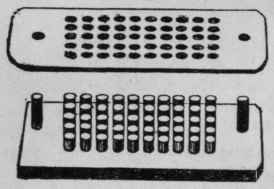
Tablet-Triturate Mould.
Alcoholic solution of nitroglycerin (10 per cent.) | 100 | parts |
Powdered chocolate ..... | 1,450 | parts |
Powdered sugar ...... | 2,500 | parts |
Mucilage of acacia ...... | 390 | parts |
Powdered acacia ...... | 360 | parts |
Distilled water ....... | 200 | parts |
All by weight.
Mix the powders, add the solution of nitroglycerin, and stir with a light hand until evenly mixed. Add the mucilage and water, and work up to a soft mass; roll into a cake, and divide into lozenges weighing exactly 5 grains.
The following is from 'Pharmaceutical Formulas':
Fry's cocoa powder (without oil) . . . . . . | 3 | oz. |
Powdered sugar ...... | 6 | oz. |
Oil of theobroma ...... | 4 1/2 | oz. |
Nitroglycerin ....... | 24 | gr. |
Mix the cocoa powder with the sugar, and pass through a fine sieve. Liquefy the oil of theobroma on a water-bath, and dissolve the nitroglycerin in it. Then add the powders, stirring the whole well together, and when mixed cut into 2 1/2-grain tablets.
The advantage of Mr. Lucas's formula is that the commercial solution of nitroglycerin is employed in making the tabellae. The second formula is a manufacturer's.
The 'Physicians' Pharmacopoeia' method of preparing chocolate tabellae is as follows:
The cocoa and other ingredients, including the medicine to be administered, are rubbed together in a mortar, massed, in the same way as a pill-mass, with the liquid excipient, and cut into pills on a pill-machine. Each pill is then taken, dusted with a powder of equal parts powdered sugar and arrowroot to prevent sticking, and placed in a tube of brass or wood standing vertically on a tile, an accurately fitting piston of wood giving a round form to the lozenge on being forced down the tube on the top of the pill. The tablets may also be turned out without the mould, by simply placing the mass on the cutter of the pill-machine after piping, and pressing down the upper cutter upon it, oblong or square tablets resulting, according to the amount of mass used.
For most medicines this process answers admirably, but there are some which could be administered in lozenge form were it not for their nauseous taste, which requires an amount of cocoa and sugar to disguise it scarcely compatible with the dimensions of an ordinary lozenge. In such cases Mr. Harold Wyatt recommends glycyrrhizin (the sweet principle of liquorice-root) and saccharin as substitutes for the sugar. He finds, for example, that 5 grains of antipyrin is rendered almost tasteless by 1/3 grain of glycyrrhizin, and that the intense bitterness of strophanthus is covered by the addition of 1/6 grain of saccharin to every 5 minims of tincture in the tablet. The following formula of Mr. Wyatt's will serve as an example:
Tabellae Acidi Arseniosi.
Trituration of arsenic (1 in 100). ... | 48 | grains |
Cocoa powder ...... | 70 | grains |
Tragacanth powder ..... | 24 | grains |
Saccharin ....... | 1 | grain |
Alcohol ....... | 30 | minims |
Essence of vanilla ...... | 24 | minims |
Distilled water ...... | 30 | minims |
Place the cocoa powder in a warm mortar; when melted add the powders, previously well rubbed together, and, after the mass has set, powder it with the aid of the alcohol and essence of vanilla; mass with the water, and divide into forty-eight tablets.
Lozenges are rarely required to be made extemporaneously, which is a good reason for saying something here about how they are made. The British Pharmacopoeia gives formulae for four bases as follows- the quantities in brackets being the author's:
Continue to:


My Books

